

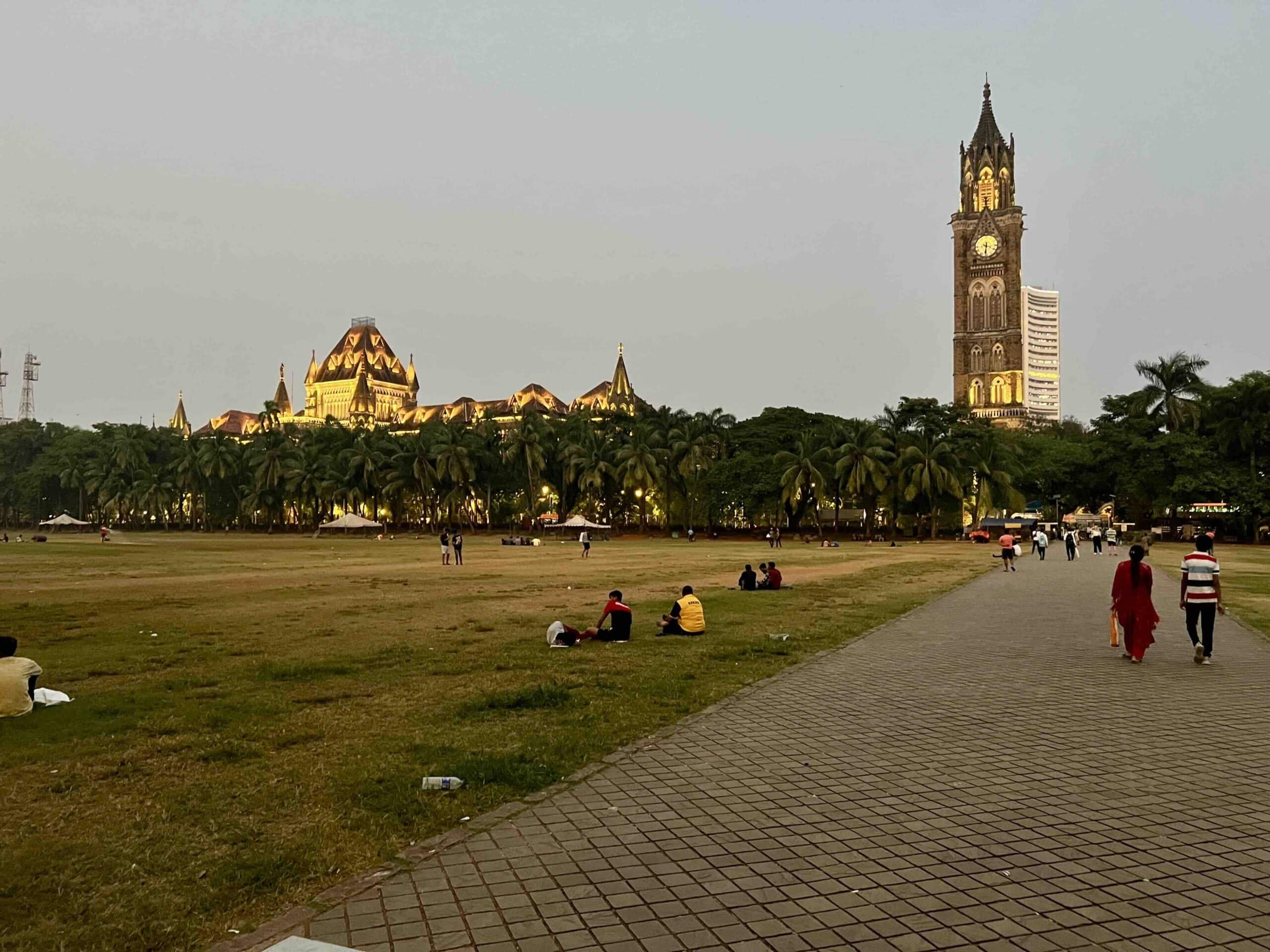
India has a peculiar relationship with time.
Travel anywhere in the country, from the deserts of Rajasthan to the mountains of the Northeast, and you’ll discover something unusual.
India operates on a single time zone. And not just any time zone.
Indian Standard Time (IST) is UTC+5:30.
Not five hours. Not six. Yes, five and a half hours.
Even I had to ask a few times while preparing for my first trip to India. Are you sure? The time difference is actually on the half hour?
It seemed like such an odd arrangement. Why not simply round it up or down to the nearest hour?
As it turns out, there’s a perfectly logical explanation.
Why five and a half hours?
The explanation begins with geography. And here is where it gets really dry. Buckle up.
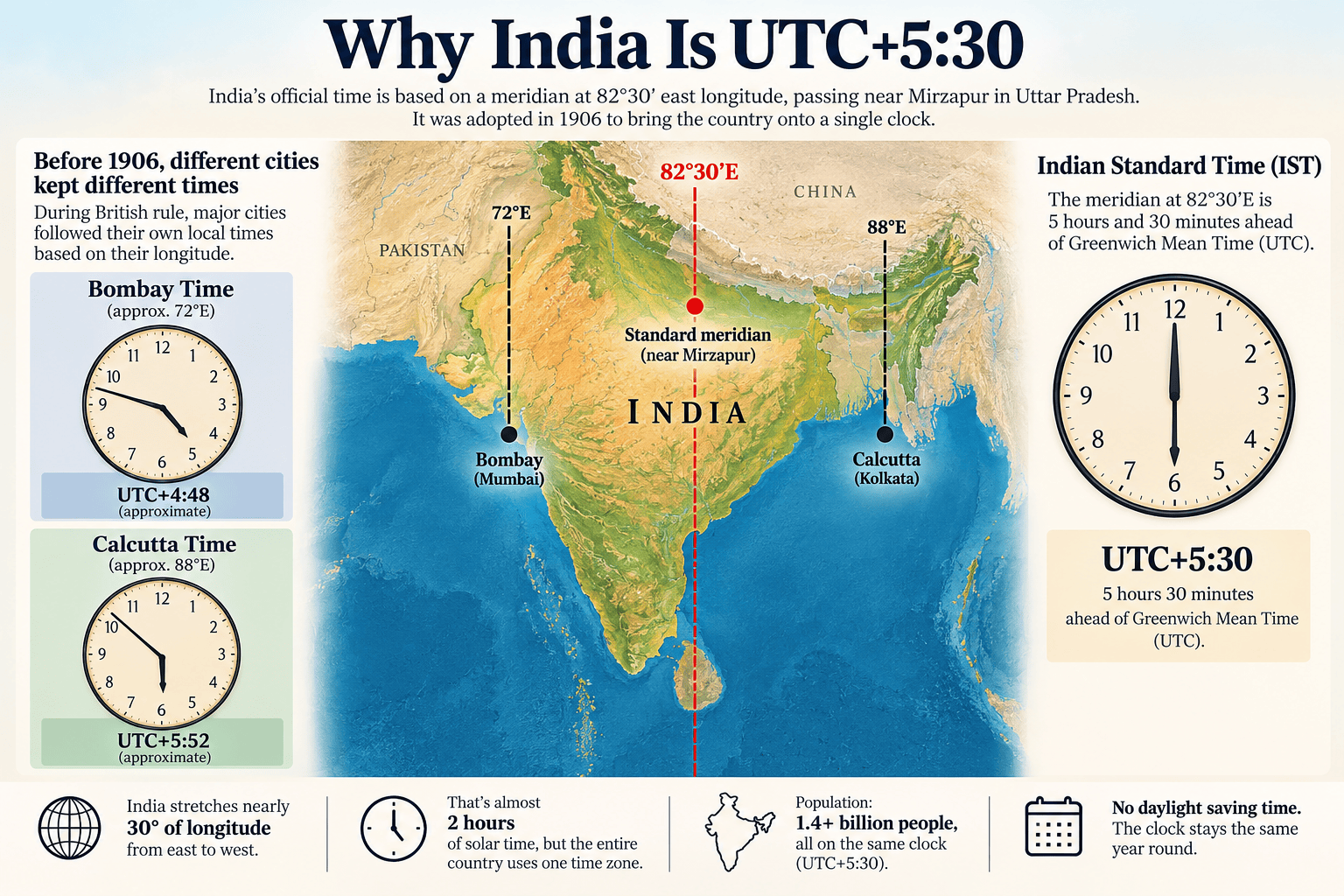
India’s official time is based on a meridian at 82°30′ east longitude, passing near Mirzapur in Uttar Pradesh. Indian Standard Time was introduced in 1906, although local timekeeping practices did not all disappear overnight.
Bombay and Calcutta once operated on different clocks. As railways expanded and administration became increasingly centralized, the advantages of a common national time became difficult to ignore.
The mathematics may be straightforward, but the decision to put such an enormous country on one clock has consequences that are still debated today.
One country, one clock
Imagine two travelers waking up at 6:00 a.m. One is in western Rajasthan, the other in Assam in India’s Northeast.
Both look at their watches and see exactly the same time.
Outside their windows, however, the morning can look remarkably different.
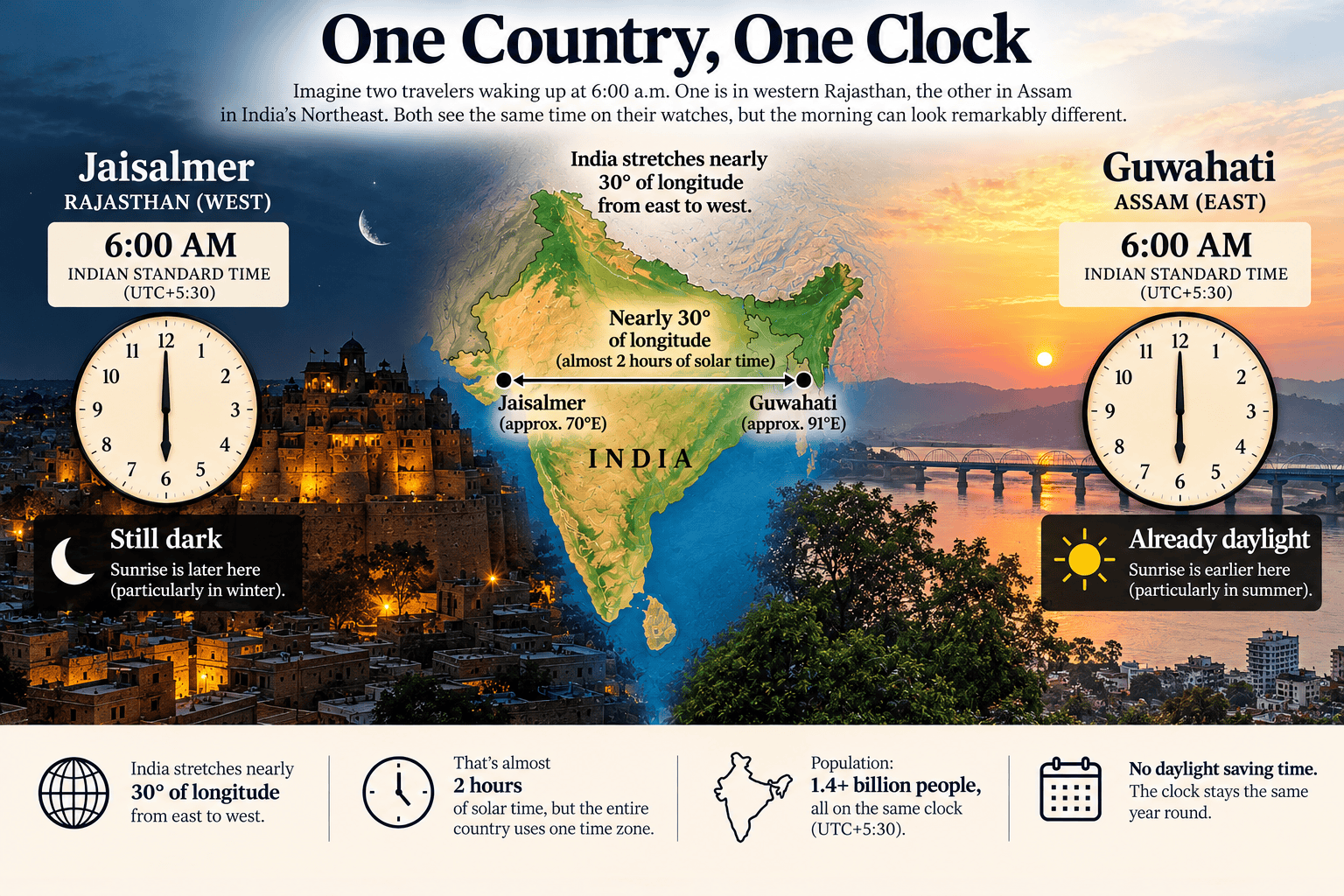
India stretches nearly 30 degrees of longitude from east to west, representing almost two hours of solar time. In the Northeast, daylight arrives much earlier than it does in western India.
The clocks agree. The sun doesn’t.
Should India have two time zones?
There have been proposals to introduce a second time zone for northeastern India. Supporters argue that an earlier official clock would better match local daylight hours, potentially reducing energy consumption and making better use of the working day.
Opponents point to the complications of coordinating railways, transportation, businesses, and government administration across two different times.
It’s a familiar debate in the United States, where arguments over time zones and daylight saving time continue today. Farmers, businesses, transportation operators, and ordinary citizens all have their opinions about what works best.
And yet, the United States manages six principal time zones across its 50 states, including Hawaii and Alaska. Arizona and Hawaii generally don’t observe daylight saving time, adding another layer of complexity.
Somehow, the trains still run, airplanes still fly, and businesses still operate.
That doesn’t necessarily mean a second Indian time zone would be simple to introduce. India’s circumstances are different, particularly given the importance of its extensive railway network. But the American example does suggest that operating across multiple time zones is hardly an insurmountable problem.
For now, India continues to operate on a single clock, from Gujarat to Arunachal Pradesh.

The other IST: Indian Stretchable Time
Of course, there’s another interpretation of IST that has absolutely nothing to do with longitude, Greenwich, or the Earth’s rotation.
Indian Stretchable Time.
It’s a familiar expression, usually accompanied by stories of someone promising to arrive in five minutes, only to turn up considerably later. A quick phone call produces the reassuring response, “Just coming!”
Exactly when that might be is another question.
My experience has been rather different.
Over more than twenty years of traveling through India, I’ve had remarkably good fortune with guides and drivers. Not only have they generally been on time, they’ve often been early.
I’ve encountered trains delayed by heavy fog or other weather conditions, flights running a little behind schedule, and the occasional monument that was unexpectedly closed. I’ve also arrived at places I was certain would be shut, only to discover the ticket window open and the gates welcoming visitors.
India can surprise you in either direction.
On my more recent trips, I’ve often walked down to meet our driver at the prearranged departure time and found the vehicle already waiting. Freshly washed, parked exactly where we agreed, and positioned for an easy departure.
One thing might be missing, however. The driver.
The vehicle is locked, the appointed hour arrives, and there’s nobody in sight. Perhaps he’s having chai, grabbing something to eat, or chatting with the other drivers.
And then he spots me standing beside the vehicle. Up he jumps, hand in the air, moving with sudden expediency.
“Just coming!”
There it is. Indian Stretchable Time.
I’ve learned that those conversations over chai aren’t necessarily idle chatter. Drivers often exchange useful information about road conditions, closures, good dhabas, toilet stops, and possible changes to the day’s itinerary.
And more often than not, we’re on our way within minutes.
Which brings me back to the distinction between Indian Standard Time and Indian Stretchable Time.
The first tells you exactly what time it is. The second is a reminder that a stated time and an actual departure aren’t always the same thing.
For travelers, my advice is simple: confirm departure times with your driver or guide the evening before, be ready when you agreed, and allow a little flexibility in your itinerary. For flights and trains, however, treat the published departure time as firm, even if delays sometimes occur.
India runs on one official clock. How the day unfolds is another matter.
What Indian Standard Time means for travelers
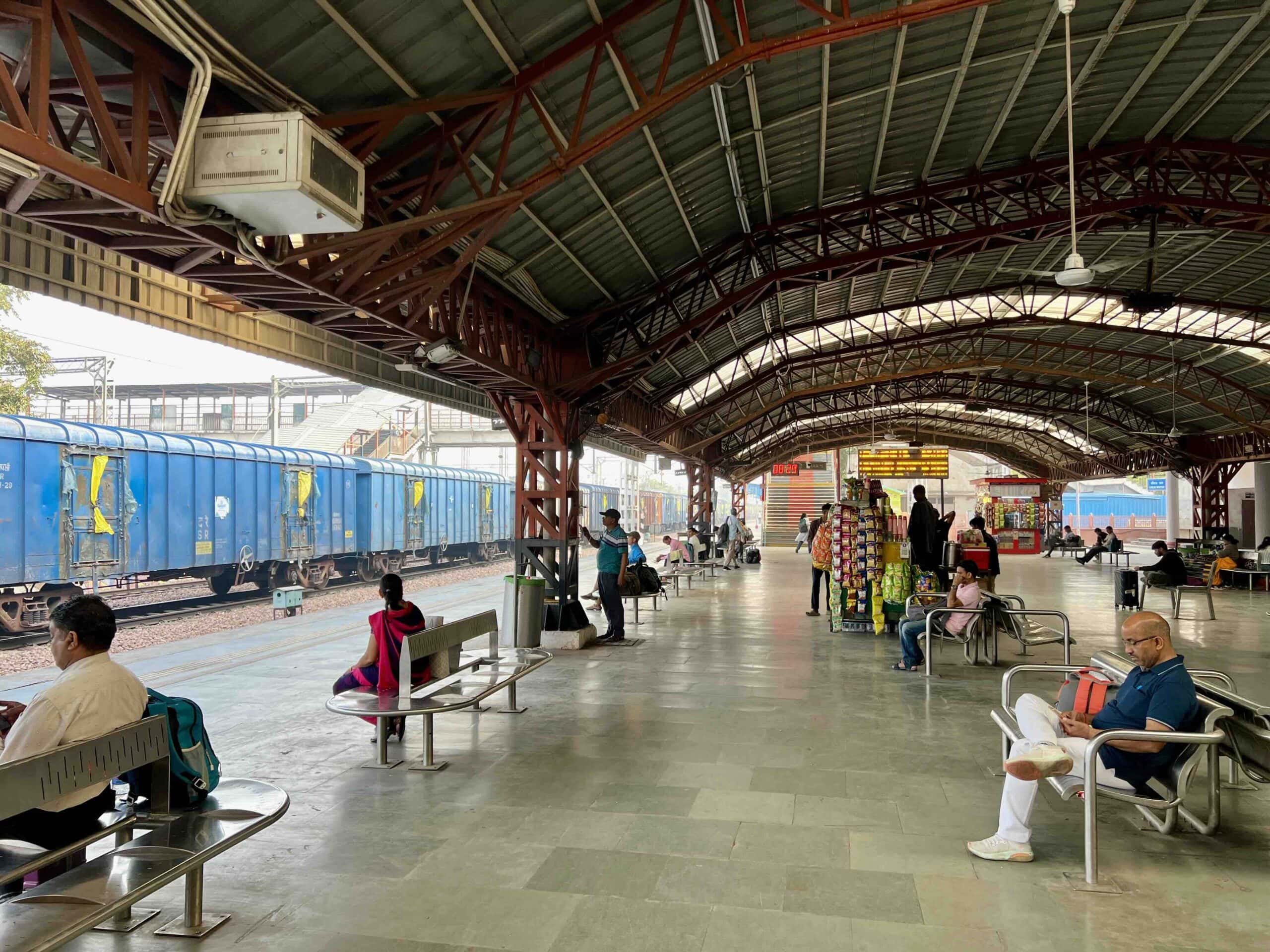
Whether you’re in Delhi, Mumbai, Jaipur, Kolkata, or Guwahati, you never need to change your watch when traveling within India. Flights, trains, hotel reservations, and tour bookings all use Indian Standard Time.
The complication comes when you’re communicating with people outside India. For Americans in particular, the difference changes during the year because most of the United States observes daylight saving time, while India does not.
India is 10 hours and 30 minutes ahead of New York during Eastern Standard Time, but 9 hours and 30 minutes ahead during Eastern Daylight Time.
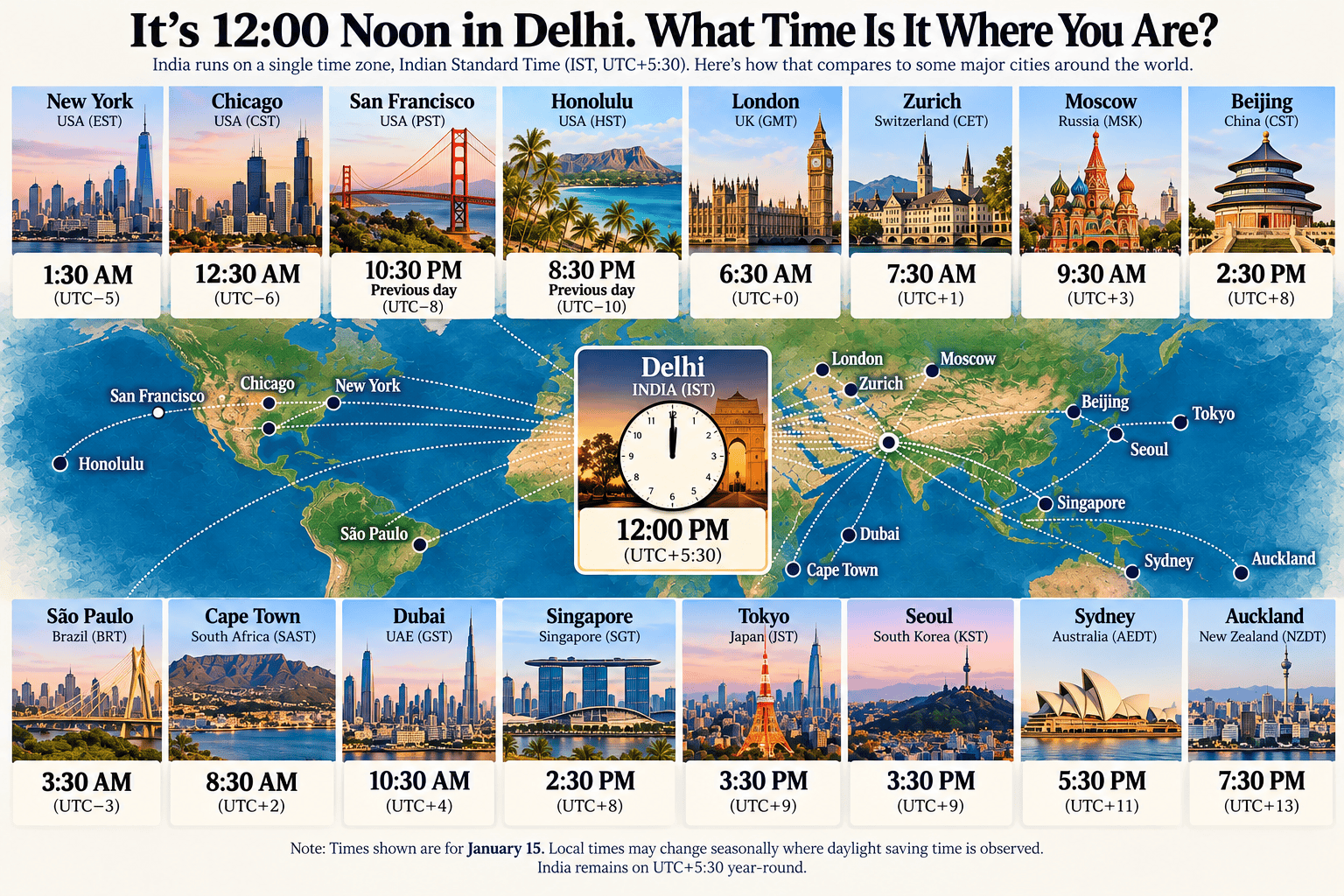
A country of extraordinary geographic, cultural, and regional differences has decided that, at least when it comes to the clock, everyone should agree. Even if the sun has other ideas.

 UPI: How India Changed the Way It Pays
 10 Essential Apps for Traveling in India in 2027