
Back in 2012, I’d already been traveling to India for several years, yet there was one little Hindi word I couldn’t seem to pronounce correctly: desi. Two syllables. That was all. Yet somehow, I managed to turn them into an ongoing source of entertainment for my Indian friends.
It wasn’t that I was using the word incorrectly. My pronunciation was the problem.
The problem is that both pronunciations look exactly the same when written in English. You’ll have to imagine the increasingly exasperated voices. A typical exchange went something like this:
“Do you want to watch a desi film?”
“A what?”
“You know, a desi film?”
“Oooooooooh, you mean desi.”
“Yeah, that’s what I said.”
“No, you said desi.”
And around we went.
Fortunately, I wasn’t the only guilty party. Mispronouncing desi provided my Indian friends with plenty of entertainment at my expense.
What does desi mean?
The Hindi word देसी (desi) refers broadly to the people, cultures, traditions, and products of the Indian subcontinent.
It comes from the Sanskrit word deśa, meaning country or land. In everyday conversation, desi can mean local, native, traditional, or simply something associated with South Asian culture.
The word isn’t limited to India. Pakistanis, Bangladeshis, and members of the wider South Asian diaspora use it as well.
Depending on the context, desi can express cultural identity, familiarity, nostalgia, or affection.
So how do you pronounce desi?
I didn’t understand the distinction back then. Today, after years of studying and speaking Hindi, I recognize exactly what my friends were trying to teach me.
The Hindi word is written देसी, and for English speakers, the closest approximation is DAY-see.
Except there’s a small catch. The Hindi D isn’t quite the same as the English D.
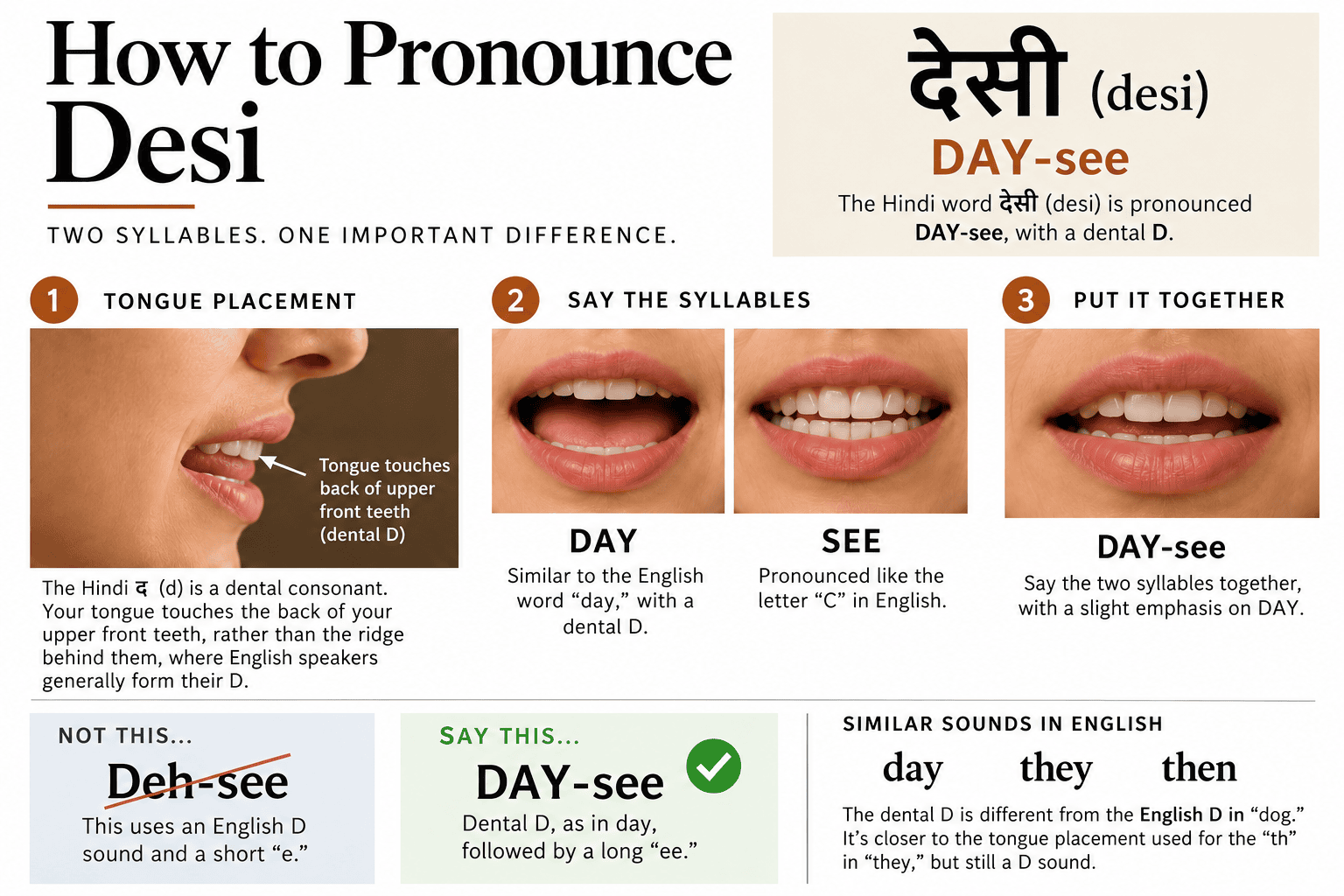
Still not hearing the difference? Here’s a quick example of desi pronounced aloud.
My Indian friends certainly noticed the difference, even when I couldn’t hear it myself.
You’ll Hear Desi Everywhere
Once you recognize the word desi, you’ll start hearing it in all sorts of conversations.
Someone might refer to desi food, meaning familiar South Asian dishes or cooking styles. Desi music might describe anything from Bollywood songs to Punjabi pop, while desi clothing could refer to a sari, kurta, or other traditional attire.
The word is also used by people describing their own South Asian identity, particularly among communities living abroad. Depending on who’s speaking and the context, desi can express a sense of familiarity, pride, or connection to home.
It’s a versatile little word, and one whose meaning often depends on who’s using it.
Fourteen Years Later
Fourteen years later, things have changed considerably. I now study and speak Hindi, and what once seemed like an impossible distinction between two nearly identical sounds has become second nature.

Looking back, I can appreciate why my Indian friends found the whole exchange so entertaining. They weren’t trying to make learning Hindi difficult. They were pointing out a difference I simply couldn’t hear at the time.
Of course, learning Hindi has introduced me to a whole new collection of words and grammatical constructions to tackle.
At least desi is no longer one of them.

 10 Important Symbols of Hinduism and What They Mean
 Lungi: The Everyday Dress of South India
 The Masala Dabba: Inside India’s Traditional Spice Box