
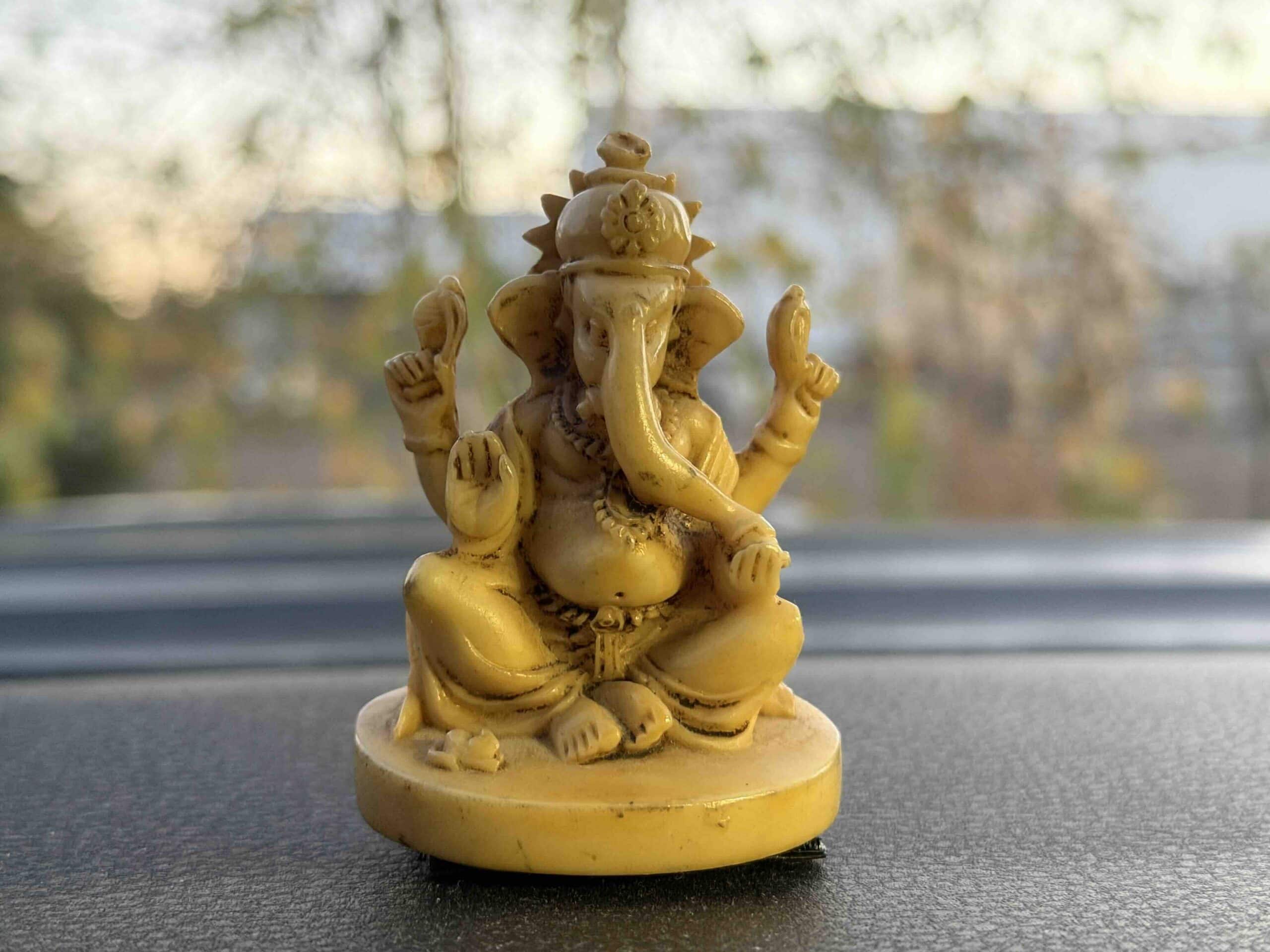
The remover of obstacles, the god of new beginnings, and a familiar traveling companion on India’s roads.
In all my travels through India by private car and driver, I can’t recall a single vehicle that didn’t have Ganesha riding along. Sometimes it was a picture or sticker, other times a keychain or a small figurine perched on the dashboard. But he was always there.
The reverence he commands is something I’ve long admired. Years ago, someone told me that Hindus often have a favorite god, a deity they feel particularly drawn to. Ganesha, I was told, was a popular choice. For some reason, that conversation has stayed with me.
Recently, while exploring an old haveli in Jaisalmer, I came upon a small gift shop near the exit. It was packed with figurines of Hindu gods. Every size, every price point, take your pick.
I found myself thinking about all those journeys through India, and all the little Ganeshas that had accompanied me along the way. Why didn’t I have one riding with me back home?
And there he was. Just the right size for the dashboard of my truck.
So now Ganesha rides with me, too. Watching over me, just as he’s watched over so many of my journeys through India.
But who exactly is this elephant-headed god who seems to have a permanent place on so many Indian dashboards? And why, of all the Hindu deities, does Ganesha inspire such widespread affection?
Meet Ganesha
India has no shortage of gods, but few are as instantly recognizable as Ganesha. An elephant’s head, a generous belly, several arms, and a mouse for transportation. It’s quite a combination.
Ganesha is one of Hinduism’s most beloved deities. The son of Shiva and Parvati, he is associated with wisdom, learning, prosperity and, perhaps most famously, the removal of obstacles.
He’s also the god of beginnings.
A new business, a wedding, an examination, a journey, or even the purchase of a vehicle may begin with a prayer to Ganesha. In a country where even the simplest undertaking can become unexpectedly complicated, having the remover of obstacles on your side seems like a sensible arrangement.
His image appears above shop entrances, in family shrines, beside cash registers and throughout India’s temples. He’s a familiar presence in everyday life, not a deity encountered only during religious festivals.
How Did Ganesha Get an Elephant’s Head?
There are several accounts of Ganesha’s birth, but one of the best-known begins with his mother, Parvati.
Parvati wanted to take a bath without being disturbed. She created a boy from material taken from her own body and stationed him at the door with strict instructions not to let anyone inside.
Unfortunately, nobody had thought to introduce the boy to Shiva.
When Shiva returned home, he found a stranger refusing to let him enter. The boy was following his mother’s orders. Shiva, unaware of who he was dealing with, was considerably less understanding.
What followed was a rather catastrophic misunderstanding.
In his anger, Shiva severed the boy’s head.
When Parvati discovered what had happened, she was devastated and demanded that her son be restored to life. Shiva agreed and sent his attendants to find a replacement head.
They returned with the head of an elephant.
Shiva attached it to the boy’s body and brought him back to life. He also granted Ganesha a special place among the gods: he would be honored before important undertakings.
The details of this story differ across Hindu texts and regional traditions, but it remains one of the most widely told explanations for Ganesha’s unusual appearance.
What Does Ganesha’s Appearance Mean?
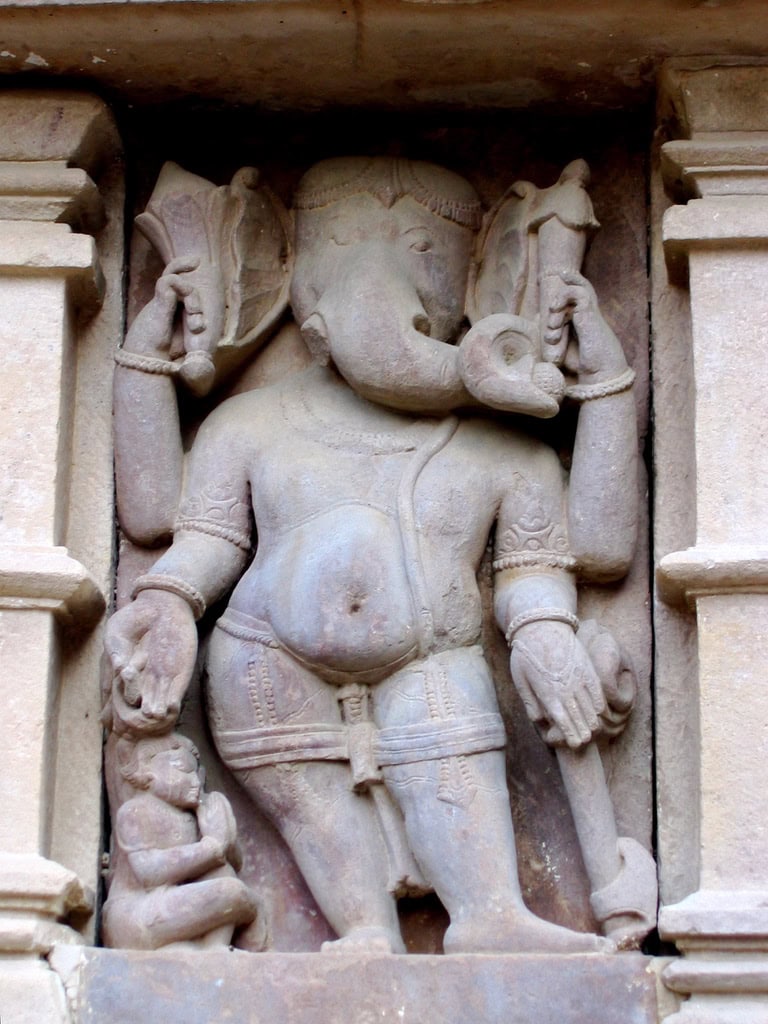
Take a closer look at a Ganesha statue and you’ll discover there’s quite a lot going on.
His elephant head, curved trunk, large ears, rounded belly and multiple arms are not simply artistic choices. Each has acquired symbolic meaning through centuries of Hindu tradition.
The elephant head and large ears. Elephants are associated with strength, intelligence and memory. Ganesha’s large head is commonly interpreted as a symbol of wisdom, while his enormous ears suggest the importance of listening carefully. There’s a lesson there for anyone who has ever been more interested in speaking than listening.
The curved trunk. An elephant’s trunk can uproot a tree or pick up something remarkably small. That combination of strength and precision makes it a fitting symbol of adaptability and discrimination—the ability to distinguish what matters from what doesn’t.
The large belly. Ganesha’s generous belly is one of his most recognizable features. Among its interpretations is the ability to accept and contain life’s experiences, both pleasant and unpleasant. Some traditions associate his belly with the universe itself.
The broken tusk. Look closely and you’ll often notice that Ganesha has one complete tusk and one broken tusk. This gives him the name Ekadanta, meaning one-tusked. One popular story tells of Ganesha serving as the scribe for the sage Vyasa as he dictated the Mahabharata, one of India’s great Sanskrit epics. When Ganesha’s writing instrument broke, he snapped off one of his own tusks and continued writing. It’s an extraordinary commitment to finishing the job. Other traditions offer different explanations for the broken tusk.
What’s Ganesha Holding in All Those Hands?
Ganesha is commonly depicted with four arms, although you’ll encounter images with different numbers of arms depending on the tradition and artistic style.
Modak — the sweet. Ganesha is famously fond of sweets, especially modak, a dumpling commonly prepared with a sweet filling. It is associated with the rewards of spiritual understanding.
Ankusha — the elephant goad. A traditional tool used to guide an elephant, often interpreted in Ganesha’s hands as a means of directing people toward wisdom.
Pasha — the noose. Commonly associated with controlling attachments and desires.
The broken tusk. A reminder of stories about Ganesha’s determination and his role in writing the Mahabharata.
You may also notice one hand raised with the palm facing outward. This is the abhaya mudra, a gesture associated with protection and reassurance. Not every Ganesha image contains the same objects.
Why Does an Elephant-Headed God Ride a Mouse?
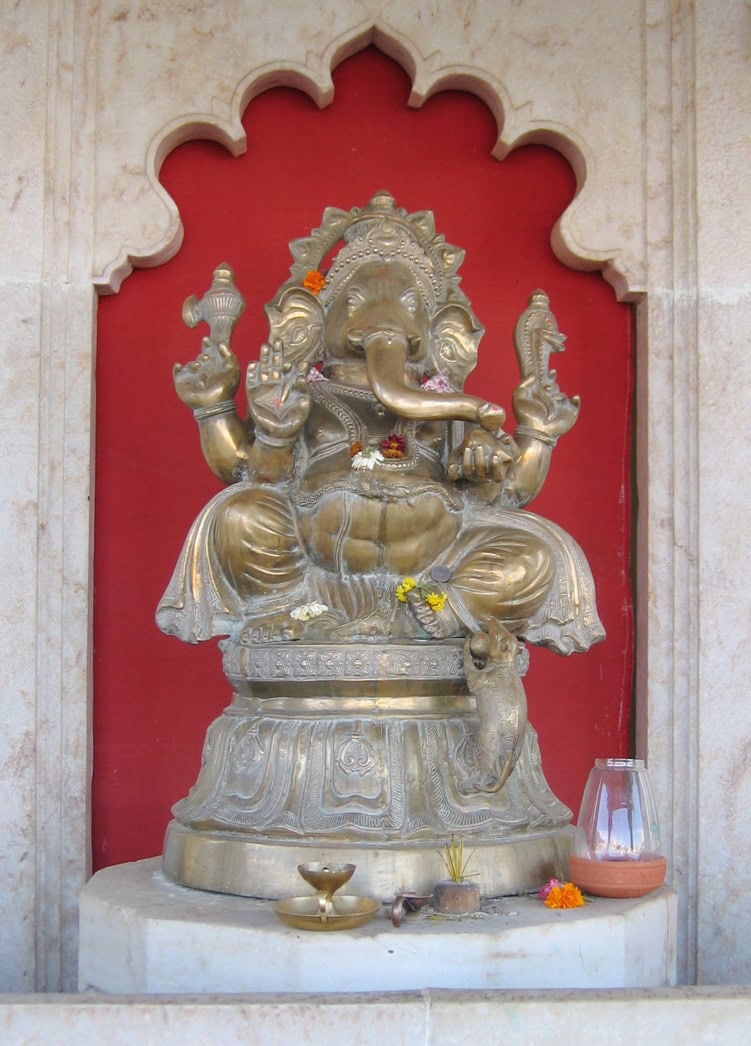
Of all the animals available to an elephant-headed god, Ganesha travels with a mouse.
Not a horse. Not a tiger. Not even an elephant.
A mouse.
It’s one of the more delightful contrasts in Hindu iconography, although there’s considerably more to it than an unusual choice of transportation.
The mouse, commonly called Mushika, is Ganesha’s vahana, or animal vehicle.
In Hindu symbolism, the mouse is often associated with restless desires and the wandering mind. Its ability to slip through tiny openings also makes it a fitting companion for a deity who removes obstacles.
The image of Ganesha with the mouse under his control can represent wisdom governing impulses that might otherwise lead a person astray.
Next time you encounter a Ganesha shrine, look near his feet. You’ll frequently find the little fellow waiting there.
Ganesha, Ganesh, Ganapati or Vinayaka?
You may hear Ganesha referred to by several different names during your travels.
Ganesh is a common shortened form of Ganesha. Ganapati is often understood as lord of the ganas, the attendants associated with Shiva. Vinayaka is another widely used name, particularly in southern India.
In Tamil Nadu, you’ll frequently hear Pillaiyar, a familiar Tamil name for Ganesha.
Hindu devotional traditions commonly recognize 108 names of Ganesha, each drawing attention to a particular quality or aspect of the deity.
There are also numerous forms of Ganesha depicted in Hindu art, with different postures, colors, objects and numbers of arms.
Look for the elephant head. You’ll be golden.
Ganesha in Everyday India
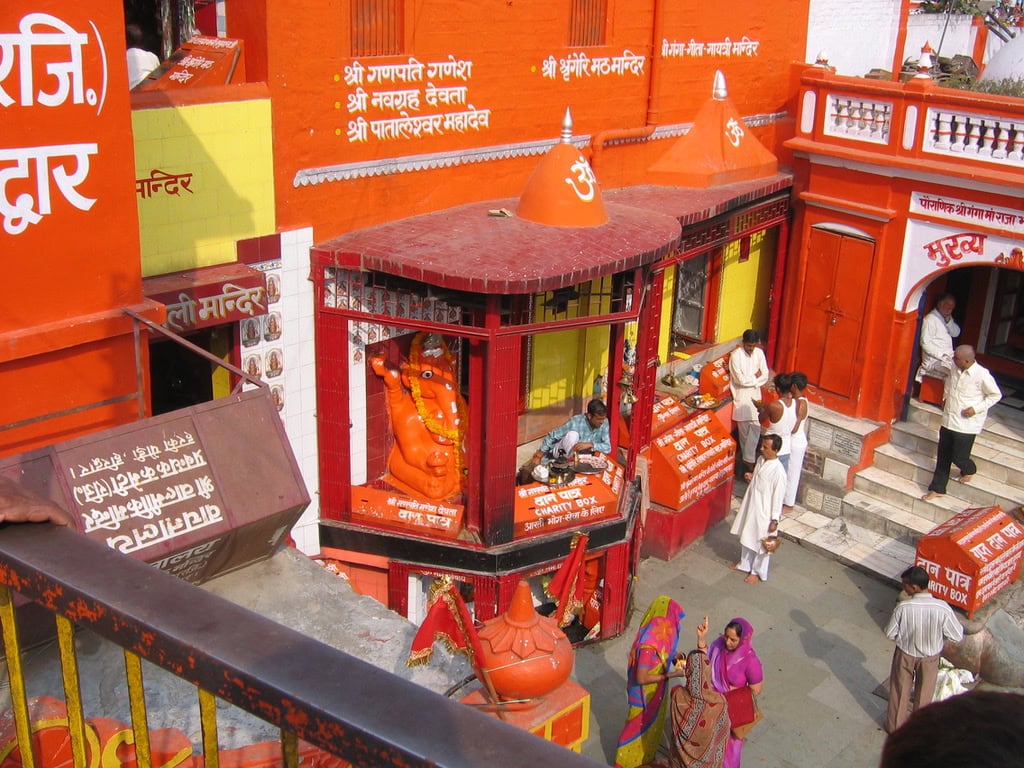
One of the things I find most interesting about Ganesha is how naturally he fits into everyday Indian life.
He’s there when a new shop opens. He’s there when a family purchases a car. He’s there when students prepare for examinations, when couples marry and when people begin journeys.
His presence isn’t limited to temples.
You’ll encounter Ganesha in homes, businesses, offices and vehicles. Small shrines may be decorated with flowers, incense and offerings of sweets. Devotees may pause for a brief prayer before beginning their day.
His popularity is particularly visible during Ganesh Chaturthi, the annual festival celebrating his birth.
The celebrations are especially elaborate in Maharashtra, where large public installations, neighborhood gatherings and processions fill streets before Ganesha images are immersed in water.
Elsewhere in India, celebrations may center on family shrines, neighborhood temples or smaller community gatherings.
The forms of worship vary, but the affection for Ganesha is widespread.
Quite the Comeback
The story of an underdog has a soft spot in my heart, and Ganesha certainly has one. A boy who lost his head for following his mother’s instructions, only to be brought back to life with the head of an elephant and become one of Hinduism’s most beloved gods. Quite the comeback.
Perhaps that’s part of his appeal. Ganesha’s own story is hardly free of obstacles, yet he’s the god people turn to when facing theirs. From the smallest roadside shrine to the grandest temple, he offers the same reassurance: whatever lies ahead, you don’t have to face it alone.
And I rather like the thought of that.

 Districts of India: The Geography Between the State and the Village
 States vs. Union Territories: What’s the Difference?
 Salwar Kameez: India’s Everyday Three-Piece Outfit