
You’ve already gone through the trouble of getting an Indian visa, filled out the application and paid the fee. Surely that’s enough paperwork?
Not necessarily.
Certain parts of India require an additional permit to visit. Another application, possibly another fee, and another document to keep track of. Who knew?
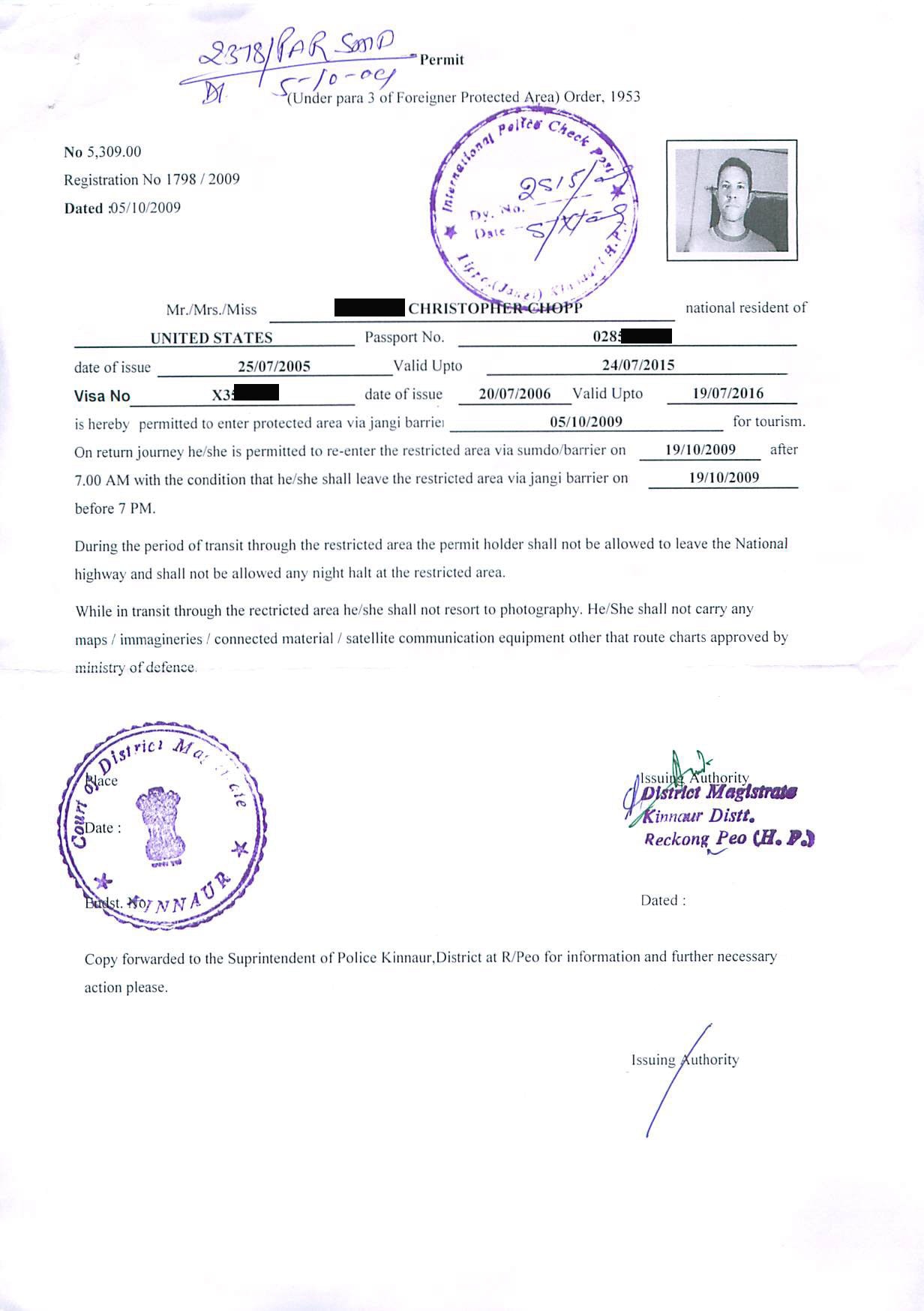
I certainly didn’t, until a trip through Himachal Pradesh in 2009 brought me face-to-face with India’s Inner Line Permit system.
The day I went looking for a permit
I was traveling through Kinnaur toward Spiti when I discovered that continuing along the road near the India–Tibet border required additional permission. At Reckong Peo, I was directed to the district administration offices. The office I needed hadn’t opened by 10:10 in the morning.
Across the hallway, a travel agency advertised Inner Line Permits. Someone offered to open early and help. I handed over copies of my passport and Indian visa, completed an application and paid ₹150. Then came the circuit of offices: a photograph, information entered into a computer, stamps, signatures and finally the District Magistrate. One hour and thirty-five minutes later, I had my permit.
That was October 2009. The price and procedure are a piece of travel history, not instructions to follow today. But the lesson survives: find out what your route requires before you reach the checkpoint.

Three permits, two different audiences
An Indian visa gets a foreign visitor into India. It does not automatically authorize entry to every protected border region or island. Indian citizens also face entry controls in some states. The important distinction is between who is traveling and where they are going.
ILP (Inner Line Permit): primarily used for Indian citizens entering designated northeastern states. PAP (Protected Area Permit): used for foreign nationals entering specified protected areas. RAP (Restricted Area Permit): applies to designated restricted areas. Local terminology is not always consistent: the document I received in Himachal Pradesh in 2009 was called an Inner Line Permit, although I was traveling on an American passport.
In the four northeastern ILP states, qualifying indigenous inhabitants and other residents or exempt categories do not need the same visitor ILP as an Indian citizen arriving from another state. The exemption rules are set by each state; living somewhere temporarily is not automatically an exemption.

India’s permit requirements at a glance
Use this table to identify the right section below. “Area-specific” means ordinary travel elsewhere in the state does not require the listed border-area permit. Foreign-national rules described here concern ordinary tourist travel; nationality-specific restrictions can be stricter.
| State / UT | Indian tourists | Foreign tourists |
|---|---|---|
| Arunachal Pradesh | ILP for non-exempt visitors | PAP — statewide |
| Nagaland | ILP for non-exempt visitors | PAP — statewide |
| Mizoram | ILP for non-exempt visitors | PAP — statewide |
| Manipur | ILP for non-exempt visitors | PAP — statewide |
| Sikkim | Excursion permits for designated areas | State entry PAP/RAP; additional excursion permits |
| Himachal Pradesh | No general tourist ILP | Permit for Kinnaur–Spiti border route |
| Uttarakhand | Area-specific access controls | PAP for designated border areas |
| Ladakh | Area-specific access controls | PAP for designated border areas |
| Jammu & Kashmir | Area-specific access controls | PAP for designated border areas |
| Rajasthan | Area-specific access controls | PAP for designated border areas |
| Lakshadweep | Entry permit for non-exempt visitors | Entry permit |
| Andaman & Nicobar Islands | Restricted islands/tribal areas | No general RAP for eligible tourists on open tourist islands; restricted areas remain |
Exemptions and permit conditions vary. The table is a quick reference, not a substitute for the detailed state instructions below.
State-by-state permit instructions
Arunachal Pradesh
Indian tourists: obtain an ILP unless exempt under state rules. Foreign tourists: obtain a PAP before entering Arunachal Pradesh. These are statewide entry requirements, not simply permits for Tawang or Mechuka.
Apply / official guidance: Indian ILP · Foreign PAP instructions
Timing: Arrange required authorization before the regulated entry or excursion. Where the issuing authority publishes no guaranteed turnaround, do not treat same-day issuance as assured.

Nagaland
Indian tourists: obtain an ILP unless exempt. Foreign tourists: obtain a PAP before entering; comply with applicable foreigner-registration instructions on arrival. Do not rely on older accounts describing Nagaland as PAP-free: the foreign-traveler exemption was withdrawn.
Apply / official guidance: Indian ILP · Foreign permits
Timing: Arrange required authorization before the regulated entry or excursion. Where the issuing authority publishes no guaranteed turnaround, do not treat same-day issuance as assured.
Mizoram
Indian tourists: obtain an ILP unless exempt. Foreign tourists: arrange a PAP before entering, and follow the state’s foreigner-registration procedure. The PAP exemption described in many older blogs no longer applies.
Apply / official guidance: State tourism · Foreign permits
Timing: Arrange required authorization before the regulated entry or excursion. Where the issuing authority publishes no guaranteed turnaround, do not treat same-day issuance as assured.
Manipur
Indian tourists: obtain an ILP unless exempt. Foreign tourists: obtain a PAP before entering. Permit approval does not override security-related restrictions or road closures; plan the route with current local access information.
Apply / official guidance: Foreign permits · Central rules
Timing: Arrange required authorization before the regulated entry or excursion. Where the issuing authority publishes no guaranteed turnaround, do not treat same-day issuance as assured.
Sikkim
Indian tourists: no general ILP to visit Gangtok, but permits apply to designated excursions. Foreign tourists: obtain the required PAP/RAP for entering Sikkim and additional permissions for designated excursions. Nathula Pass is not open to foreign tourists. Do not confuse permission to enter Sikkim with permission to visit North Sikkim or Tsomgo Lake.
Apply / official guidance: State permit information
Timing: Arrange required authorization before the regulated entry or excursion. Where the issuing authority publishes no guaranteed turnaround, do not treat same-day issuance as assured.

Himachal Pradesh
Indian tourists: no Inner Line Permit for the ordinary Spiti road journey. Foreign tourists: the Shimla–Kinnaur–Spiti route requires an Inner Line Permit; the ordinary Manali–Kaza approach does not. Himachal Tourism identifies Reckong Peo as an issuing location. This is the route-specific distinction that mattered on my 2009 trip.
Apply / official guidance: Official Spiti guidance
Timing: Arrange required authorization before the regulated entry or excursion. Where the issuing authority publishes no guaranteed turnaround, do not treat same-day issuance as assured.

Uttarakhand
Neither Indian nor foreign tourists need a special border-area permit for ordinary visits to Haridwar or Rishikesh. Designated border zones have separate access controls; foreign nationals need authorization for protected areas. A trekking itinerary near the frontier must be assessed by its exact destination.
Apply / official guidance: Central protected-area framework
Timing: Arrange required authorization before the regulated entry or excursion. Where the issuing authority publishes no guaranteed turnaround, do not treat same-day issuance as assured.
Ladakh
Neither Indian nor foreign tourists should assume that access to Leh automatically authorizes every border excursion. Indian visitors follow local rules for designated areas; foreign visitors require a PAP for protected areas under the central 2025 framework. Confirm the exact route and the permit’s listed destinations before leaving Leh.
Apply / official guidance: Central protected-area framework
Timing: Arrange required authorization before the regulated entry or excursion. Where the issuing authority publishes no guaranteed turnaround, do not treat same-day issuance as assured.

Jammu & Kashmir
No general ILP is needed for ordinary Indian tourist travel to Srinagar. Foreign tourists do not need a PAP simply to visit the usual Srinagar tourist circuit. Specific border areas are protected and require separate authorization for foreigners; other local controls can apply to Indian visitors.
Apply / official guidance: Central protected-area framework
Timing: Arrange required authorization before the regulated entry or excursion. Where the issuing authority publishes no guaranteed turnaround, do not treat same-day issuance as assured.
Rajasthan
No special border permit is needed for ordinary sightseeing in Jaipur, Udaipur, Jodhpur or the standard Jaisalmer tourist circuit. The central framework designates particular border areas as protected for foreign nationals. A desert excursion close to the Pakistan border is not interchangeable with a standard Jaisalmer tour.
Apply / official guidance: Central protected-area framework
Timing: Arrange required authorization before the regulated entry or excursion. Where the issuing authority publishes no guaranteed turnaround, do not treat same-day issuance as assured.
Lakshadweep
Indian and foreign tourists who are not exempt must obtain the Union Territory’s entry permit before boarding a flight or ship. Apply using the new official online portal. The administration lists a five-business-day standard processing period; allow additional time rather than booking around the minimum. The permit covers the approved visit and islands.
Apply / official guidance: Official application · Instructions
Timing: Arrange required authorization before the regulated entry or excursion. Where the issuing authority publishes no guaranteed turnaround, do not treat same-day issuance as assured.

Andaman & Nicobar Islands
Indian tourists can visit the usual open tourist islands without a general ILP; tribal reserves and restricted islands are not open for casual visits. Eligible foreign tourists can visit the main open tourist islands without obtaining a general RAP, but this does not authorize access to protected tribal areas or the Nicobar Islands. Distinguish an open tourist island from a restricted one before planning transport.
Apply / official guidance: Central restricted-area framework
Timing: Arrange required authorization before the regulated entry or excursion. Where the issuing authority publishes no guaranteed turnaround, do not treat same-day issuance as assured.

The permit business: what to watch for
That travel agent across the hallway in Reckong Peo helped me get my permit in 2009. I paid for the assistance, got the document and continued my journey. A local agent isn’t automatically a problem. In some places, an authorized tour operator is exactly who you need. The problem is paying someone who misrepresents the rules, the fees or what they’re actually arranging.
Look-alike application websites. A website may resemble a government permit portal without being one. Start with the official links in the state sections above. If you use a private service, make sure you understand that you’re paying a middleman, not the issuing authority.
“Guaranteed” permits. An agent can prepare an application; they cannot guarantee government approval. Be especially wary of promises to bypass nationality restrictions or secure entry to places that are closed to ordinary tourists.
Unexplained charges. Ask what portion is the government permit fee and what portion is the agent’s service charge. Environmental, conservation or local entry charges may be separate and legitimate, but they should be identified rather than bundled into a mysterious “permit fee.” Ask for a receipt.
Permits you don’t need. A permit may be required for one road into a region but not another, or for a border excursion but not the nearby town. Before paying, confirm the requirement for your passport, destination and route.
Last-minute arrangements. Don’t assume your driver can obtain the necessary approval at a checkpoint. Some authorizations require advance applications, specified dates or an approved operator. A promise to “sort it out on the way” is not a travel plan.
And keep control of your documents. Provide passport copies through the required official or authorized process; don’t surrender your original passport to an unfamiliar intermediary without a clear, legitimate reason. A payment confirmation or WhatsApp message from an agent is not, by itself, proof that a government permit has been issued.
What does a permit cost?
There is no India-wide permit price. Some applications have government fees, some destinations charge separate environmental or entry fees, and a tour operator may charge for handling the paperwork. These are different expenses. For example, Arunachal Pradesh’s official e-ILP portal publishes its own Indian-visitor permit charges. Compare the amount shown there with any quotation you receive from an agent, and ask what additional service you’re buying.
I’d avoid treating any fee quoted in an older travel article—including my ₹150 payment in 2009—as today’s price. Use the current government application screen for the actual amount, and keep the receipt.
When should you apply?
Before you commit to a restricted excursion, find out how the permit is issued. Some applications are online; others involve local authorities or an authorized operator. Approval may depend on nationality, route, group arrangements and security restrictions. A permit for one destination may not cover another, even in the same state.
Apply as soon as your route and dates are settled, allowing time for questions or corrections. Lakshadweep’s published processing guidance, for instance, is a useful reminder that island permits should be arranged before departure—not left until airport check-in. No agent’s promise of same-day approval should replace the issuing authority’s instructions.
If approval is delayed or refused: don’t attempt to continue through a controlled checkpoint on the strength of your Indian visa, a booking confirmation or an agent’s assurance. Ask the issuing authority or authorized operator what can be corrected, and have an alternative route or destination in mind. A valid visa doesn’t override a regional entry restriction.
Indian passports, OCI cards and foreign passports
This distinction matters more than it first appears. Indian citizenship, Indian ancestry and an Overseas Citizen of India (OCI) card are not the same legal status. An OCI cardholder travels on a foreign passport and should not assume that an Indian-citizen ILP exemption applies. Foreign tourists may also face different rules based on nationality, even when traveling together on the same itinerary.
Solo travelers should pay particular attention to any permit conditions involving an approved tour operator, a guide or minimum group size. Rules that apply to one destination or nationality should not be generalized to the whole state. Where the application portal doesn’t clearly address your situation, obtain written guidance from the issuing authority before booking the excursion.
Before you apply
Write down the exact places you plan to visit, not just the state name. Confirm which traveler category applies to you, and check the permit’s approved dates, routes and destinations. If a hotel, driver or tour company is arranging it, agree in advance on who is responsible and what the service costs.
Your permit checklist
- Confirm whether your exact route and destination require a permit.
- Use an official government portal or an appropriately authorized operator.
- Check passport nationality, OCI status where relevant, group requirements and permit validity.
- Separate government fees from operator charges and obtain a receipt.
- Carry your approved permit and required identification, including an offline or printed copy when practical.
- Make sure every restricted destination on your itinerary is actually covered.
At the checkpoint
Expect an officer to compare your permit with your identification and check the dates and authorized route. Your details may be entered in a register. Carry a copy that can be shown without a mobile signal; a screenshot of an agent’s promise to apply isn’t a substitute for the issued permit. Follow any conditions on photography, overnight stops and movement beyond the approved route.
If your name, dates or destination are wrong, deal with the issuing authority rather than hoping nobody notices. And if the road is closed for security or weather, a valid permit won’t make it open.
One last thing
In 2009, the man across the hallway in Reckong Peo turned a confusing morning into a successful one. I was grateful for his help. What I didn’t know when I arrived was whether I needed his services, how much the official process cost or how long it would take. That’s the information I’d want in hand today—before paying anyone, and certainly before setting off toward the border.
Permit reference updated November 2026. Central framework: Immigration and Foreigners Order, 2025. State application links are included above.

 How to Prepare for Culture Shock in India
 Which Airport Should You Fly Into in India?
 Where to Stay in India: Finding Hotels, Guesthouses & Hidden Gems