
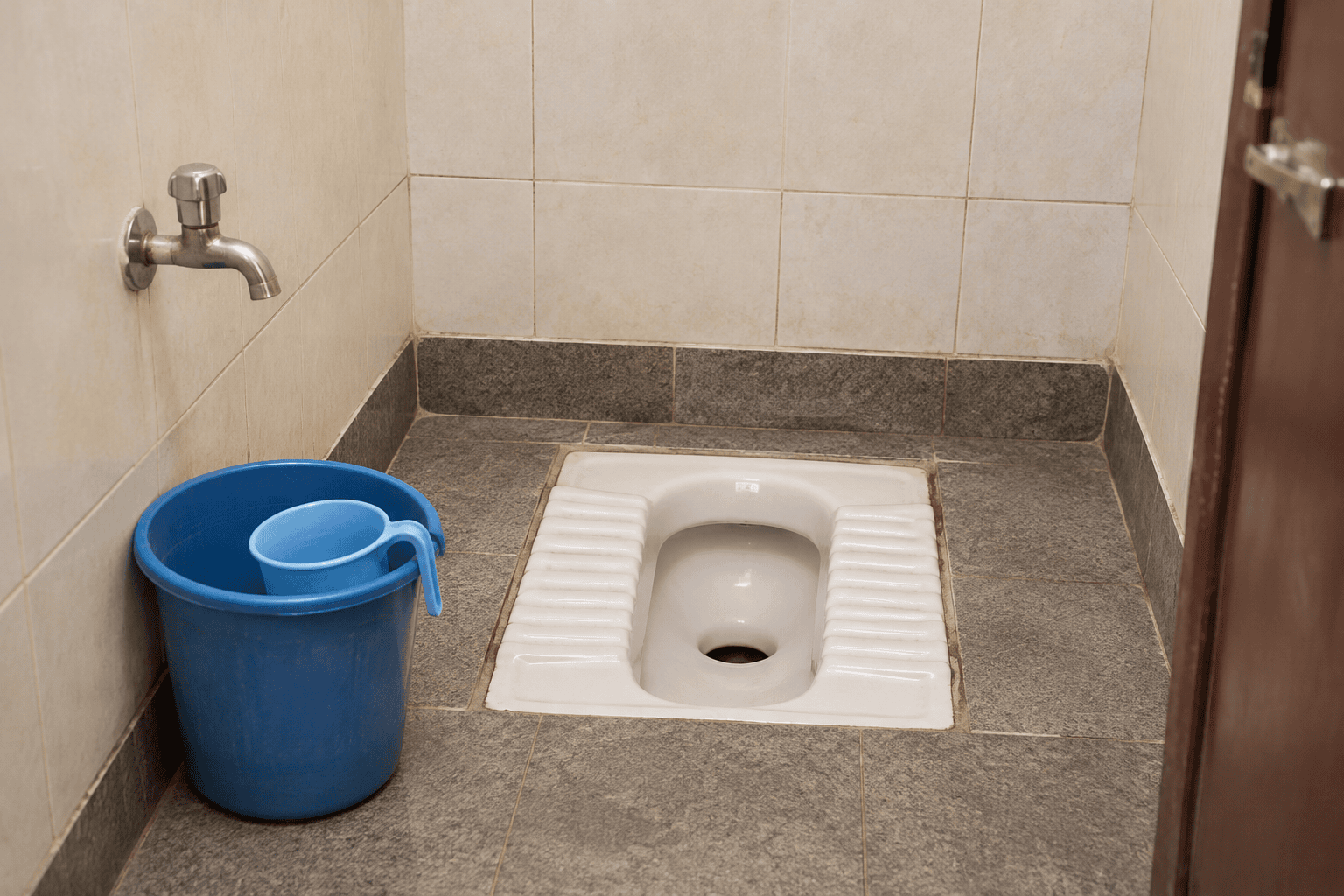
Four stalls at Delhi airport. Four squat toilets. And not the faintest idea what to do with the little plastic mug.
I vividly remember my first encounter with an Indian toilet.
I’d just arrived in Delhi for the first time, fresh—or perhaps not so fresh—off a flight from Paris. Back then, I was a Delta brat, which meant flying from Minneapolis, my home base, to Paris, then onward to Delhi aboard Air France.
I stumbled through immigration, half asleep, and made my way toward baggage claim. Thankfully, I spotted a toilet sign. I needed it, particularly since I had no idea how long the drive from the airport to our hotel would take.
As one does, I walked into the bathroom.
I remember it being white. Very white. White tile on the walls, the floor, even the ceiling. All the urinals were occupied, so I headed for the stalls.
First stall. Whoa! Okay, we’re doing this.
Second stall. Okay now, calm down.
Third stall. Come on.
Fourth and final stall. Oh, for Shiva!
Four stalls. Four Indian toilets. Not a Western toilet in sight.
I’d been given no gentle introduction to the Indian toilet. And I’m better for it.
That first encounter was less about technique and more about necessity. I approached the situation much as I would have while camping: find my balance, aim for the appropriate target, and hope for the best.
Over the days that followed, curiosity got the better of me. I began choosing my moments to ask people how these toilets were actually meant to be used. How to squat properly. What to do with the little plastic mug. Whether toilet paper was involved. And, perhaps most importantly, how to accomplish all of this without soaking myself or my trousers.
Some questions were easier to ask than others.
To this day, I’m no expert. Far from it. But at least I know what I’m getting myself into when I open the stall door.
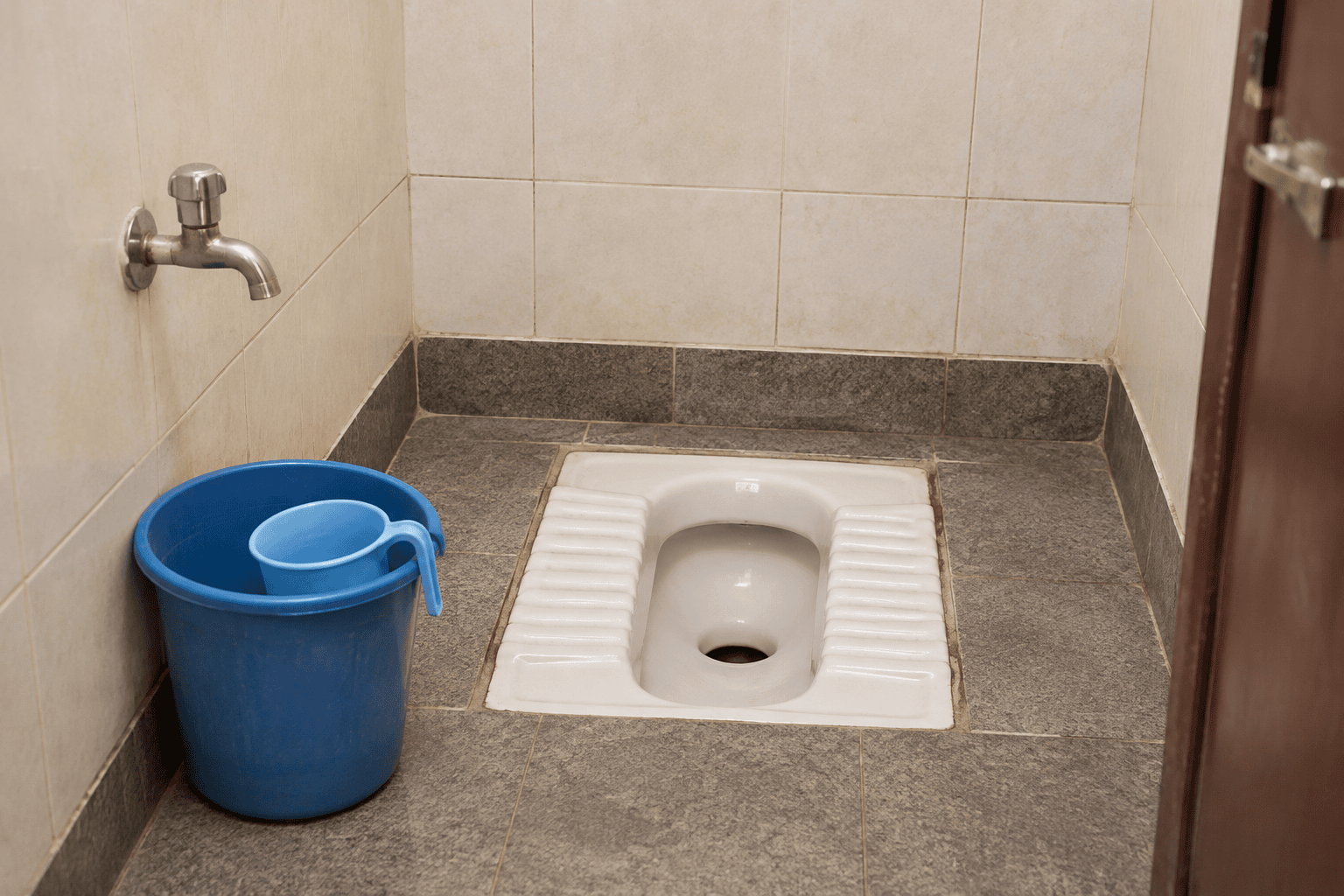
Are squat toilets still common in India?
Absolutely. You’ll still come across Indian-style squat toilets while traveling, whether at a railway station, a roadside stop or a public bathroom. Often there’s a choice between an Indian toilet and a Western-style one. Other times there isn’t, and the Indian toilet is what’s available. That’s why it’s useful to know how to use one before you need to.
Indian trains are a good example. Depending on the coach, you’ll find Indian and Western-style toilets, sometimes both on the same train. Check the door signage to see what’s available.
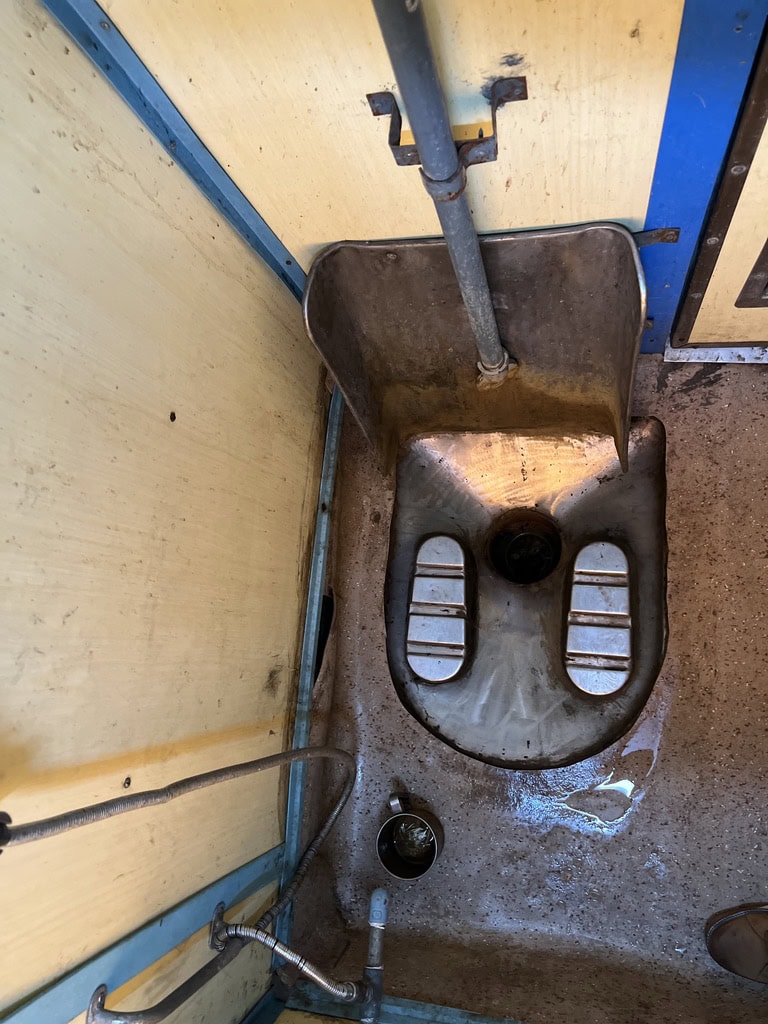
There’s also a difference below the floor. Older train toilets could discharge waste directly onto the tracks; Indian Railways has since introduced bio-toilets in passenger coaches to reduce that practice. A bio-toilet describes the waste-treatment system, not whether the fixture above it is a squat pan or a seat.
My practical advice for train travel? Use the toilet while the train is steady, keep your shoes on, secure anything that might fall from your pockets, and check for water before you begin. The small details matter considerably more on a moving train.
The anatomy of an Indian toilet
Look down. The toilet itself is a ceramic or metal pan set into the floor, with two textured footrests alongside the opening. No seat, no lid. Nearby you may find a tap, a bucket, a smaller mug, or a handheld spray. Not every bathroom has all of them.
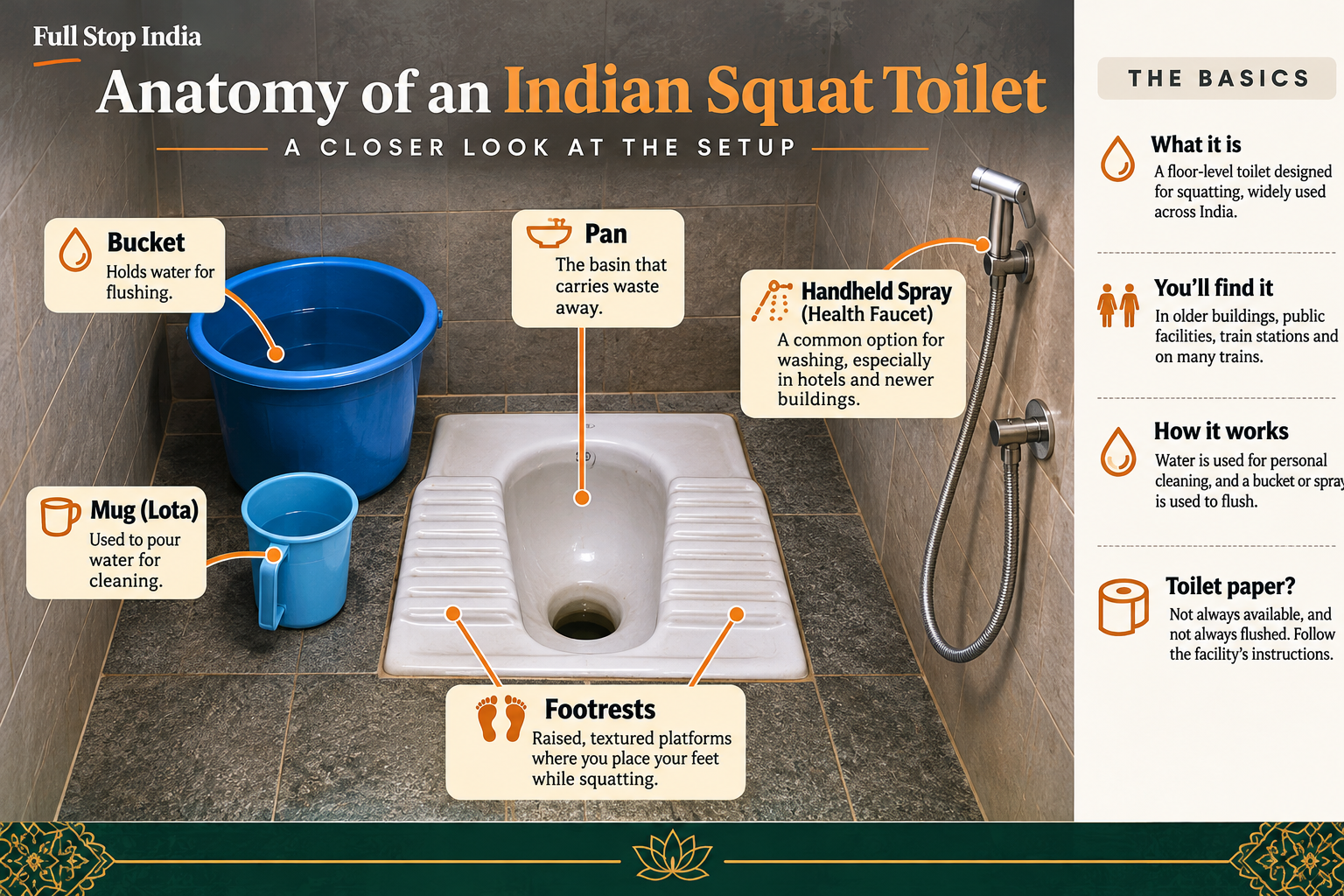
How to actually use one
Clothing
Keep trousers gathered and clear of the floor.
Feet
Stand on the two textured rests and squat.
Water
Pour with the mug or use the handheld spray.
Flush
Use the flush control or bucket, as fitted.
First, the trousers. Lower them enough to squat comfortably, but keep the fabric gathered and away from the floor and pan. Around the knees works for some people; others find it easier to keep clothing lower. There’s no universal trick, except not letting your trousers land in anything unpleasant.
Find your footing. Put one foot on each textured rest, then lower yourself into a squat. The pan’s shape and raised end can help indicate which way to face, but designs differ. Keep your weight over your feet rather than reaching for questionable plumbing to steady yourself. If your knees or balance won’t allow a safe squat, use a seated toilet.
A small trick before you begin: wet the pan with a little water. It can make the final flush easier.
Now, the water. Afterward, pour water with the mug while cleaning yourself with the other hand; traditionally, the left hand is used for washing. A handheld spray does the pouring for you, though it’s wise to test the pressure gently first. Keep the mug itself from touching your body or the pan. Some people use a little tissue to dry afterward; others simply allow the remaining water to drip off. Don’t expect a towel to be provided.
Finally, flush. Use the flush control if there is one; otherwise, pour water from the bucket until the pan clears. Refill the bucket if that’s how the facility operates, and leave the mug clean for the next person. Follow posted instructions for paper disposal and pay any posted attendant fee. Wash your hands thoroughly with soap and water. If there’s no water, use another functioning facility.
Two more questions worth asking
What if I can’t squat? Don’t force it. If balance or mobility is an issue, find a seated toilet. Never stand on the rim of a Western toilet to imitate a squat pan.
Is the water safe? The mug and spray are for washing, not drinking. If the supply looks contaminated, find another facility. Carry hand sanitizer as a backup when soap isn’t available.
The great toilet paper divide
In much of the West, toilet paper is the default. In many Indian households, water is. That’s why a bathroom can be perfectly functional without a roll in sight. Washing with water is an established personal-cleaning practice, not a sign that someone forgot to stock the toilet.
Here’s something I’ve found rather curious after years of traveling in India. Tell someone you’ve used an Indian toilet and the reaction is often some variation of, “Ewwww. You actually used one?”
In my professional life as an interior designer, I’ve specified expensive Japanese toilets with integrated bidets for clients. Heated seats, adjustable water pressure, warm-air dryers, remote controls. Impressive engineering, certainly. But at the heart of it all is a stream of water to clean your backside.
Japan has made remarkable advances in electronic toilet technology. Washing with water, however, has been an everyday practice in India and elsewhere for generations. I find it rather funny that something which draws a grimace when associated with an Indian squat toilet becomes the height of bathroom luxury when packaged in gleaming porcelain with a four-figure price tag.
Traditionally, the left hand is used for cleaning and the right for eating, serving food and greeting people. Practices vary, of course, but understanding that distinction explains a bit of everyday etiquette beyond the bathroom.
If you prefer paper, bring a small packet of tissues. Hotels often supply toilet paper; public facilities are less predictable. Check posted disposal instructions rather than assuming paper should be flushed or that every bin is meant for it. Never flush wet wipes, including those sold as flushable.
Wilbur Sargunaraj demonstrates
If my description still leaves you with questions, Wilbur Sargunaraj has a demonstration for you. He approaches the subject with the confidence of a man who has never considered an Indian toilet remotely complicated.
India’s toilet revolution
When I first arrived in India in 2005, more than half of Indian households had no toilet on their premises, according to the preceding Census. That was changing, as the figures below show.
Data sources: Census of India and NFHS-5.
Then came the Swachh Bharat Mission, launched in 2014, with an enormous push to build toilets and reduce open defecation. But a toilet being built is not necessarily one that’s usable, maintained or regularly used. Nor do the national figures tell us how many toilets are Western-style seats versus Indian squat pans: the Census categorizes sanitation systems, not the position of the person using them.
For a visitor, this is a question of convenience. For a household gaining its first private, functioning toilet, the stakes are much larger: privacy, safety, health and dignity. It’s worth remembering that before we get back to the business of keeping our trousers dry.
There’s something I should disclose here. Growing up, I spent my summers at our family’s cabin in far northern Minnesota. We had no indoor plumbing. Our toilet was a small wooden shed about thirty feet from the cabin. Inside was a seat over a pit in the ground. No running water, no flushing mechanism. You did your business, cleaned yourself with toilet paper, and walked back to the cabin.
Our family considered that outhouse perfectly normal. In fact, compared with an Indian squat toilet equipped with running water and proper waste disposal, it was considerably more rudimentary. I’d spent countless summers using a hole in the ground with a wooden seat over it, yet a ceramic pan in Delhi left me bewildered.
Squatting isn’t the same as flushing
Two things are often confused. Squat versus seated describes the position of the person using the toilet. Pour-flush versus cistern-flush describes how water carries waste away. An Indian squat pan can have a conventional flush, while a pour-flush toilet uses water tipped into the pan by hand. Neither term tells you everything about the plumbing underneath.
One particularly important Indian innovation is the twin-pit pour-flush toilet. Waste flows into one underground pit; when it fills, the flow is switched to the second, allowing the contents of the first to decompose before it is emptied safely after an appropriate resting period. The system can work without a municipal sewer network and uses comparatively little water.
Today I still live in the country, where we rely on a septic system. Our waste doesn’t disappear down a pipe to some mysterious sewage-processing factory miles away. Solids settle in a tank buried in the yard, and wastewater flows into a drain field. It’s more sophisticated than an outhouse, but like India’s twin-pit systems, it manages waste close to home. We simply have more plumbing between ourselves and the evidence.
The man behind a sanitation movement
Dr. Bindeshwar Pathak (1943–2023) founded Sulabh International and championed affordable twin-pit pour-flush toilets. Sulabh describes a design using around 1.5–2 liters of water per flush. But Pathak’s work wasn’t only about plumbing. It was also about ending the degrading practice of manual scavenging—the handling and removal of human waste by workers, historically tied to caste discrimination—and expanding access to dignified sanitation.
That is quite a legacy for something most of us would rather not discuss over dinner. Read about Sulabh’s sanitation technology.
When Nature Calls
Twenty years and countless Indian bathrooms later, what once left me bewildered in a Delhi airport stall is now just another familiar part of traveling in India.
And should I ever find myself back in that same airport bathroom, I can assure you I’ll know exactly what to do with the little plastic mug.

 Tamil: The Language of Tamil Nadu
 Malayalam: The Language of Kerala
 Why Do Hindu Gods and Goddesses Have So Many Arms?