
In 2024, I was about 45 minutes down the road from my hotel in Thekkady when I realized… shizzle sticks. I’d left my bag of freshly laundered underwear on a table in the hotel lobby. Why? Because somehow I thought keeping it in a bag separate from my backpack and main luggage made sense. Shrug. Rookie traveling 101.
And when I say underwear, I mean ALL my underwear.
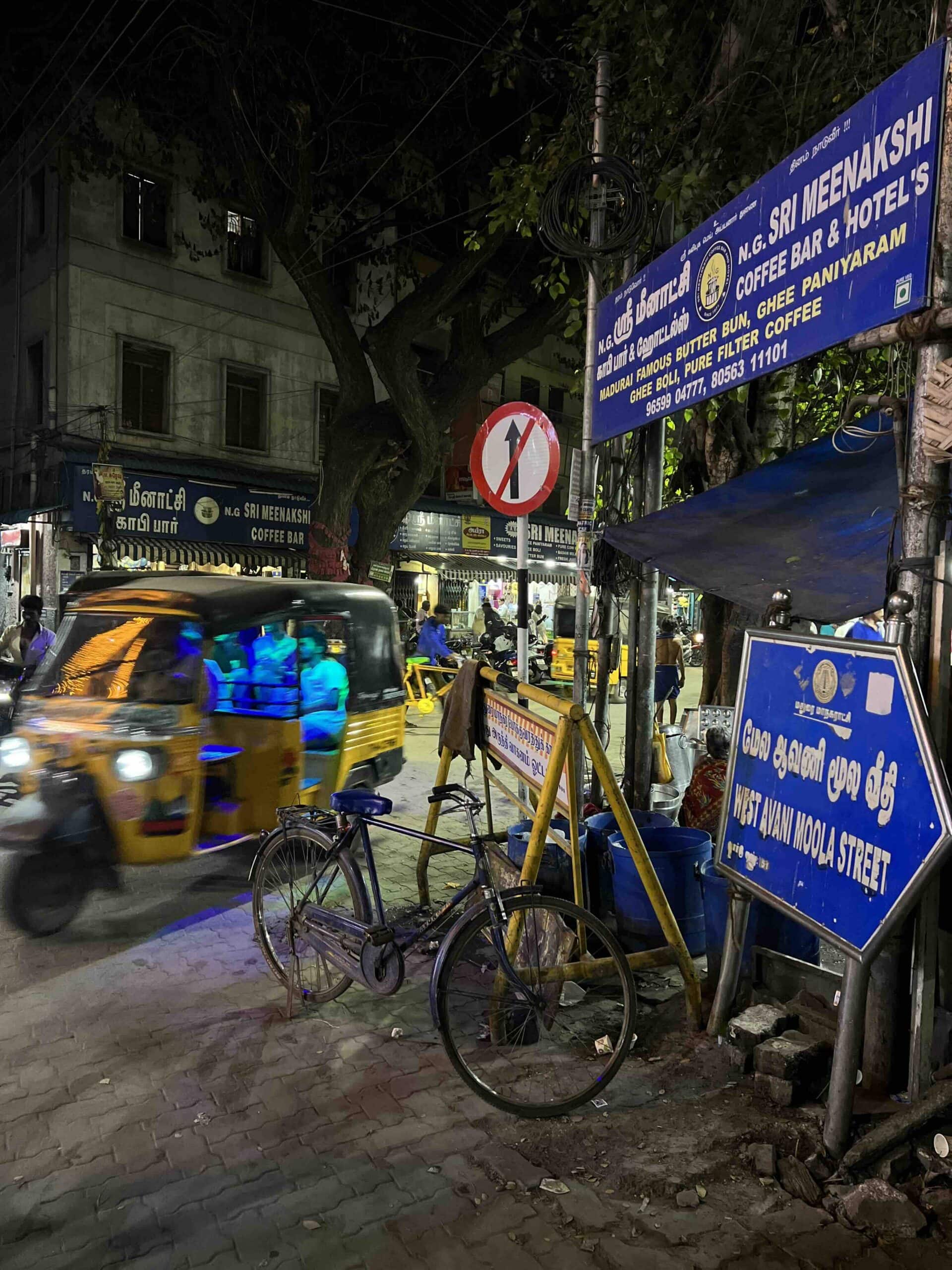
Immediately upon checking into my hotel in Madurai, I made a beeline for the main shopping street. As if by divine intervention, a Jockey store was right at the intersection.
The two sales attendants spoke limited English, and I spoke no Tamil. Fortunately, colorful boxes with pictures of the various styles and clearly printed sizes made for a quick and successful shopping trip.
Tamil at a Glance
Where Is Tamil Spoken?
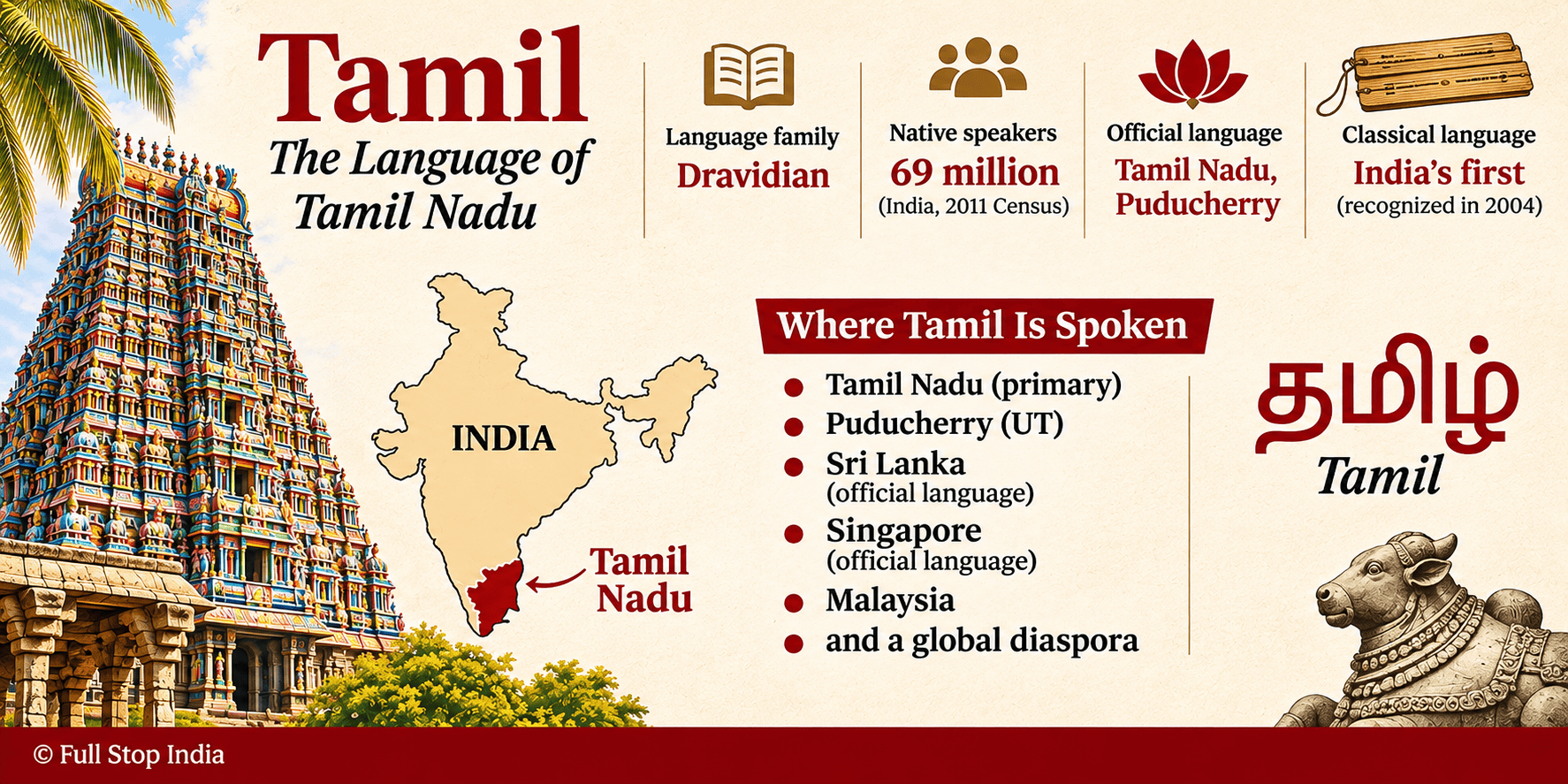
Tamil is the principal language of Tamil Nadu and is widely used in Puducherry and Karaikal. Communities across Karnataka, Kerala and other parts of India also speak it. Beyond India, Tamil is an official language of Sri Lanka and one of Singapore’s four official languages.
In Malaysia, Tamil-medium primary schools help maintain the language across generations. Communities in Mauritius, South Africa, Canada, Britain and elsewhere reflect centuries of migration, including colonial-era labor migration and more recent professional migration.
The international presence of Tamil predates European colonialism. Maritime commerce connected Tamil merchants with Southeast Asia centuries ago. Singapore’s National Heritage Board explores these connections in its exhibition From the Coromandel Coast to the Straits.
The Origins of Tamil
Long before India had its present borders, Tamil was being recorded in inscriptions. Tamil-Brahmi inscriptions from the last centuries BCE survive on rock surfaces and pottery. Precise dates for some archaeological finds remain debated, but the evidence establishes a remarkably long written history.
Sangam literature preserves poems about love, war, generosity, separation, landscapes and the lives of kings and ordinary people. These are not simply religious texts; they offer glimpses of an ancient society and the relationship between people and their surroundings.
The Tolkappiyam, an early work on grammar and poetics, is central to Tamil literary history. Its precise date remains debated. Another enduring work, the Tirukkural, attributed to Tiruvalluvar, consists of 1,330 couplets addressing virtue, wealth and love. In Kanyakumari, a towering statue of Tiruvalluvar stands offshore beside the Vivekananda Rock Memorial.
India’s recognition of Tamil as a classical language in October 2004 acknowledged this historical and literary inheritance. For further reading, see the Central Institute of Classical Tamil.
Understanding the Tamil Script
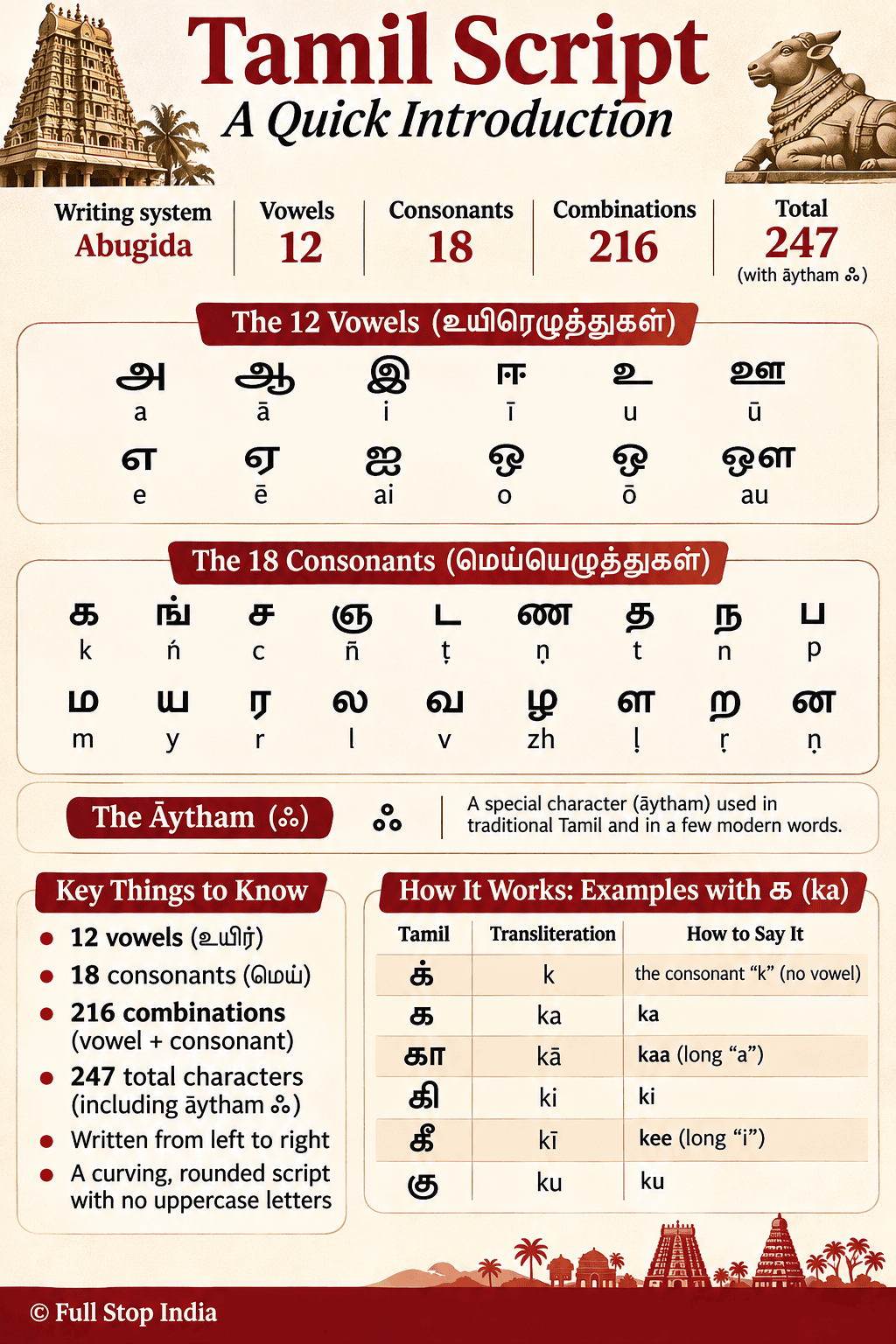
Unlike English, Tamil uses a writing system known as an abugida. Consonants carry an inherent vowel that can be modified by vowel signs or removed by a dot called a pulli. Additional letters accommodate sounds in borrowed words.
Can You Pronounce Tamil?
The name of the language itself, தமிழ், contains ழ, often represented by zh in English transliteration. The sound is produced with the tongue curled back and has no simple English equivalent. Malayalam shares a related sound. Vowel length also matters: a short vowel and its longer counterpart can distinguish entirely different words.
For a technical explanation of the writing system, see the W3C Tamil script guide.
Listen to Tamil
Reading about Tamil is one thing. Listening to the language spoken aloud offers an introduction to its sounds and rhythm.
What’s in a Name?
Older English spellings still turn up in railway timetables, hotel names and historical accounts. Learning a few alternatives can save confusion when planning a trip.
| Older or alternative name | Current name |
|---|---|
| Madras | Chennai |
| Trichinopoly / Trichy | Tiruchirappalli |
| Tanjore | Thanjavur |
| Tuticorin | Thoothukudi |
| Ootacamund / Ooty | Udhagamandalam |
| Cape Comorin | Kanyakumari |
Chennai’s airport code MAA retains a connection to Madras, while Tiruchirappalli uses TRZ. Check the actual airport or railway station before booking rather than assuming a familiar spelling identifies the correct terminal.
Tamil Isn’t Spoken the Same Way Everywhere
The Tamil heard on the streets of Chennai differs from speech in Madurai, the Kongu region around Coimbatore and the southern districts near Tirunelveli. Sri Lankan Tamil has its own regional varieties as well. Social background, age and setting also influence speech.
One particularly important distinction for learners is between formal written Tamil and conversational Tamil. Linguists call this diglossia. A phrase learned from a textbook may sound unusually formal when used at a tea stall. Cinema, interviews and conversations with native speakers can complement formal study. The University of Pennsylvania’s introduction to Tamil explains this distinction.
Tamil and the Making of Tamil Nadu
After independence in 1947, India’s internal boundaries were reorganized partly around language. The Telugu-speaking areas of Madras State were separated to create Andhra State in 1953. Further reorganization in 1956 transferred other territories to neighboring states and brought Kanyakumari into Madras State.
Language was already a contentious political issue. Opposition to compulsory Hindi instruction in schools during the late 1930s developed into a wider movement defending Tamil linguistic identity. In 1965, protests intensified as the constitutional transition period for the Union’s official language arrangements approached its end. Demonstrations turned violent in places and lives were lost.
The dispute was not simply about whether Hindi was a useful language to learn. For many Tamil speakers it raised questions about equal access to government employment, education and political participation in a multilingual country. English continued alongside Hindi for Union official purposes, and Tamil Nadu adopted a two-language school policy centered on Tamil and English.
In 1969, Madras State officially became Tamil Nadu. The name recognized a regional identity that had existed long before the modern state. Historian Sumathi Ramaswamy examines this history in Passions of the Tongue.
Tamil in Everyday Life
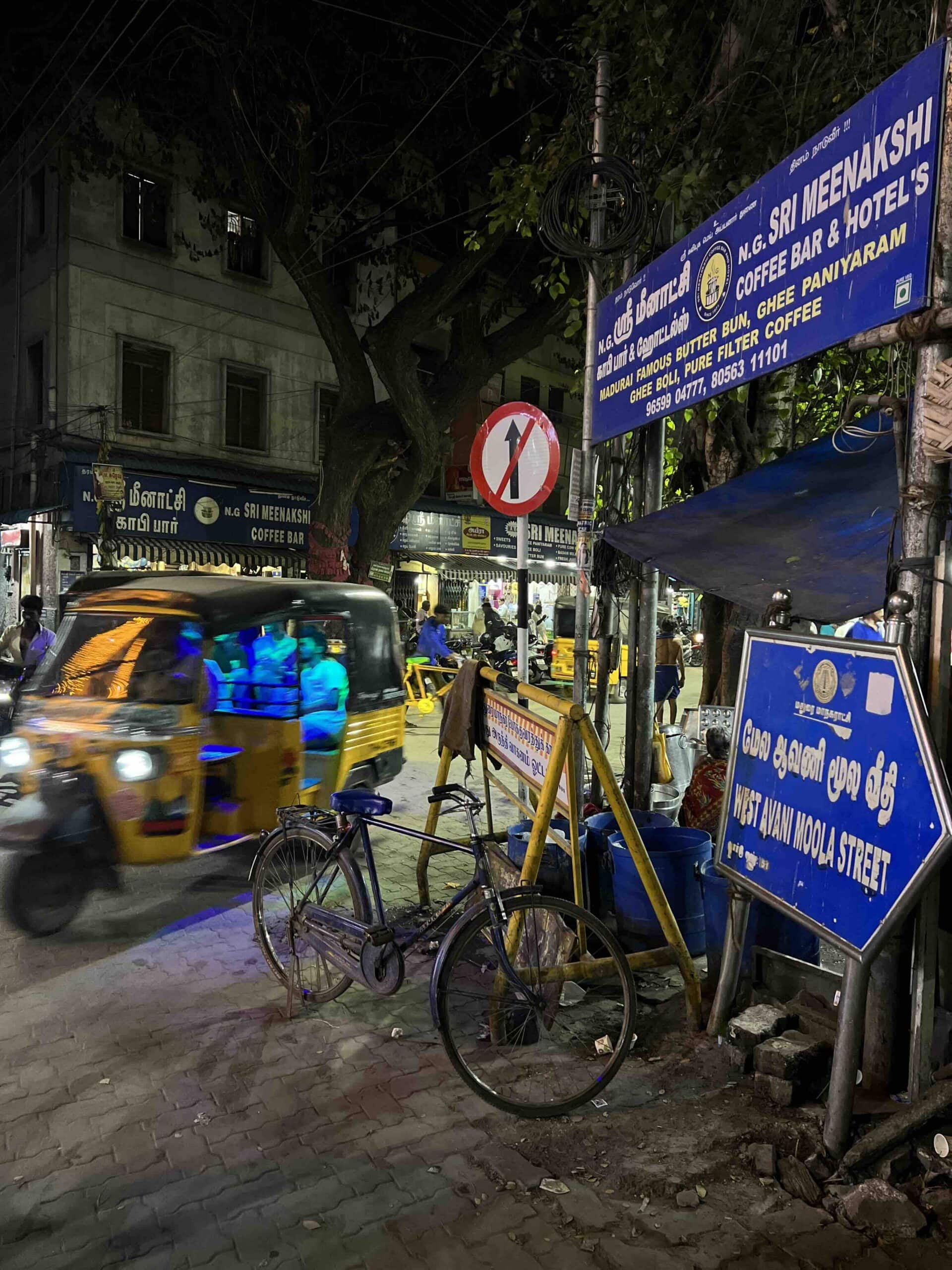
Temple inscriptions, political posters, newspapers and film advertisements all provide opportunities to see Tamil outside a classroom. Newspapers such as Dina Thanthi, Dinamalar and Dinamani reflect a lively Tamil-language press, while television, radio and digital media carry the language into homes and workplaces.
Tamil Literature
Subramania Bharati wrote poetry about freedom, social reform and women’s emancipation. His work remains an important part of modern Tamil cultural identity.
Kalki Krishnamurthy‘s historical novel Ponniyin Selvan brings the world of the Chola dynasty to life through political intrigue and adventure. It provides an interesting literary companion to a visit to the temples of the Kaveri delta.
Perumal Murugan explores village life, family and social expectations in contemporary Tamil writing. His novel One Part Woman is available in English translation.
Tamil Cinema
Centered in Chennai, Tamil cinema is often called Kollywood, after the city’s Kodambakkam neighborhood. Film has also played a remarkable role in state politics, with screenwriters and actors including M. Karunanidhi and M. G. Ramachandran becoming chief ministers.
English and Hindi in Tamil Nadu
During my visits to Tamil Nadu in 2024 and 2025, language was rarely an issue. English was widely spoken at my hotels, my guide handled any necessary translations during sightseeing and food tours, and whenever I encountered hotel staff from northern India, my attempts at Hindi were met with smiles.
I wouldn’t, however, assume Hindi is understood everywhere in Tamil Nadu. Start with English or a Tamil greeting, and use a translation app if necessary.
India has no constitutionally designated national language. Hindi is an official language of the Union, with English also used for official purposes. Tamil has its own official status within Tamil Nadu and is one of India’s 22 scheduled languages.
Tamil Cultural Vocabulary
| Tamil | Say it | Meaning |
|---|---|---|
| கோயில் | Koyil | Temple |
| கோபுரம் | Gopuram | Temple gateway tower |
| கோலம் | Kolam | Decorative floor pattern |
| வேட்டி | Vetti | Traditional waist-wrapped garment |
| பொங்கல் | Pongal | Rice dish and harvest festival |
| அம்மா | Amma | Mother; also respectful address |
English Words with Tamil Roots
Catamaran comes from kattumaram, referring to tied logs used as a watercraft. Curry is traced to kari, a term associated with a dish or relish. Mulligatawny, a soup adapted during British rule, derives from milagu thanni, pepper water. Cheroot, a type of cigar, is traced through European borrowing to Tamil suruttu, something rolled.
These words reflect trade, food and encounters between languages rather than a simple one-way exchange of vocabulary. See the Online Etymology Dictionary entries for catamaran, curry, mulligatawny and cheroot.
Essential Tamil Words and Phrases for Travelers
A greeting or a thank-you doesn’t require months of language lessons. These simplified transliterations are a starting point, not a precise pronunciation guide.
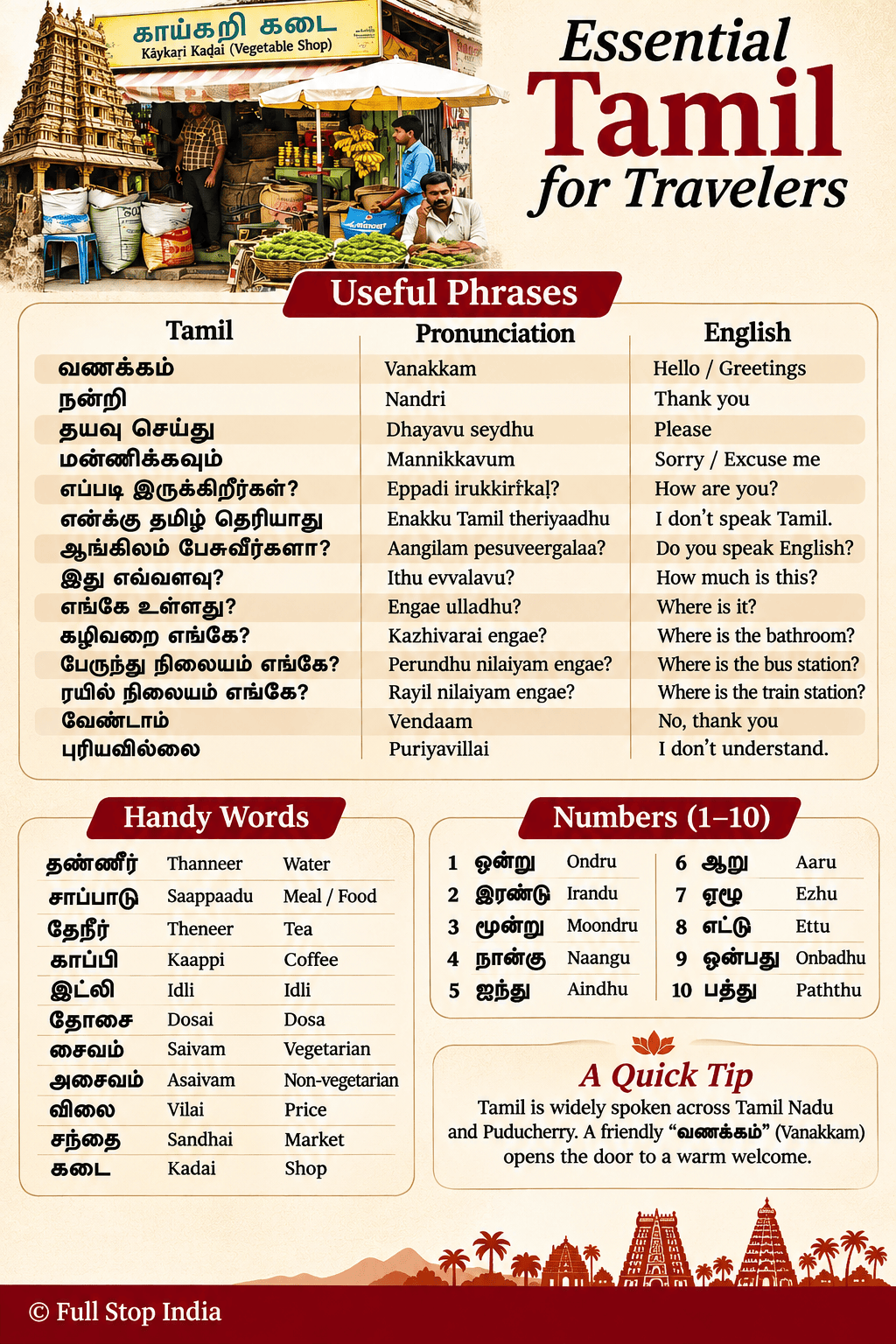
Reading Signs in Tamil Nadu
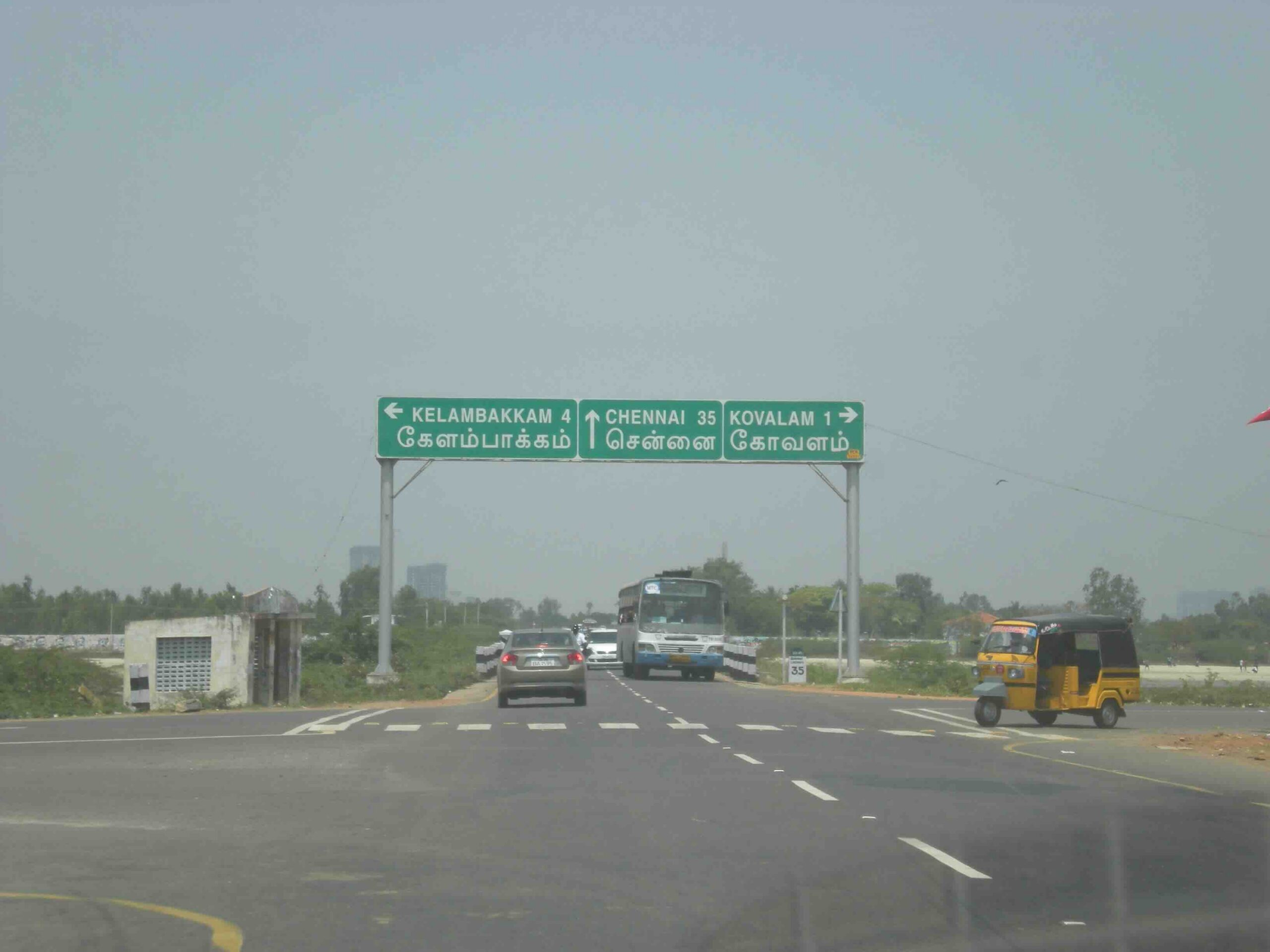
Railway station signs commonly display Tamil, Hindi and English. Road signs and shop names may appear in Tamil and English, but local bus destinations and small businesses may offer fewer English clues. A phone camera translation can help, although decorative lettering and poor lighting can produce errors.
Look for சைவம் (saivam), indicating vegetarian food, and அசைவம் (asaivam), indicating non-vegetarian food. As elsewhere in India, a roadside establishment called a hotel may serve meals without offering accommodation.
Tamil in the Digital Age
Tamil has a strong presence in digital publishing, cinema, messaging and social media. Informal Roman-letter Tamil and mixtures of Tamil and English are often called Tanglish. Someone might type Vanakkam instead of வணக்கம், especially on an English keyboard.
That convenience raises the same question I considered in my article about Malayalam: speaking a language and reading its traditional script are related but distinct skills. Tamil education, digital libraries and Unicode keyboards make it possible to retain both. English-language education and Tamil cultural identity need not be in conflict.
Learning Tamil
| Resource | Useful for |
|---|---|
| Tamil Virtual Academy | Language courses and literature |
| Tamil Digital Library | Digitized books and historical material |
| Google Translate | Everyday translation |
| Project Madurai | Tamil literary texts |
More Than a Language
I’m unlikely to take up Tamil anytime soon. Hindi keeps me busy enough.
What surprised me while researching this article was how much of Tamil Nadu’s history, politics and cultural identity is intertwined with its language. I’d traveled through the state without fully appreciating that connection.
You don’t need to speak Tamil to enjoy traveling through Tamil Nadu. But knowing a little about the language and what it means to the people who speak it gives you a better understanding of the place you’re visiting.
Explore Tamil Nadu
Tamil Nadu: A State Guide — Explore the districts, regional culture, landscapes, food and transportation.
Festivals of Tamil Nadu — Discover Pongal, Tamil New Year and other celebrations.
Further Reading & Sources
Census of India · Central Institute of Classical Tamil · Tamil Virtual Academy · Tamil Nadu Tourism
Part of Full Stop India’s Languages of India series, exploring the 22 languages recognized under the Eighth Schedule of the Indian Constitution.

 Malayalam: The Language of Kerala
 Why Do Hindu Gods and Goddesses Have So Many Arms?
 The Indian Toilet: Everything You Were Afraid to Ask