Tamil Nadu, Beyond the Temple Towers
Ancient kingdoms, busy manufacturing towns, river deltas, hill plantations and a coast with a long memory.

Tamil Nadu is often introduced through its temples, and the temples are extraordinary. But travel beyond the familiar gopurams and the state begins to tell several other stories at once: garment factories sending clothes around the world, flower markets opening before sunrise, ports handling cargo on the Bay of Bengal, and villages where irrigation still determines the farming year.
The west is a country of engineering cities, textile mills and mountains. The Cauvery delta has a different rhythm, with rice fields, waterways and the legacy of the Cholas. Farther south are pilgrimage towns, industrial centers and the sea. Chennai, meanwhile, is an entire chapter of its own.
There are 38 districts. Rather than treating them as a checklist, we’ll travel through them in broad geographical sweeps, beginning in the north, crossing the western and central districts and working toward the southern tip. The journey is a way to understand how different one part of Tamil Nadu can be from the next.

Thirty-eight districts, many different Tamil Nadus
These district introductions take us from the northern plains through the Western Ghats and Cauvery delta to the southern coast, where the landscape, industries and local traditions change considerably along the way.
Tamil Nadu is one of India’s 28 states. Curious about the distinction between states and Union Territories—including neighboring Puducherry? Read States vs. Union Territories: What’s the Difference?.

01 / Chennai District
A city that refuses to be only a gateway
Chennai is also Tamil Nadu’s principal air and rail gateway. Chennai International Airport handles extensive domestic and overseas services, while Chennai Central and Egmore are major terminals for long-distance trains across southern India and beyond.
Chennai has temple towers, a long urban beachfront and streets that reveal centuries of trade. Visit Kapaleeshwarar Temple in Mylapore, follow the colonial layers around Fort St. George and George Town, and spend time in the neighborhoods rather than treating the city as an airport stop.
Automobiles, technology, healthcare, cinema and education make this one of India’s most important working cities. During the December music season, Carnatic concerts fill auditoriums; on an ordinary morning, the flower sellers, coffee counters and markets are just as revealing.

02 / Tiruvallur District
Lagoons, pilgrims and the metropolitan fringe
Tiruvallur and Avadi sit within Chennai’s extensive suburban railway network, giving the district frequent connections with the metropolitan area. This is commuter rail territory as much as a destination for long-distance travelers.
At Pulicat, fishing boats cross a great brackish lagoon shared with Andhra Pradesh, and seasonal birdlife changes the character of the shore. Inland, Tiruttani’s Murugan temple draws pilgrims up its hill, while Poondi Reservoir belongs to the everyday water geography of the Chennai region.
Factories, logistics hubs, power facilities and commuter towns have spread across the district. Beyond those corridors, farming and fishing still support villages. Tiruvallur shows how quickly Chennai’s urban influence gives way to a very different landscape.

03 / Ranipet District
The leather towns of Arcot country
Arakkonam Junction is a major railway interchange in Ranipet district, linking routes toward Chennai, Bengaluru and Tirupati. Its transport role is significant even though it is not one of the state’s major tourist destinations.
Arcot’s history is bound up with the Carnatic Wars, and Sholinghur’s hill temples remain important pilgrimage destinations. Ranipet was separated from Vellore district in 2019, but its towns have traded across this region for much longer.
Leather processing and leather goods are defining industries, alongside engineering and other manufacturing. The economic benefits of these factories sit beside longstanding concerns about industrial wastewater. This is a district where the working economy is as significant a story as the monuments.

04 / Vellore District
A fort city with an international medical reputation
Katpadi Junction, near Vellore, is a major railway interchange on routes linking Chennai with Bengaluru and Andhra Pradesh. It is especially useful for visitors arriving for Vellore’s medical institutions.
Vellore Fort is a substantial granite stronghold, surrounded by a moat and enclosing the Jalakandeswarar Temple. The fort’s walls speak to the many powers that competed for this stretch of northern Tamil Nadu.
Christian Medical College has made Vellore known to patients and medical professionals far beyond the state. Hospitals, colleges, commerce and farming sustain the city and surrounding settlements. A visitor may arrive for the fort, but medicine has become one of Vellore’s defining modern institutions.

05 / Tirupattur District
Ambur biryani and the climb to Yelagiri
Jolarpettai Junction is an important railway interchange in Tirupattur district, with connections toward Bengaluru, Chennai and western Tamil Nadu. It is a useful arrival point for the district’s hill and trading towns.
Yelagiri’s winding approach road leads into a modest hill landscape of orchards, viewpoints and walking paths. Below, Ambur and Tirupattur are busy commercial towns with strong links to the Palar valley.
Ambur is known for both leather and footwear production and its distinctive style of biryani. That combination of factory work and food culture makes the district more interesting than a simple hill-station detour. Tirupattur became a separate district in 2019.

06 / Krishnagiri District
Mango orchards beside an industrial corridor
Krishnagiri’s rocky hills and reservoirs sit along the road to Bengaluru. Hosur, near the Karnataka border, has developed into a major manufacturing center, while older forts and rural settlements mark the wider district.
Automotive, engineering and electronics businesses have expanded around Hosur. Away from the factories, mango orchards are central to the district’s agricultural identity. Few places illustrate the coexistence of industrial supply chains and seasonal farming quite so clearly.

07 / Dharmapuri District
Mango country and the Cauvery’s rocky falls
At Hogenakkal, the Cauvery breaks into channels and waterfalls over dark rock. The river scenery is the district’s best-known attraction, but Dharmapuri’s dry interior has a character of its own.
Mango cultivation is particularly important, alongside millets, groundnut and other crops suited to the climate. Markets and smaller farming towns connect this region to Salem and Bengaluru. The landscape is a reminder that much of Tamil Nadu is neither tropical coast nor lush highland.

08 / Salem District
Steelworks below the Shevaroy Hills
Salem has a regional airport with more limited commercial services than the state’s major gateways. Salem Junction, however, is a significant railway stop for travel between Chennai, western Tamil Nadu and Kerala.
Salem combines a busy commercial city with the cooler roads of Yercaud in the Shevaroy Hills. Sankagiri Fort and the Kottai Mariamman Temple add history and religious life to the district’s industrial reputation.
Steel, textiles, sago processing, granite and agricultural trading all contribute to the economy. Salem is also an important transport junction. The contrast between factories on the plains and coffee-growing hill settlements is part of what makes the district distinctive.

09 / The Nilgiris District
Tea gardens, shola forests and a mountain railway
The Nilgiri Mountain Railway climbs toward Coonoor and Ooty through steep terrain and changing vegetation. Beyond the familiar hill-station streets are tea estates, protected forests, high grasslands and communities with deep histories in these mountains.
Tea and vegetable cultivation, tourism and conservation shape local livelihoods. Mudumalai and Mukurthi protect different highland habitats. The hills are beautiful, but they are also working landscapes where farming, wildlife and settlement compete for space.
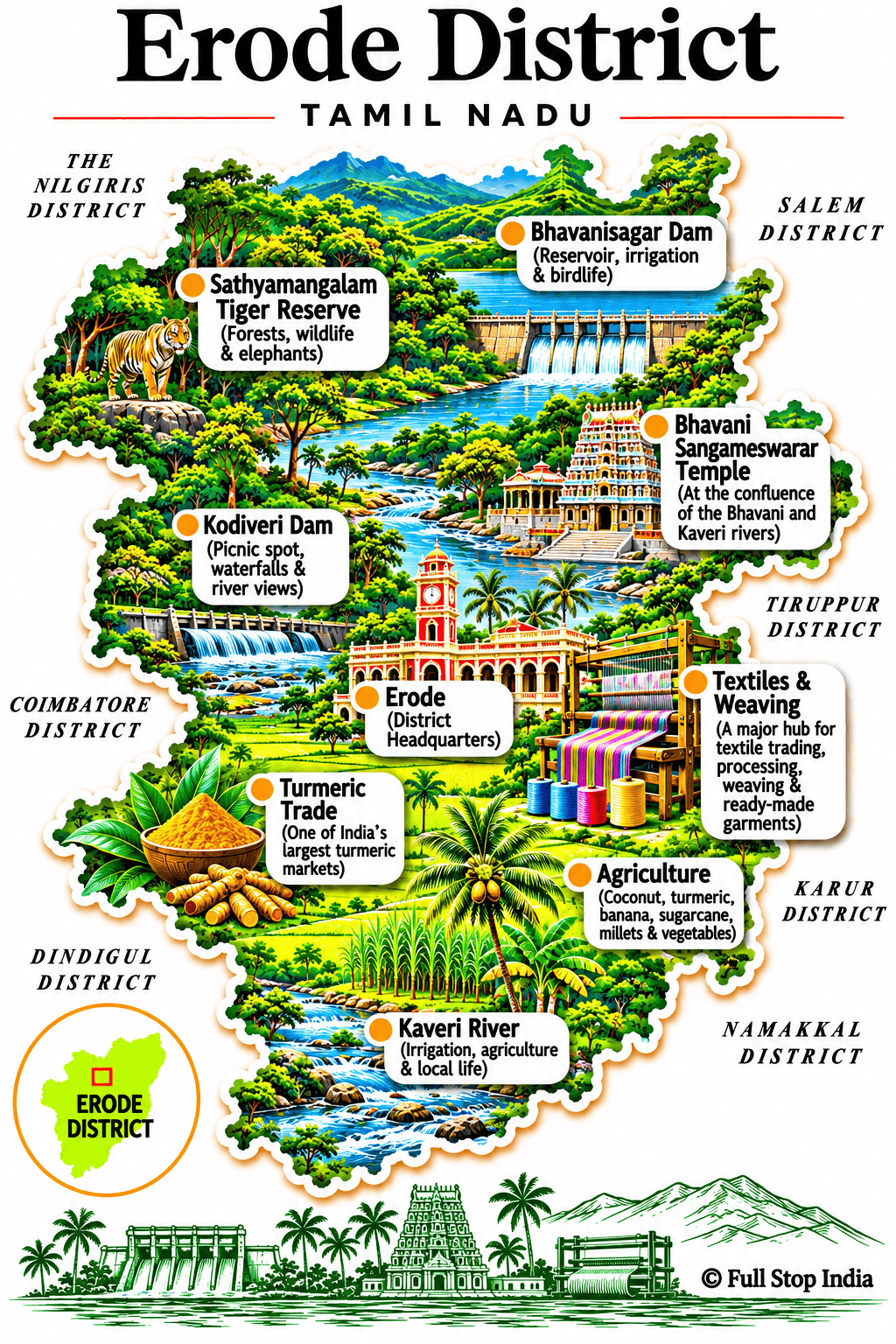
10 / Erode District
Turmeric markets and the Bhavani looms
Erode Junction is one of western Tamil Nadu’s important railway stations, on routes connecting Chennai and Salem with Coimbatore and Kerala. It is a useful rail gateway for the district’s textile and trading towns.
Erode is a trading city built around textiles and agricultural commerce. At Bhavani, the Sangameswarar Temple stands near the meeting of rivers, while the Sathyamangalam landscape stretches west toward forests and the Ghats.
Turmeric is a major trading commodity, and powerloom weaving, garments and dyeing support businesses across the district. Bhavani’s woven textiles have a reputation of their own. Trucks, cloth markets and produce yards tell as much about Erode as its temples.

11 / Tiruppur District
Inside India’s knitwear machine
Tiruppur is famous less for a monument than for the extraordinary scale of its garment industry. Knitting, stitching, dyeing, finishing and shipping operations form a network that supplies clothing to Indian and overseas markets.
The textile economy raises questions about labor, water and industrial growth. Avinashi’s temple and the cattle-breeding traditions around Kangeyam point to an older rural identity. This is one of the most instructive districts for understanding how modern Tamil Nadu earns its living.
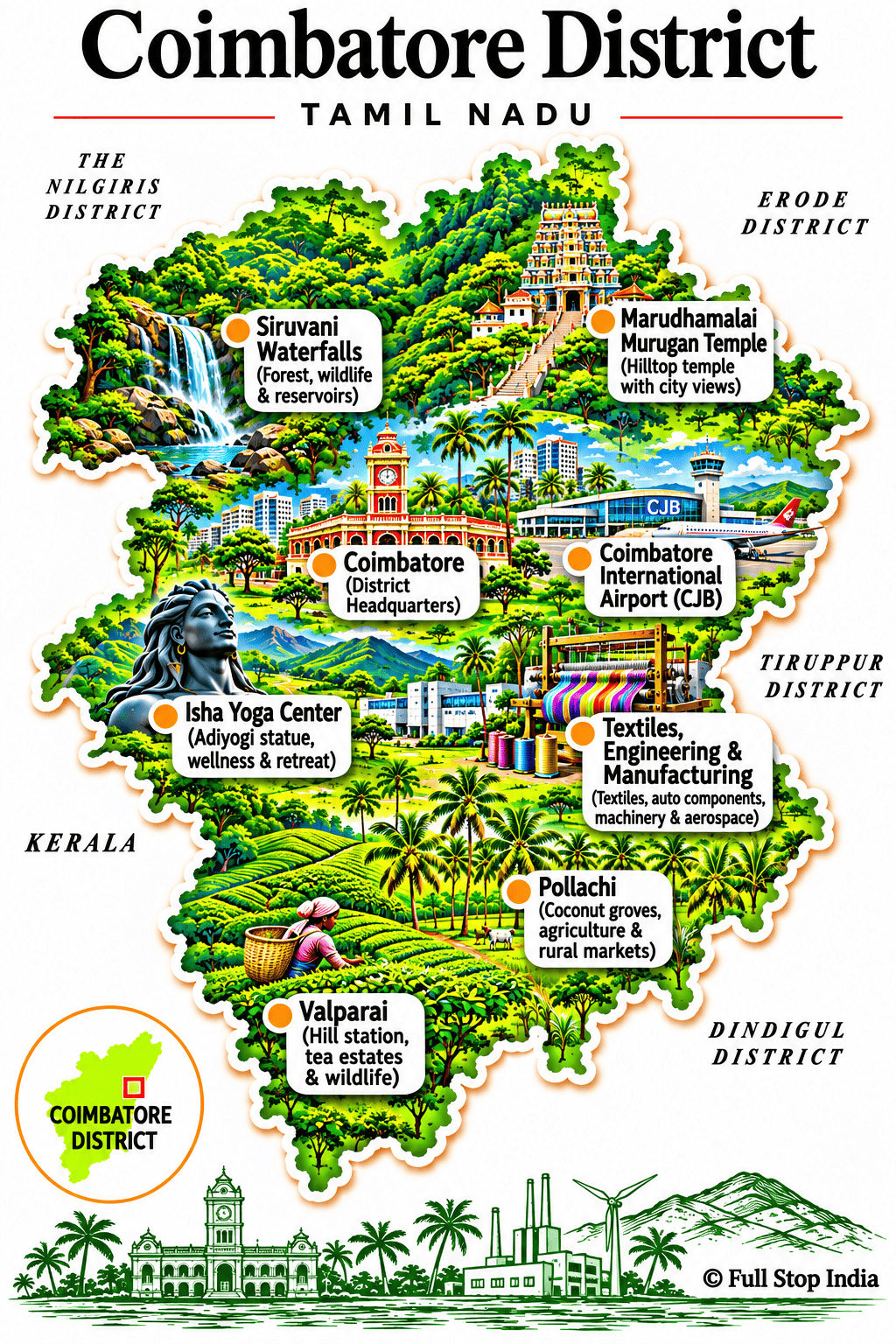
12 / Coimbatore District
Engineering at the foot of the Western Ghats
Coimbatore International Airport provides domestic and selected international connections. Coimbatore Junction is a major stop on the rail corridor toward Kerala and western Tamil Nadu, making the city a practical base for onward journeys to the Nilgiris.
Coimbatore lies where the plains approach the Western Ghats. Perur and Marudamalai are important temple stops, while roads toward the hill country reveal another side of the district.
Textile mills helped establish the city’s industrial character; pumps, motors, foundries, engineering firms, education and technology have since broadened it. Coimbatore’s commercial connections with Kerala are strong. It is a city of workshops and enterprise as much as one of temples and mountain views.
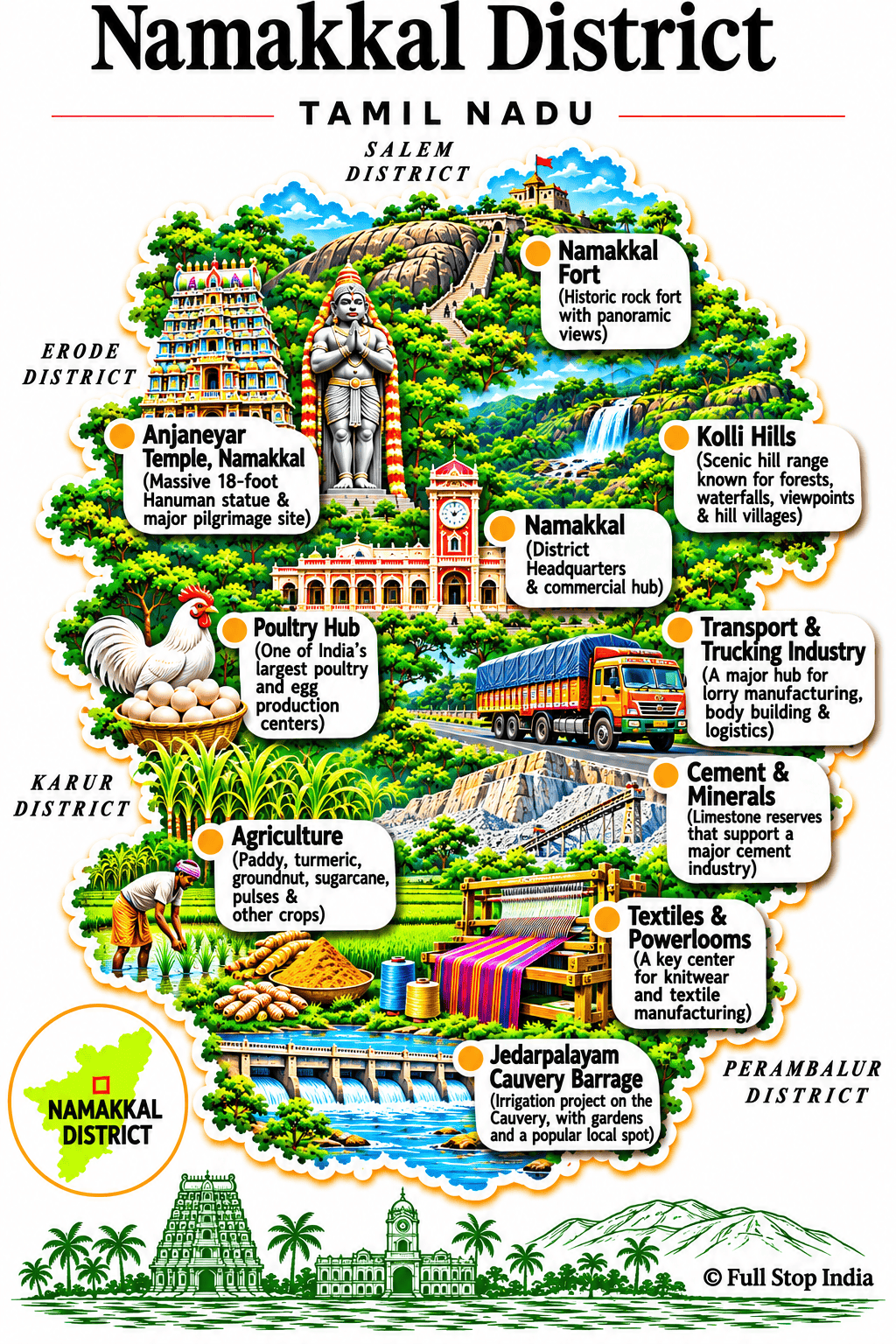
13 / Namakkal District
Eggs, trucks and the Kolli Hills
Namakkal’s rock fort and Hanuman statue are local landmarks, while the winding roads of the Kolli Hills lead to villages and forested slopes far removed from the traffic below.
Poultry and egg production are central to the district’s economy. Lorry transport, vehicle-body building and related businesses are equally distinctive, alongside cement and agriculture. The trucks that travel across India are part of Namakkal’s story.

14 / Karur District
The home-textile workshops of the Cauvery
Karur’s position near the Cauvery and Amaravathi rivers has long supported trade. Pasupatheeswarar Temple and ancient inscriptions around Pugalur offer glimpses of the district’s earlier history.
Today, home textiles are a major export industry: table linen, towels, furnishings and other products are made through networks of mills and workshops. Farming and small manufacturing continue alongside this global business. Karur is an unexpected stop for anyone interested in the things Indian factories make for homes around the world.
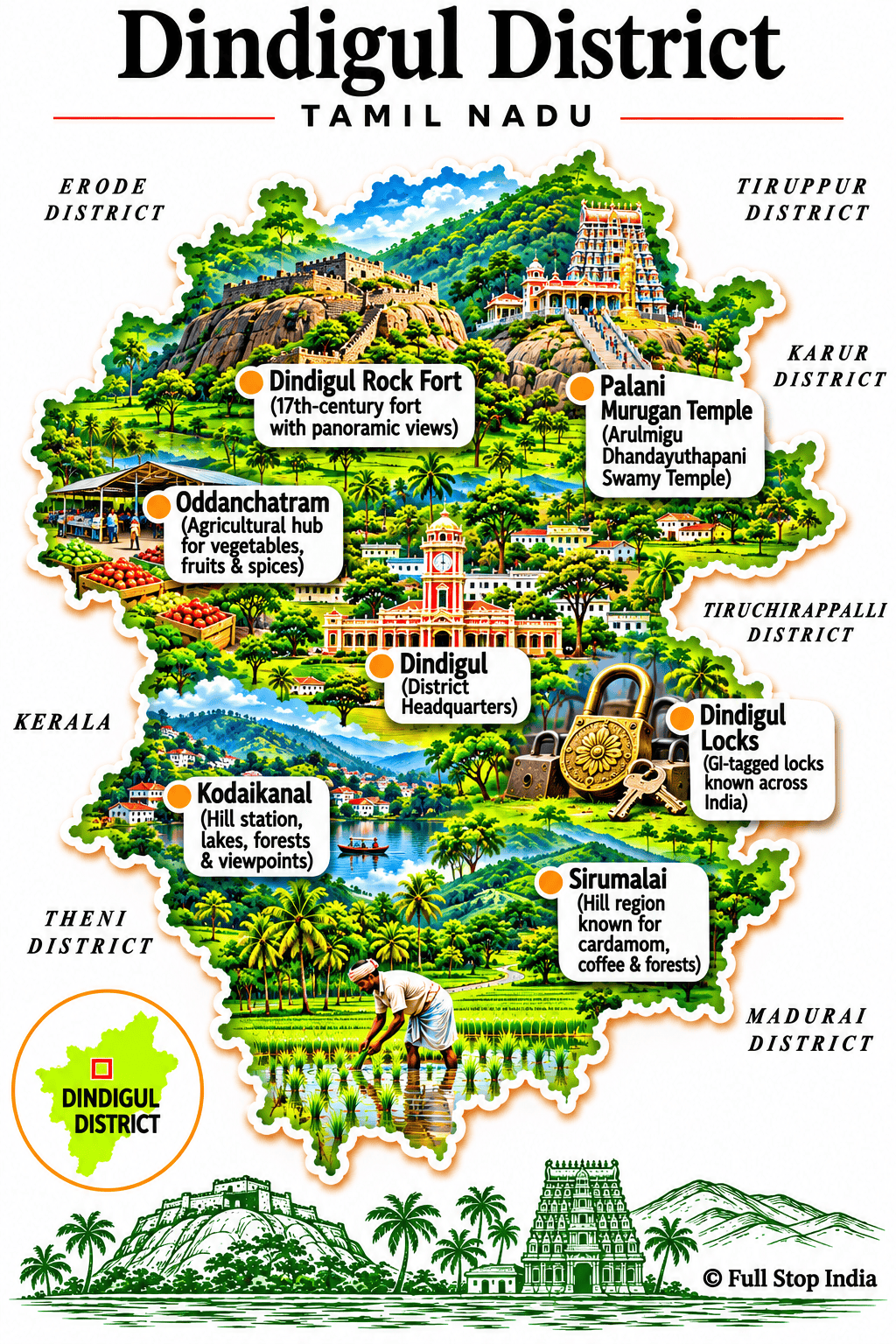
15 / Dindigul District
Locks, biryani and the Palani hills
Dindigul Junction is an important railway interchange, linking routes toward Madurai, Tiruchirappalli, Coimbatore and Palani. It is especially useful for travelers continuing into the Palani Hills.
Dindigul Fort crowns a huge rock above the city. Palani is one of Tamil Nadu’s major Murugan pilgrimage centers, while the district’s western hills include Kodaikanal and its surrounding settlements.
Lock-making is a celebrated local craft, and Dindigul has a biryani tradition that deserves attention. Leather, trade, farming and hill horticulture also support the economy. The district changes dramatically between the busy plains and the cooler uplands.
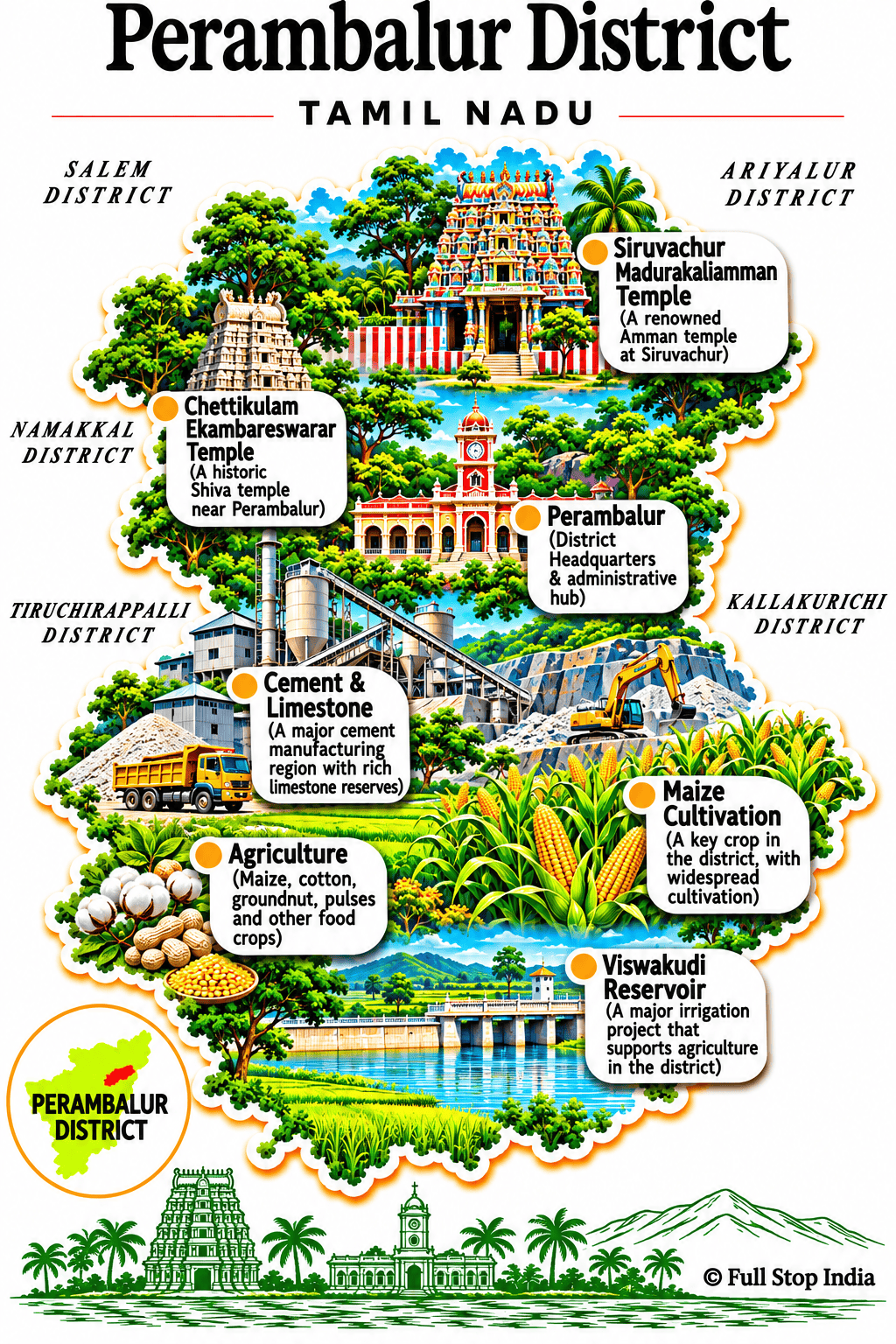
16 / Perambalur District
Cement country on the central plains
Perambalur’s agricultural villages and small towns are easily missed by travelers moving between larger destinations. Siruvachur’s Madhurakaliamman Temple is one of its better-known religious sites.
Limestone supports cement production, while maize, paddy, sugarcane and other crops shape rural livelihoods. Perambalur is a useful reminder that the ordinary commercial and agricultural districts are part of Tamil Nadu’s story, not empty spaces between landmarks.

17 / Ariyalur District
Ancient seas beneath Chola country
Ariyalur is remarkable for its fossil-bearing rocks, evidence that marine environments once covered this part of Tamil Nadu. Gangaikonda Cholapuram, the great Chola temple complex, is the district’s outstanding architectural landmark.
Limestone extraction and cement plants form a major industrial base, alongside farming. In a short journey, the district takes you from prehistoric geology to medieval imperial ambition and modern manufacturing.
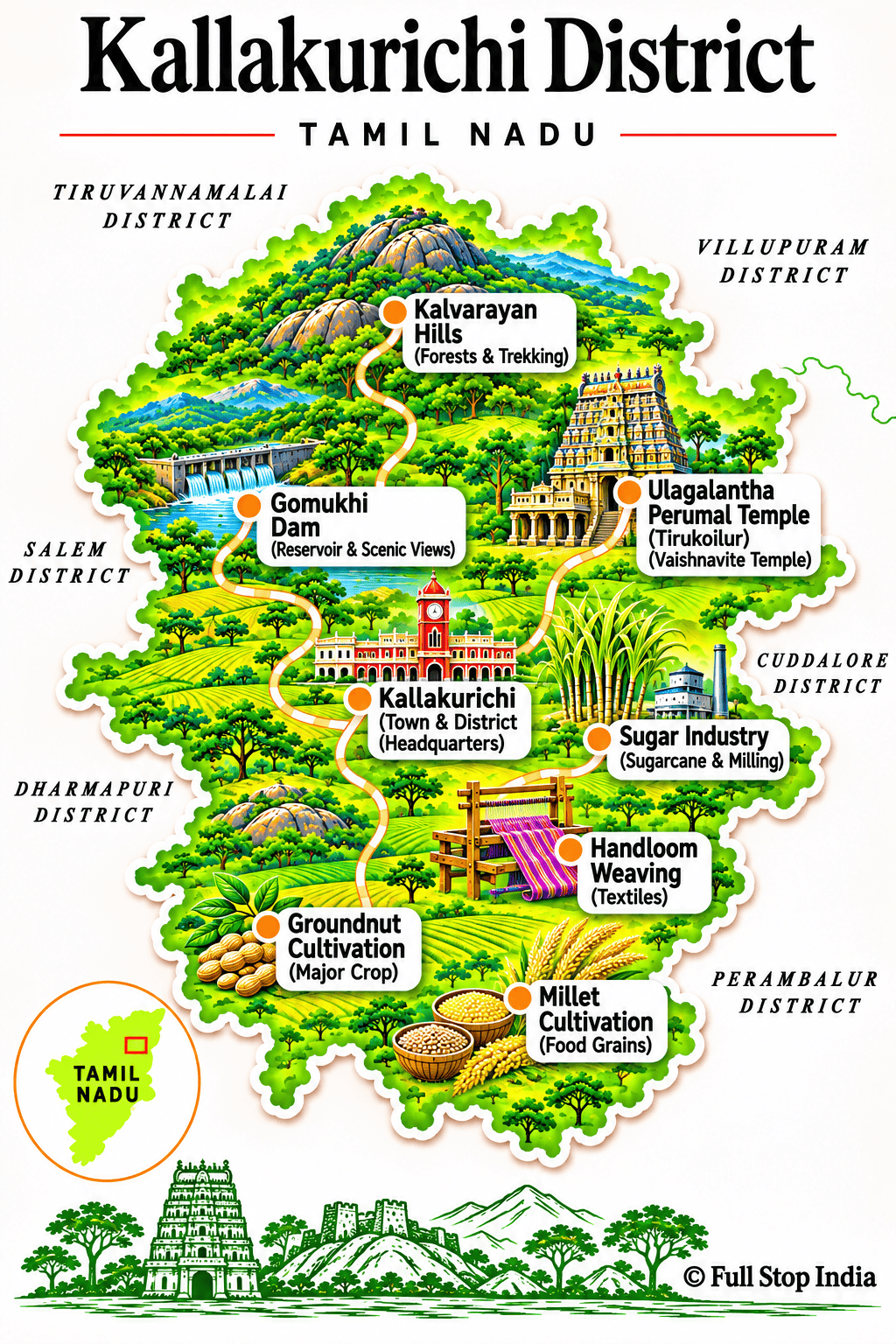
18 / Kallakurichi District
Sugarcane fields and the Kalrayan Hills
Kallakurichi became a separate district in 2019. The Kalrayan Hills rise above the plains, with forest roads and settlements that feel different from the more intensively farmed country below.
Sugarcane, paddy and other crops support farming and agro-processing. Local market towns and temples give the district a quieter rhythm than the industrial centers farther west. Its appeal lies partly in that rural character.
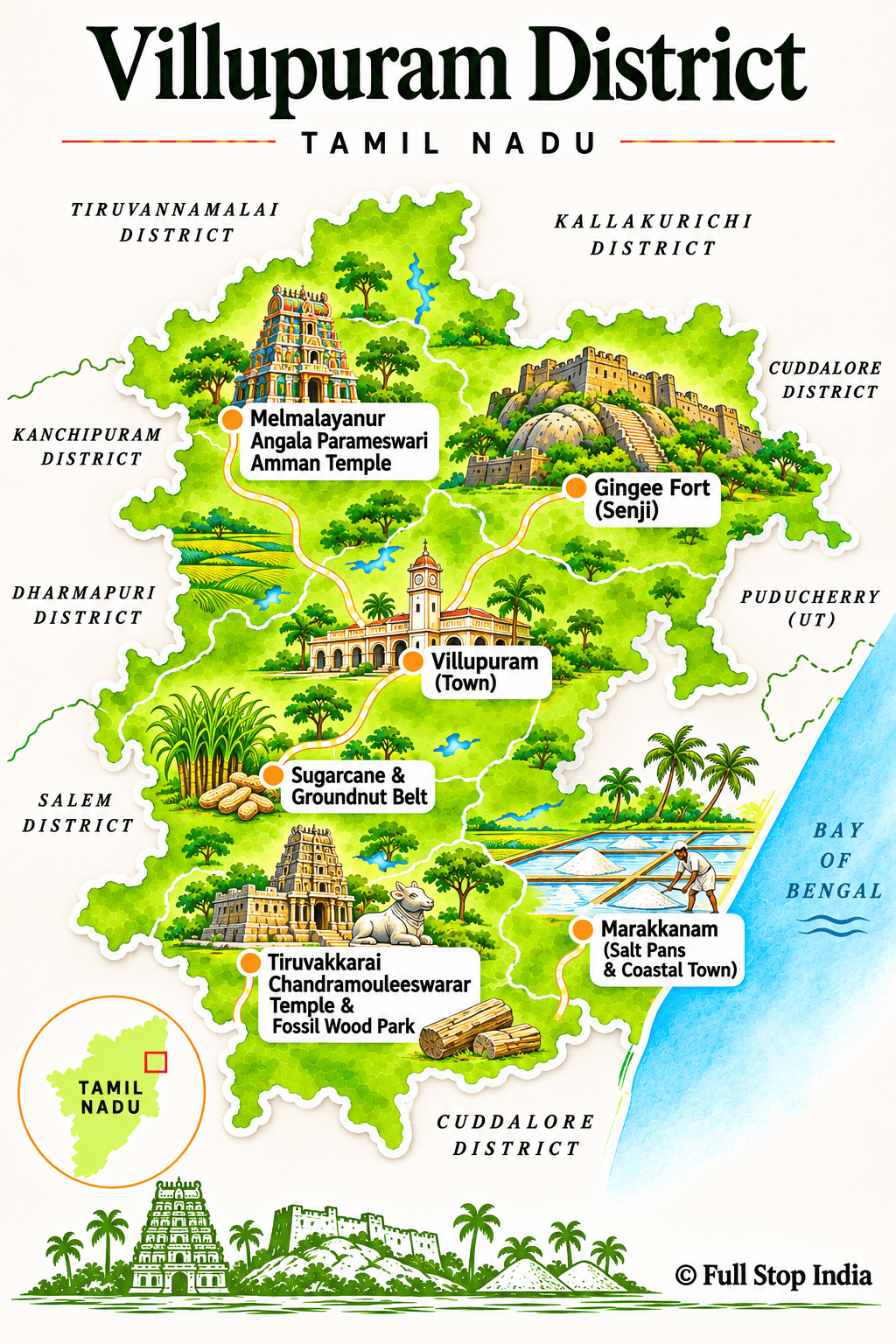
19 / Villupuram District
Gingee’s fortresses above the plains
Villupuram Junction is an important railway interchange, with routes connecting Chennai, Tiruchirappalli and parts of the Cauvery delta. It makes the district a useful connection point even for travelers who do not stop in Villupuram town.
Gingee Fort’s immense hilltop defenses are among Tamil Nadu’s most impressive historic sites. The rock-cut monuments at Mandagapattu offer another architectural chapter, while Villupuram itself is an important transport junction.
Agriculture, rice mills, trade and transport sustain the district. Its landmarks are spread across the countryside, making it better suited to a deliberate excursion than a hurried stop on the way to Puducherry.
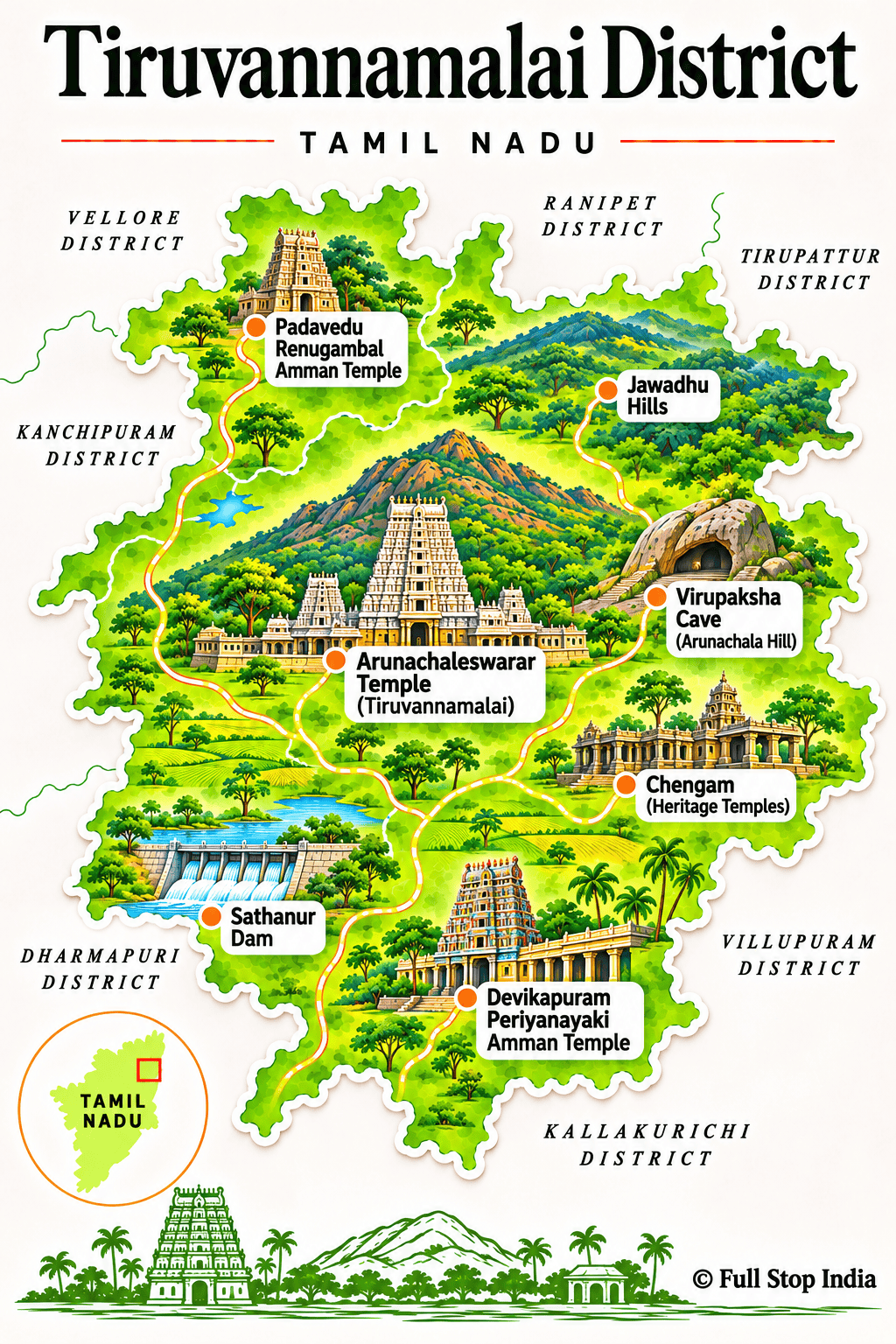
20 / Tiruvannamalai District
The mountain that shapes a pilgrimage town
Arunachala Hill rises directly above Tiruvannamalai, and the vast Annamalaiyar Temple anchors its religious life. The full-moon walk around the hill brings devotees into streets that otherwise serve an ordinary market town.
Pilgrimage supports lodging, shops, food businesses and transport, while farming remains important beyond the town. Jain monuments at Tirumalai and other historic sites show that the district’s heritage extends beyond its most famous shrine.

21 / Kanchipuram District
Silk saris and Pallava stone
Kanchipuram is one of South India’s great temple cities. Kailasanathar and Ekambareswarar temples reveal different chapters of its architectural history, while weaving workshops sustain another centuries-old reputation.
Kanchipuram silk saris depend on skilled artisans and trading networks. The wider district also contains industrial and manufacturing activity linked to metropolitan Chennai. The celebrated temple town and the modern factory belt are parts of the same district.

22 / Chengalpattu District
Pallava monuments on a changing coast
Chengalpattu Junction is an important railway gateway south of Chennai, connecting suburban services with longer-distance routes toward central and southern Tamil Nadu. Chennai International Airport is the principal nearby air gateway.
Mamallapuram’s Shore Temple and rock-cut monuments are among India’s most important early medieval architectural sites. Elsewhere, Chengalpattu’s coastline, lakes and rapidly developing towns offer a different view of the district.
Automobile and electronics manufacturing, logistics, construction and services have expanded as Chennai grows southward. The meeting of ancient stonework and new industrial estates makes this district unusually revealing.

23 / Cuddalore District
Mangroves, ports and Nataraja
Chidambaram’s Nataraja Temple is one of Tamil Nadu’s great sacred complexes. Near the coast, Pichavaram’s mangroves form a watery maze, while Cuddalore’s old port history recalls centuries of maritime competition.
Fishing, farming, chemicals, power generation and manufacturing shape the district. Inland, Neyveli’s lignite and power operations are an enormous part of the regional economy. Cuddalore has much more to it than a coastal stop.

24 / Mayiladuthurai District
Temple towns beside the lower Cauvery
Mayiladuthurai is a district of river-fed fields, market streets and important temples. Vaitheeswaran Koil and the pilgrimage town of Sirkazhi attract devotees, while Poompuhar recalls the ancient maritime history of the Chola coast.
Paddy cultivation, fishing, commerce and small industries support the district. Established in 2020 after separation from Nagapattinam, it brings together places whose cultural connections to the Cauvery delta are far older than the administrative boundary.

25 / Nagapattinam District
A working coast with a long maritime memory
Nagapattinam’s harbors and fishing settlements face the Bay of Bengal. Velankanni is an important Christian pilgrimage center, while coastal temples and markets speak to the district’s varied religious and trading history.
Fishing, seafood commerce, salt-related activity and agriculture support local livelihoods. The coast also bears the memory of the 2004 Indian Ocean tsunami, which profoundly affected communities here. This is a place where the sea is both a source of work and a serious force in everyday life.

26 / Tiruvarur District
The sound of Carnatic music in the delta
Tiruvarur Junction connects several railway routes across the Cauvery delta, including services toward Nagapattinam, Mayiladuthurai and Tiruchirappalli. It is a regional interchange rather than a major long-distance terminal.
Tiruvarur’s Thyagaraja Temple is famous for its grand chariot festival and the great Kamalalayam tank. The town is closely associated with the Carnatic musical trinity, and the wider district includes the major Rajagopalaswamy Temple at Mannargudi.
Paddy fields, irrigation channels and small farming settlements dominate much of the landscape. Handloom weaving and fishing around Muthupet add other livelihoods. Here the cultural history of music and temple ritual is inseparable from the agricultural world of the delta.

27 / Thanjavur District
Chola grandeur and the rice bowl
Thanjavur Junction connects the city to other parts of the Cauvery delta and the wider railway network. Tiruchirappalli International Airport is the nearest major commercial air gateway for many visitors.
Brihadisvara Temple dominates Thanjavur, an extraordinary statement of Chola power and architectural ambition. The palace complex, Sarasvati Mahal Library and the district’s bronze-casting and painting traditions reward time beyond the main temple.
The Cauvery delta supports extensive rice cultivation, while artisans produce classical bronze images, paintings and traditional instruments. Thanjavur is also a center of Carnatic music and Bharatanatyam scholarship. Few districts combine artistic inheritance and agricultural life so closely.

28 / Tiruchirappalli District
Rock Fort above a river city
Tiruchirappalli International Airport provides an important air gateway to central Tamil Nadu, including overseas links to Southeast Asia and the Gulf. Tiruchirappalli Junction is a major interchange for trains across the Cauvery delta and southern Tamil Nadu.
Trichy rises around Rock Fort, with Srirangam’s Ranganathaswamy Temple across the Cauvery and the ancient Kallanai barrage downstream. These landmarks make the district a remarkable concentration of religious and engineering history.
Manufacturing, heavy engineering, education and transport are major parts of its economy. The National Institute of Technology and other institutions bring students from across India. Trichy is both a temple city and a practical industrial and educational center.
29 / Pudukkottai District
Rock-cut shrines and quiet heritage towns
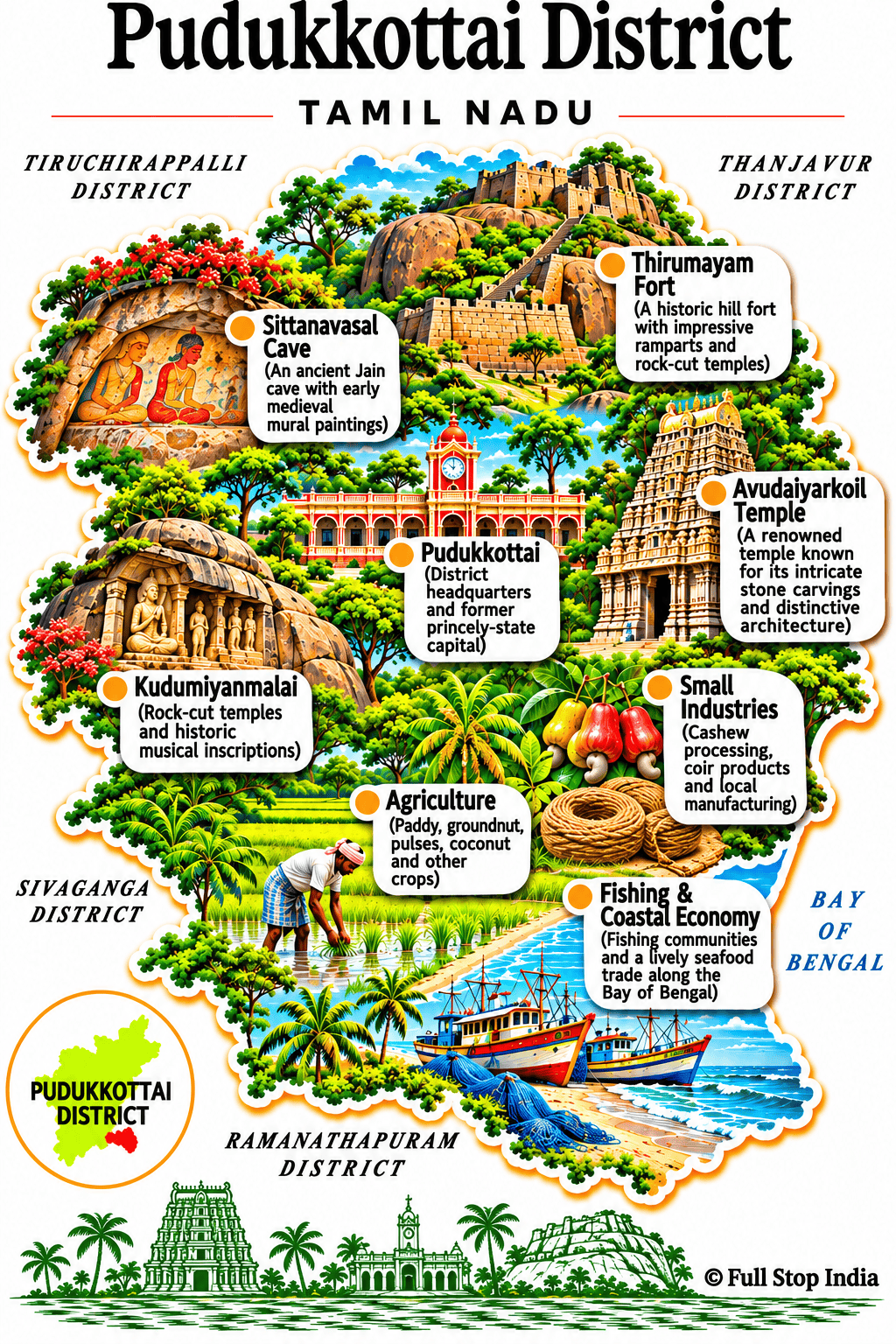
Pudukkottai’s heritage is scattered across villages, forts and temple sites. Sittanavasal’s Jain cave paintings and the rock-cut monuments at Kudumiyanmalai and Thirumayam deserve particular attention.
Agriculture, small industries, trade and local crafts sustain the district. Its former princely-state history gives the town another layer. Pudukkottai rewards travelers who enjoy less-crowded historic sites and don’t need every stop to be famous.
30 / Sivaganga District
Chettinad mansions and merchant history
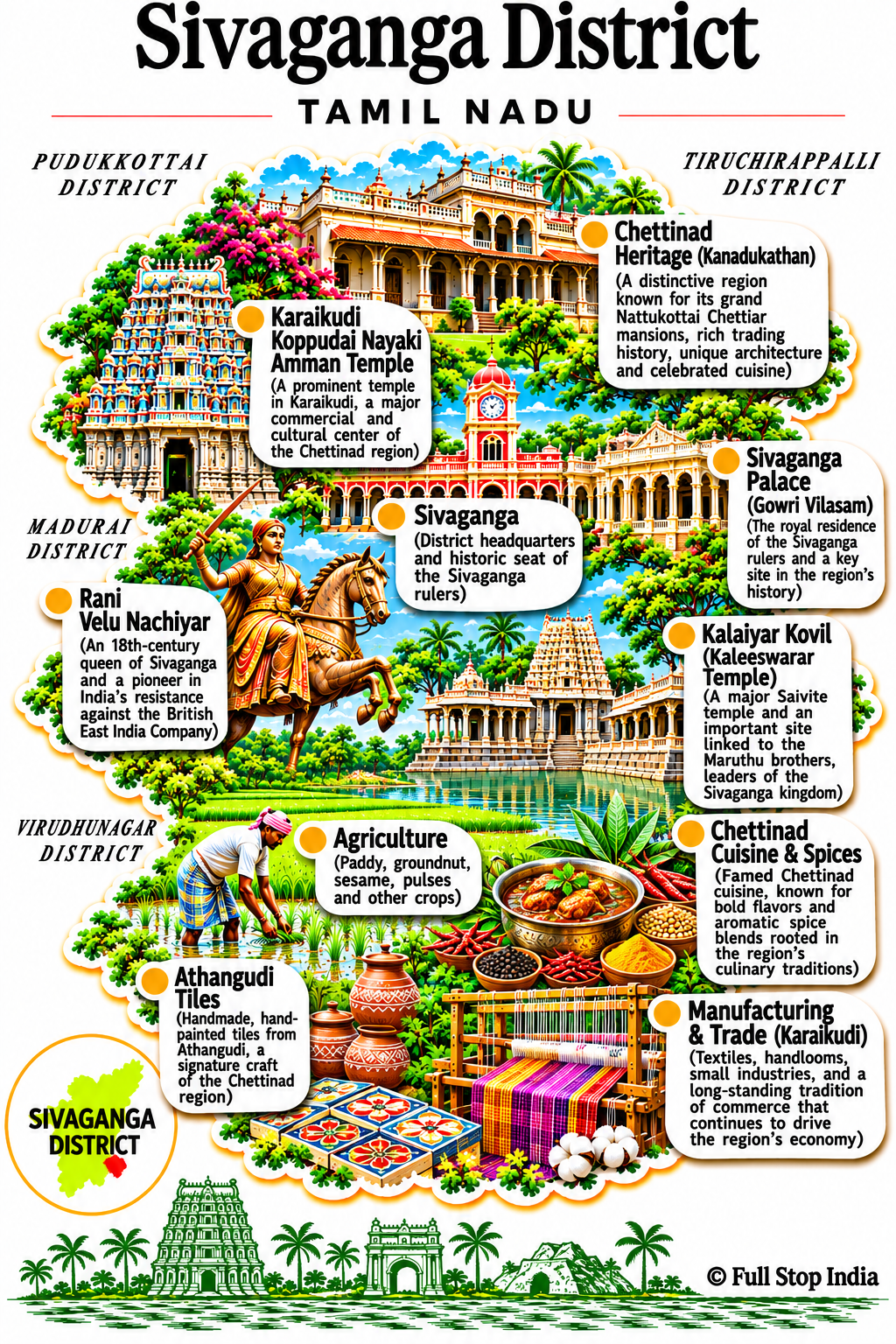
The Chettinad region is known for its imposing merchant houses, distinctive cuisine and carefully crafted interiors. Karaikudi is a useful base, while Kalaiyarkoil and other temples recall the district’s religious and political history.
The Nagarathar trading community built far-reaching commercial networks, leaving an architectural legacy in towns and villages. Agriculture, food businesses, handloom work and Athangudi tile-making continue locally. The story of Rani Velu Nachiyar adds an important chapter of resistance to colonial power.

31 / Madurai District
Jasmine, markets and the Meenakshi temple
Madurai Airport provides an important air entry point to southern Tamil Nadu, while Madurai Junction connects the city by rail with Chennai and destinations farther south.
Meenakshi Amman Temple stands at the center of Madurai, but the city is much more than its monumental towers. Markets, neighborhood shrines, old streets and the Thirumalai Nayakkar Palace make it one of Tamil Nadu’s most absorbing urban destinations.
Jasmine cultivation and flower trading are famous here, alongside textiles, food businesses and a growing service economy. Madurai’s food culture is an attraction in its own right, from jigarthanda to busy evening tiffin shops. This is a city to explore on foot, with time to linger.

32 / Theni District
Plantations beneath the southern Ghats
Theni sits below the Western Ghats, with routes leading toward Megamalai, Suruli Falls and the highland landscapes near the Kerala border. Vaigai Dam and the agricultural valleys are important features of the district.
Grapes, bananas, mangoes and vegetables grow alongside cardamom, coffee and other hill crops. Trading markets connect growers to consumers far beyond the district. The contrast between irrigated orchards and forested mountains gives Theni its character.
33 / Virudhunagar District
Fireworks, printing and a famous sweet
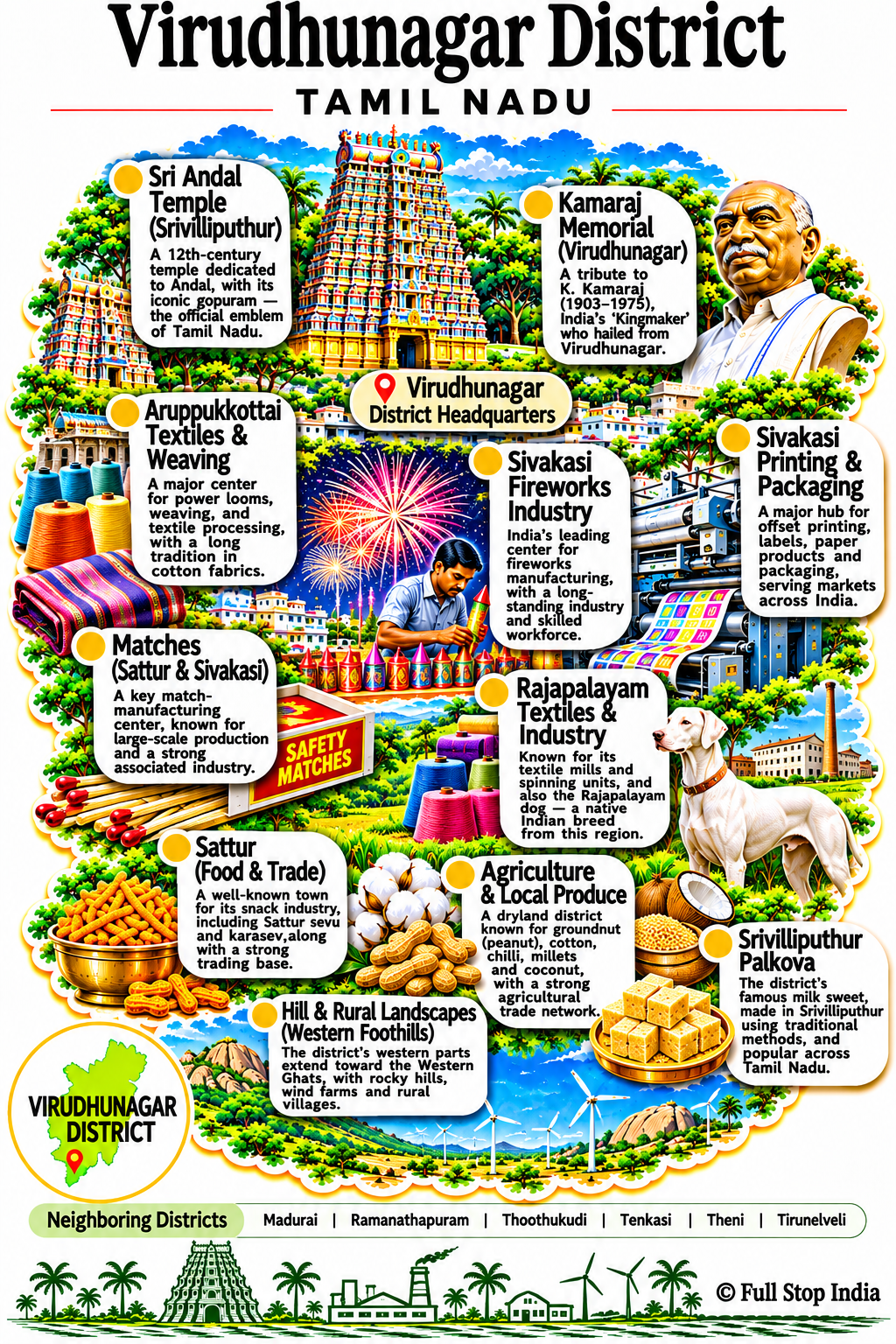
Virudhunagar district contains some of Tamil Nadu’s best-known manufacturing towns. Sivakasi is associated with fireworks, matches and printing; Srivilliputhur is known for its Andal Temple and palkova sweet.
Kamaraj, an influential Tamil Nadu political leader, came from Virudhunagar. Sattur’s savory snacks and the district’s dryland crops add to its identity. Industry brings economic opportunity, but fireworks production also raises serious worker-safety concerns.

34 / Ramanathapuram District
Pilgrimage at the edge of the sea
Rameswaram is one of India’s major pilgrimage destinations, with the Ramanathaswamy Temple and its long corridors drawing visitors from across the country. Pamban Bridge connects the island to the mainland, while Dhanushkodi’s coastal ruins are a striking reminder of the 1964 cyclone.
Fishing, salt production, agriculture and marine trade shape the district. The Gulf of Mannar’s coral reefs, seagrass beds and marine biodiversity make conservation an important local issue. Few places bring together religious travel and coastal ecology so directly.

35 / Thoothukudi District
Port cranes, salt pans and the Gulf of Mannar
Thoothukudi Airport serves the port city and surrounding districts with domestic flights. The city’s railway connections complement its role as a working seaport, although its passenger station is not a major statewide interchange.
Thoothukudi is a working port city, with cargo terminals, shipping and industry defining much of its waterfront. Inland, Panchalankurichi is associated with Veerapandiya Kattabomman; along the coast, Manapad and the Basilica of Our Lady of Snows add other historical layers.
Salt production, fishing, energy, chemicals and logistics are central to the economy. The Gulf of Mannar’s marine habitats are ecologically significant, and pearl fishing belongs to the region’s maritime history. The port is the district’s modern engine.

36 / Tenkasi District
Waterfalls below the southern mountains
Courtallam’s waterfalls draw visitors during the season, while Tenkasi’s Kasi Viswanathar Temple and Sankarankoil’s shrine are important religious landmarks. The Western Ghats form a dramatic green backdrop to much of the district.
Agriculture, small trading towns and hill crops support local life, with plantations in the wetter uplands and fields on the plains. Tenkasi became a separate district in 2019. Its mountain scenery makes it feel quite different from the drier country farther east.
37 / Tirunelveli District
An old city beside the Tamiraparani
Tirunelveli Junction is one of the principal railway stations in the far south, with connections toward Madurai, Chennai, Nagercoil and other destinations. For flights, travelers generally use nearby airports outside the district, particularly Thoothukudi or Madurai.
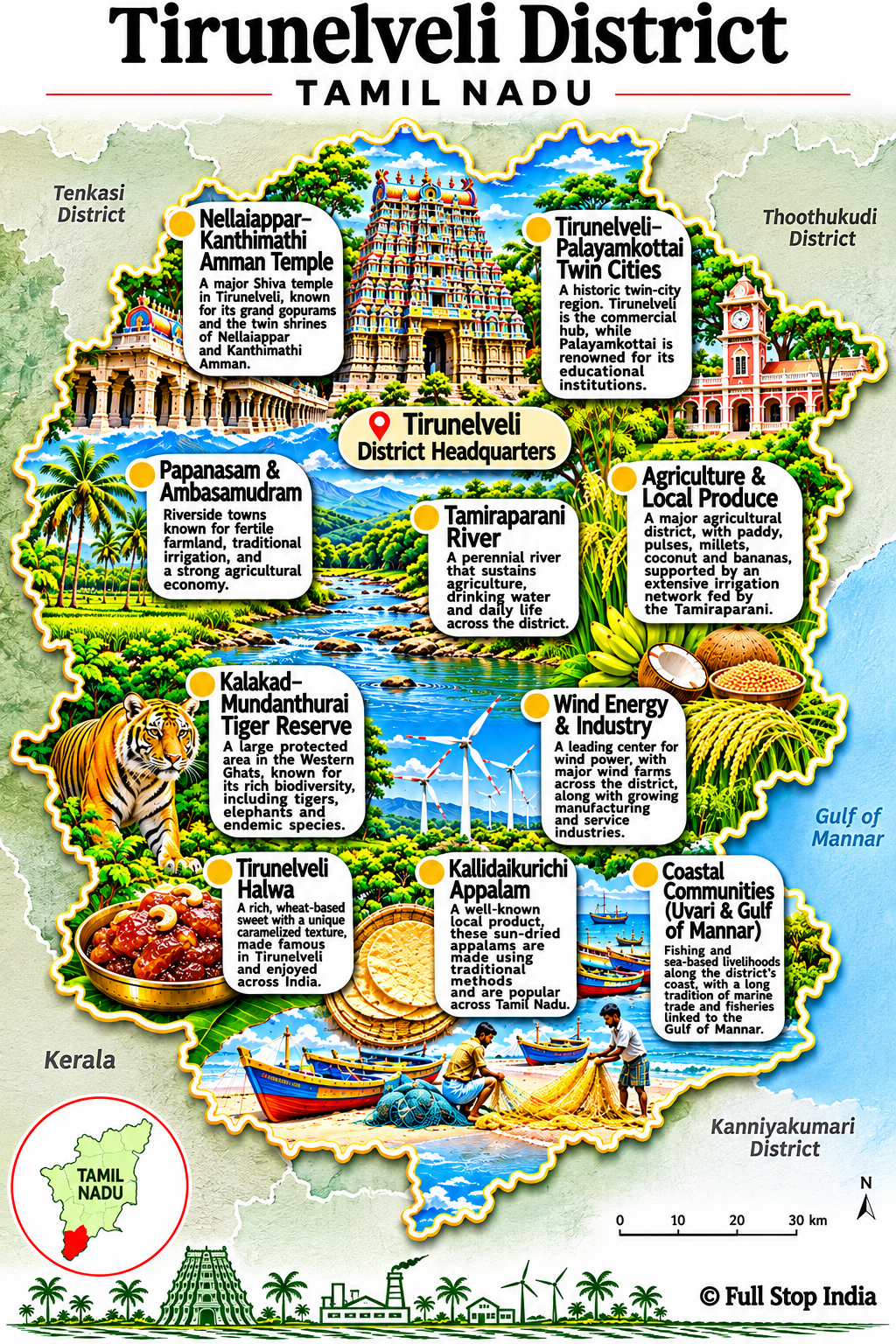
Tirunelveli’s Nellaiappar Temple is a major landmark, and the Tamiraparani River runs through a region with deep agricultural and religious history. The district also reaches toward the Western Ghats and the protected landscapes around Kalakad–Mundanthurai.
Paddy, bananas and other crops depend on river irrigation, while trade, education and small industries support the city. Tirunelveli halwa is famous across Tamil Nadu. The district is an excellent place to see how a river shapes both food and settlement.
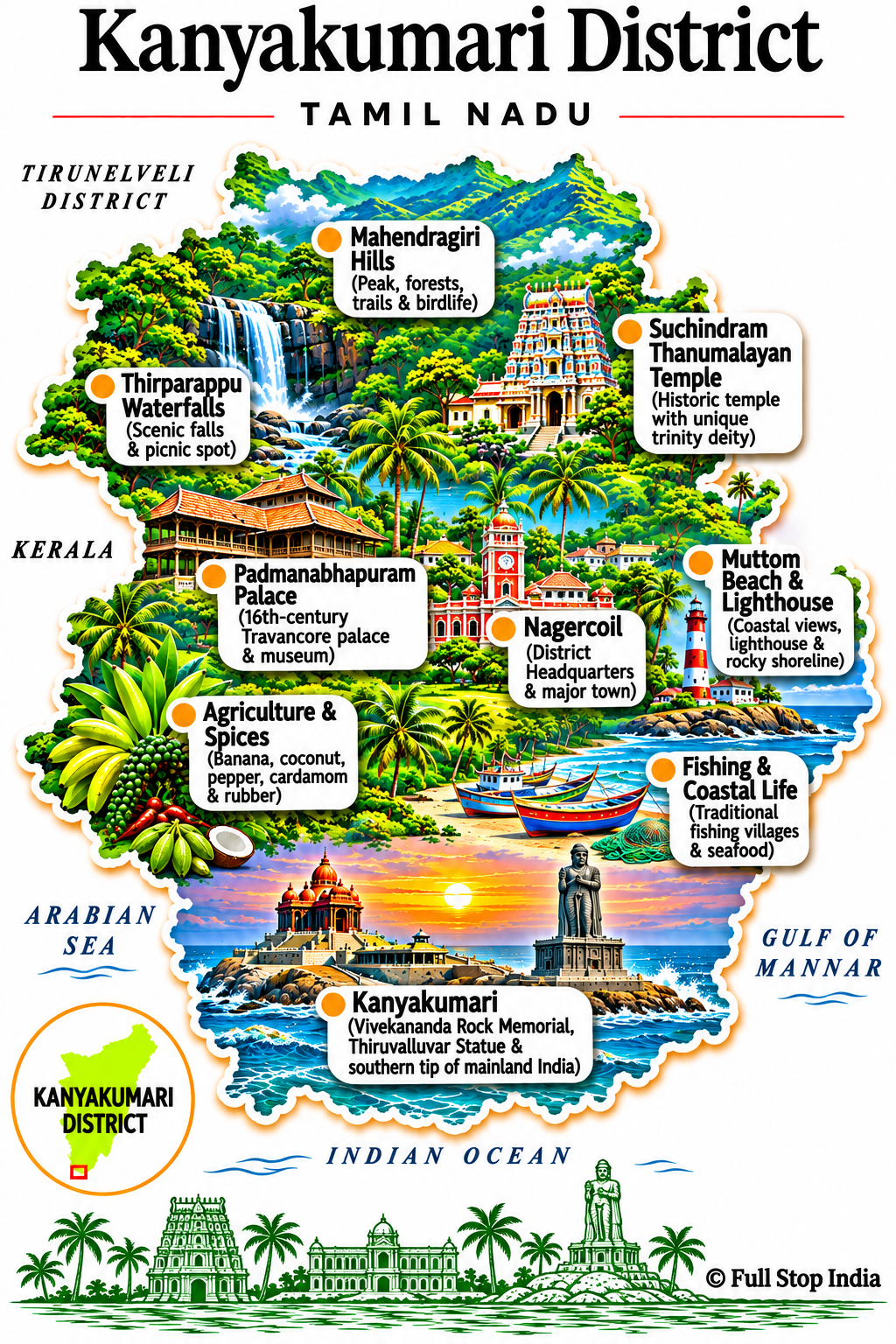
38 / Kanyakumari District
Where three seas meet
Nagercoil Junction is an important rail interchange for travel toward Kerala and the rest of Tamil Nadu, while Kanniyakumari is also a rail terminus. Thiruvananthapuram International Airport, across the Kerala border, is a practical air gateway for much of the district.
At India’s southern tip, Kanyakumari is known for its seafront memorials, sunrise views and the meeting of the Arabian Sea, Bay of Bengal and Indian Ocean. Padmanabhapuram Palace, Suchindram Temple and the hills around the district make it more than a single coastal viewpoint.
Rubber, coconut, fishing and horticulture contribute to the local economy, alongside tourism and education. The district’s close links to Kerala appear in language, architecture and food. It is a fitting southern end to a journey through Tamil Nadu.
Tamil Nadu beyond the map
Food changes across the state. Chennai’s tiffin counters, Ambur biryani, Dindigul’s rice dishes, Madurai’s street food and the seafood of the coast all belong to different local traditions. So do the millet dishes of the interior and the meals served on banana leaves in temple towns and family kitchens.
Festival calendars are just as varied, from Pongal celebrations to temple car festivals and the Chennai music season.
Arriving & getting around
Getting to Tamil Nadu & Getting Around
By air
Choose your region first.
Chennai International Airport (MAA) is Tamil Nadu’s principal international gateway, but it isn’t always the best arrival point. Coimbatore International Airport (CJB) serves the Nilgiris and western Tamil Nadu; Tiruchirappalli International Airport (TRZ) serves the Cauvery delta and central temple towns; and Madurai Airport (IXM) is a natural starting point for the south. Salem Airport (SXV) and Thoothukudi Airport (TCR) provide additional regional options. Choosing the right airport can save considerable road travel.
By train
For the cities in between.
Trains connect Tamil Nadu’s major cities and many of its smaller towns. Chennai Central (MAS) and Chennai Egmore (MS) are major gateways; Coimbatore Junction (CBE), Tiruchirappalli Junction (TPJ) and Madurai Junction (MDU) are important regional hubs. Rail is especially useful when your itinerary crosses the state rather than staying in one region. For hill towns, villages and places away from the main lines, you’ll generally finish the journey by road. Search trains through IRCTC.
By road & bus
Beyond the railway lines.
Buses link district headquarters, smaller towns and places the trains don’t reach. They are part of everyday life across Tamil Nadu, not just a fallback when there isn’t a railway station. For schedules and booking, see Tamil Nadu State Transport Corporation (TNSTC). A car and driver give you more flexibility for scattered temples, rural districts and hill roads. Road distances can be deceptive, particularly once you leave the main highways.
Choosing where to stay
For a first visit, Chennai, Madurai and Thanjavur make strong bases for distinct parts of the state. Coimbatore is practical for the western districts, while Tiruchirappalli offers access to central Tamil Nadu. For the hills, consider Ooty, Coonoor or Kodaikanal; for the southern coast and pilgrimage sites, Rameswaram and Kanyakumari require their own travel time.
Trying to cover all 38 districts on one trip would turn the experience into a procession of check-ins. Choose a region and allow time for the places between the famous stops.
Explore More of India
Local celebrations, cultural events and annual festivals.
The geography between the state and the village.
How India’s states and Union Territories differ.
The currency of Tamil Nadu and all of India.
Tamil Nadu’s language, script, literature, cinema and cultural identity.