
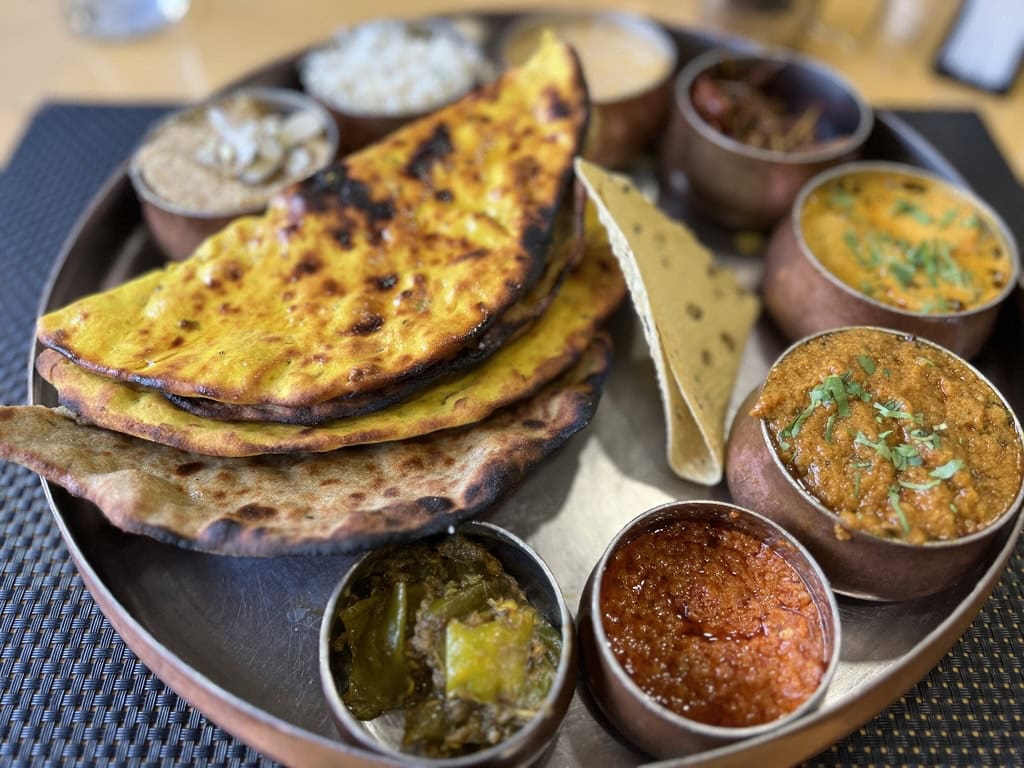
From an elaborate dining room in Delhi to a banana leaf in Kerala, thali is one of my favorite ways to eat in India. Twenty years of traveling the country, and I’ve yet to have a bad one.
My first thali. Bahut fancy.
My introduction to thali was in 2005, at Daniell’s Tavern in the Imperial Hotel in New Delhi. I was on my first trip to India, and I don’t believe I knew exactly what I was ordering.
The Imperial is fancy. Bahut fancy. I was a long way from knowing my way around an Indian menu, but I was certainly enjoying myself.
When my meal arrived, an enormous platter held little bowls of curries, vegetables, rice, and bread. I didn’t know what half of it was, but I’d clearly ordered very well indeed.
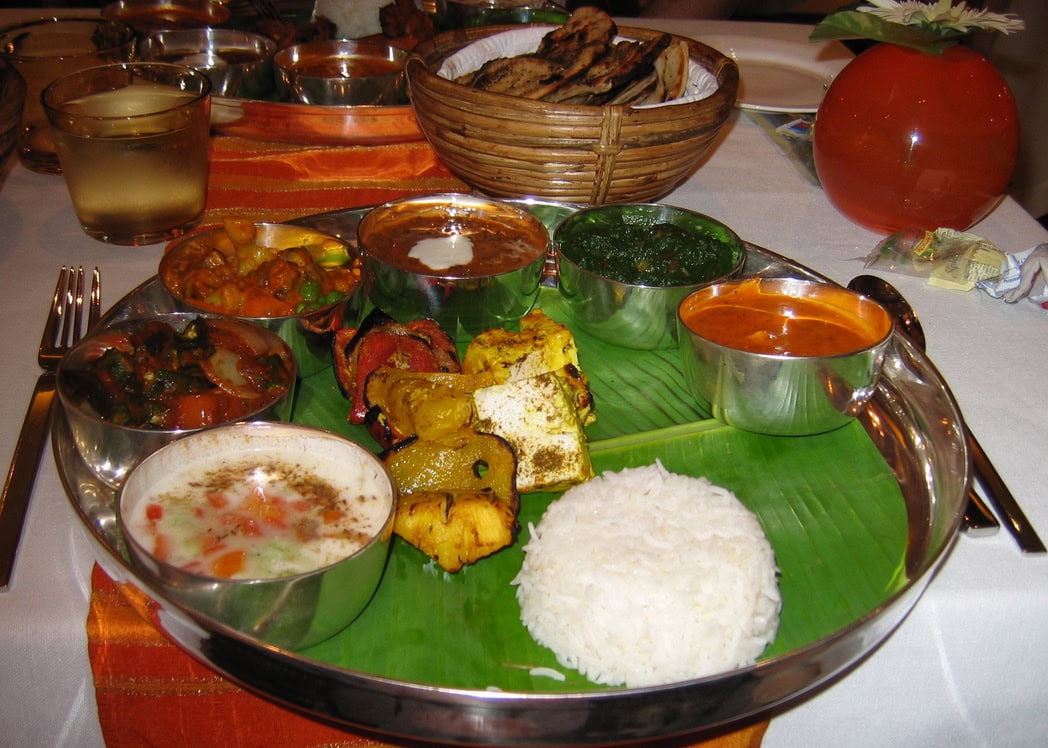
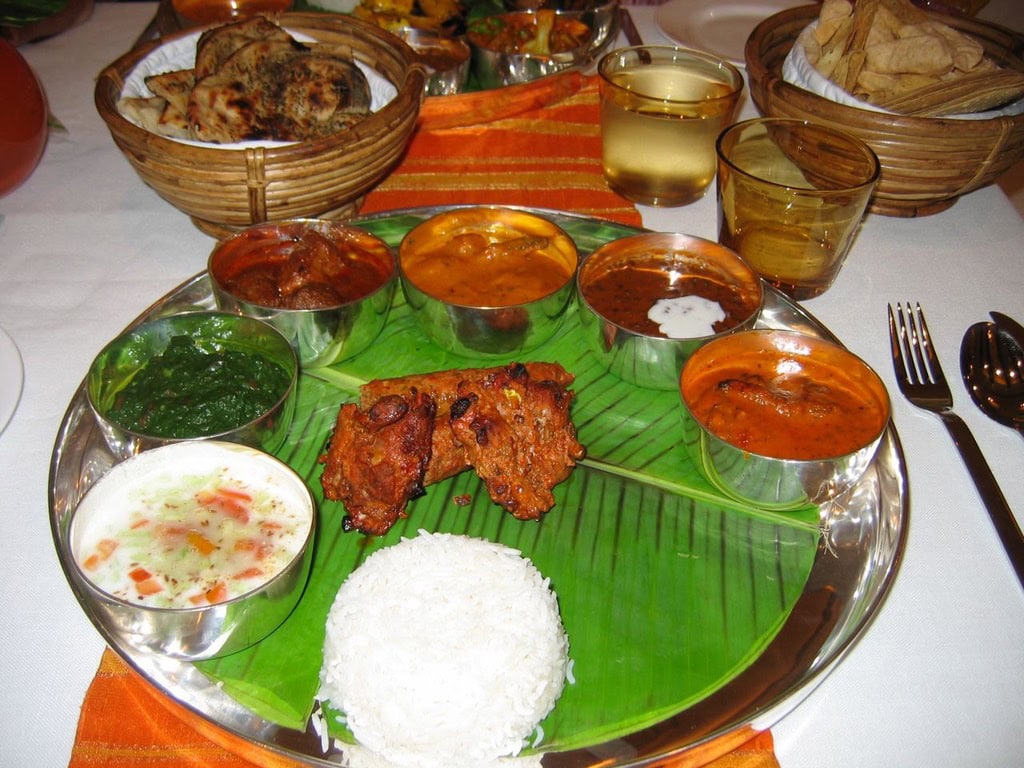
Daniell’s Tavern, The Imperial, New Delhi, 2005. Photos © Full Stop India.
That first meal introduced me to something I’ve actively sought out on my travels ever since. Today, if I know I’m having thali for dinner, there’s a good chance I’ll skip lunch. I’ve learned that lesson.
So, what exactly is a thali?
The Hindi word thali (थाली) means plate or platter. But when you see thali on a restaurant menu, you’re generally ordering a complete meal consisting of several preparations served together.
The easiest way to describe it is a buffet on a plate. Imagine walking through a buffet, selecting a little of everything, and having someone portion it all onto a platter for you. That’s essentially what arrives at your table, except the restaurant has already made the selections.
And much like a buffet, many thali restaurants offer unlimited refills. Others may replenish only certain items, such as breads, rice, or dal. Some serve a fixed meal with no refills at all.
The beauty of it is that you get to sample a variety of dishes without having to order each one separately. And in restaurants offering unlimited service, there’s usually someone nearby making sure your plate never stays empty for long.
There isn’t a national thali recipe, or even a standard number of dishes. What arrives depends largely on where you’re eating. A Gujarati thali might include sweetened dal, kadhi, rotli, vegetables, farsan, and sweets. In Rajasthan, you might encounter dal baati churma and gatte ki sabzi. Head south, and rice takes a more prominent role, accompanied by preparations such as sambar, rasam, and curd.
Even the terminology changes. In Tamil Nadu, you may encounter saapadu, meaning a meal. Kerala’s elaborate vegetarian feast is called sadya. In Himachal Pradesh, dham refers to a traditional ceremonial meal with its own regional customs. These aren’t simply different names for the same dish.
What’s on the plate?
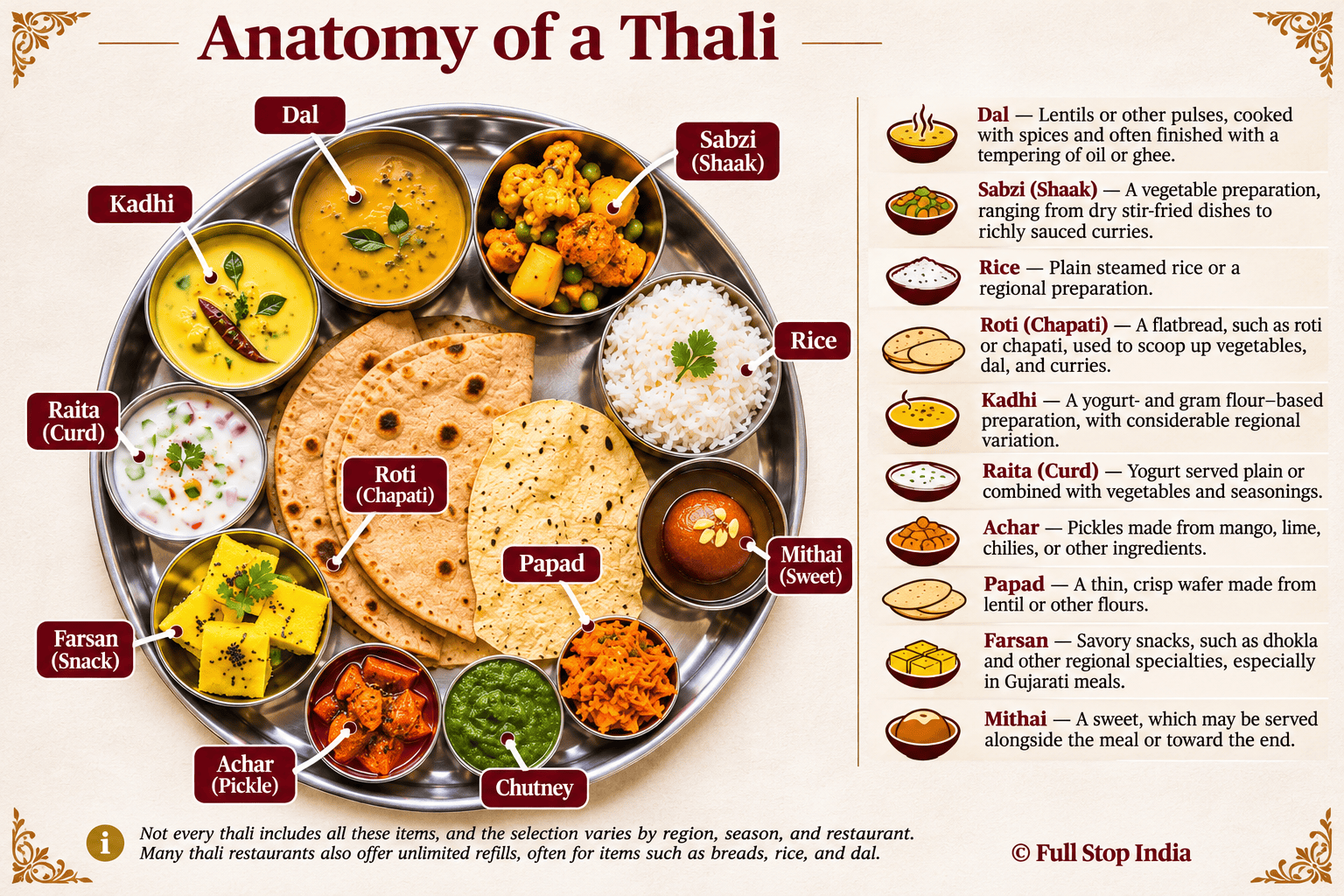
Not every thali includes all the components above. And then there’s the question of how to eat it.
I’m probably not the person to demonstrate the traditional technique. I have a thing about food. At home, in Europe, or in India, I like to start one thing and finish it before moving to the next. So when I’m presented with a thali containing a dozen small bowls, I tend to work my way through them individually.
One bowl, then the next. I’ll dip roti into whatever I’m eating, and happily mix dal, chawal (rice), and roti together. That’s comfort food. Otherwise, I keep things separate.
I still find things on my thali that I can’t identify. Sometimes I’ll ask the server what something is. Other times, I’ll just eat it and see what happens.
And occasionally, I’ll take a bite of something and immediately remember why I didn’t like it the first time.
Ker sangri. I’m looking at you!
Why a thali looks the way it does
I’ve eaten from polished steel plates, little metal bowls, and one Ahmedabad platter so heavy it could probably double as exercise equipment. The plate is part of the experience, not just something to hold dinner.
There’s no tidy invention date for the complete meal we now call a thali. Regional eating traditions developed over centuries; the modern restaurant thali brings some of them into a recognizable format. That doesn’t mean a Harappan meal was a Gujarati restaurant thali with fewer katoris.
Those little bowls? They’re called katoris.
Stainless steel is common in Indian homes and restaurants: sturdy, reusable, and easy to clean. Brass, bronze, and silver have their own histories in Indian dining, varying by community and occasion. In southern India, a banana leaf may take the place of the plate entirely.
A journey through India’s regional thalis
Across India, the plate changes with the landscape: wheat in much of the north, rice in the south and east, coconut along the coasts, and millet in drier regions. But geography is only the beginning.
Gujarat: where the refills never seem to end
If there’s a state that has perfected the theater of restaurant thali service, Gujarat makes a convincing case.
A traditional Gujarati thali is usually vegetarian, with several preparations arriving together. Expect rotli, the thin wheat flatbread eaten throughout the state; dal, which may have a noticeable sweetness; kadhi; rice; vegetables known as shaak; pickles; chutneys; and farsan, a broad category of savory preparations that can include dhokla and other steamed or fried snacks. Sweets are frequently part of the meal rather than something ordered separately at the end.
The balance of sweet, sour, salty, and spicy flavors is one of the characteristics of Gujarati cooking, although there are substantial differences between the state’s regions. Kathiawadi food, associated with Saurashtra, is often more assertively spiced and makes extensive use of garlic, chilies, bajra, and other ingredients suited to the region.
In 2024, I spent time in Ahmedabad with my Hindi tutor, Manjit. He’s a whiz with Google Maps. He’ll scour a destination, examine the options, and put together a plan. Between the two of us, we found two thali restaurants that couldn’t have offered more different experiences.
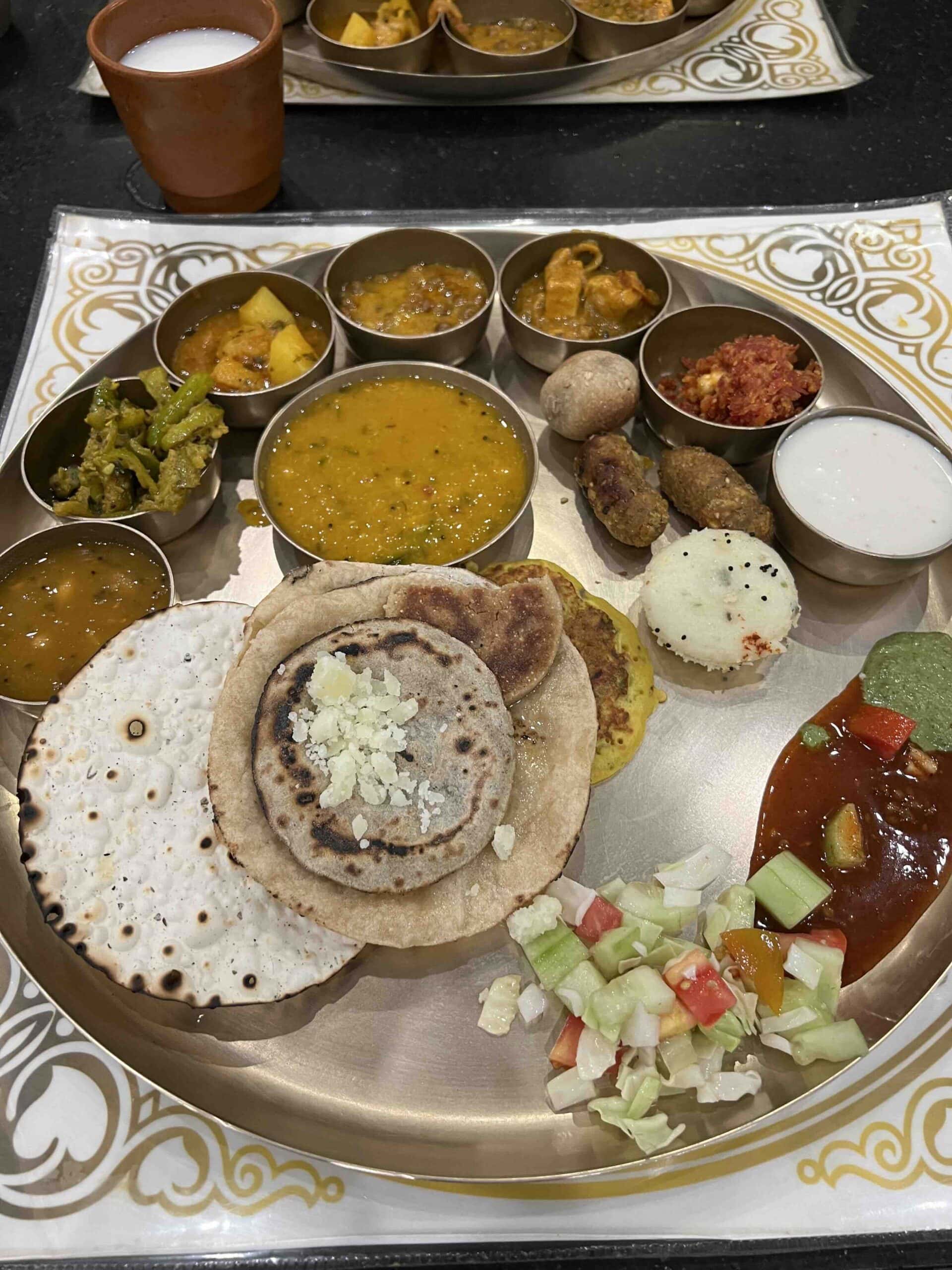
The first was Gordhan Thal, a brightly lit dining room absolutely packed with people. It was a turn-and-burn operation, but not in the unpleasant sense. Nobody rushed us. The service was simply so extraordinarily efficient that there was little reason to dawdle after eating.
Men moved continuously through the room carrying metal vessels of food. A bowl would begin to empty, and someone appeared to refill it. Bread, dal, vegetables, sweets. It just kept coming. You had to turn your bowls upside down and physically cover your plate to stop them.
I love this kind of service. It reminds me of watching a busy espresso bar, with all the hissing, steaming, and organized movement. There’s a certain pleasure in watching people who are exceptionally good at what they do.
The second Ahmedabad restaurant, Rajwadu, was an entirely different affair. It felt much more intimate. We ate outdoors beneath trees strung with lights, tucked into our own little dining area. Musicians played nearby, and there was a puppet show in the main courtyard. It was as much an evening out as a meal.
The thali platters were enormous, the heaviest and largest I’ve encountered anywhere in India. The first portions looked almost ridiculously small against all that metal, but the servers kept returning with more until we couldn’t eat another bite.
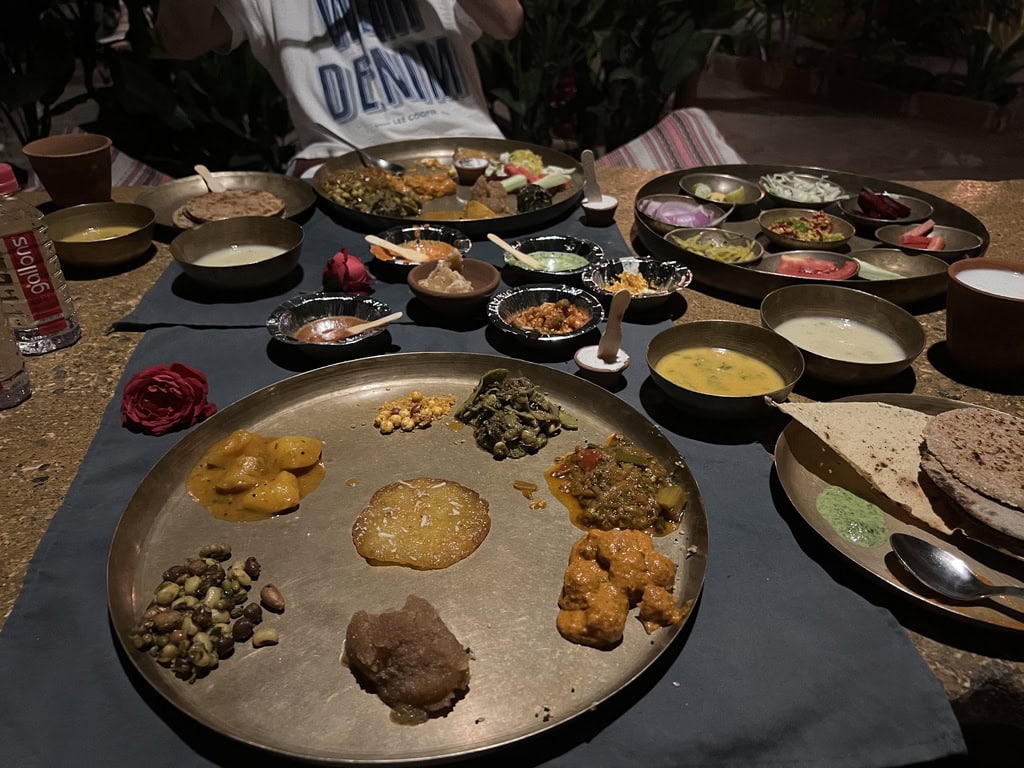
The first restaurant was somewhere to bring family or friends, eat extremely well, and move on with your day. The second was a place to spend an entire evening with your partner or good friends. Both were wonderful.
Rajasthan: a meal shaped by the desert
Rajasthan’s cooking reflects its geography. Much of western Rajasthan is covered by the Thar Desert, so traditional cooking makes extensive use of ingredients that can be stored, dried, or grown with relatively little water. Bajra, or pearl millet, is particularly important in many rural areas. Gram flour appears in dishes such as gatte ki sabzi, made from cooked gram-flour dumplings served in a spiced gravy.
Then there’s dal baati churma, perhaps the state’s best-known traditional combination. Baati are firm balls of wheat dough, baked and often served with generous amounts of ghee. They’re eaten with dal, while churma provides a sweet contrast.
And then there’s ker sangri, the dish I mentioned earlier. Ker is a small desert berry, while sangri is the pod of the khejri tree. They’re traditionally dried and later prepared with spices and other seasonings. The result can be tangy, earthy, and quite distinctive.
I’ve given ker sangri several chances over the years. Still don’t like it. Rajasthan has plenty of other things I’d happily eat twice.
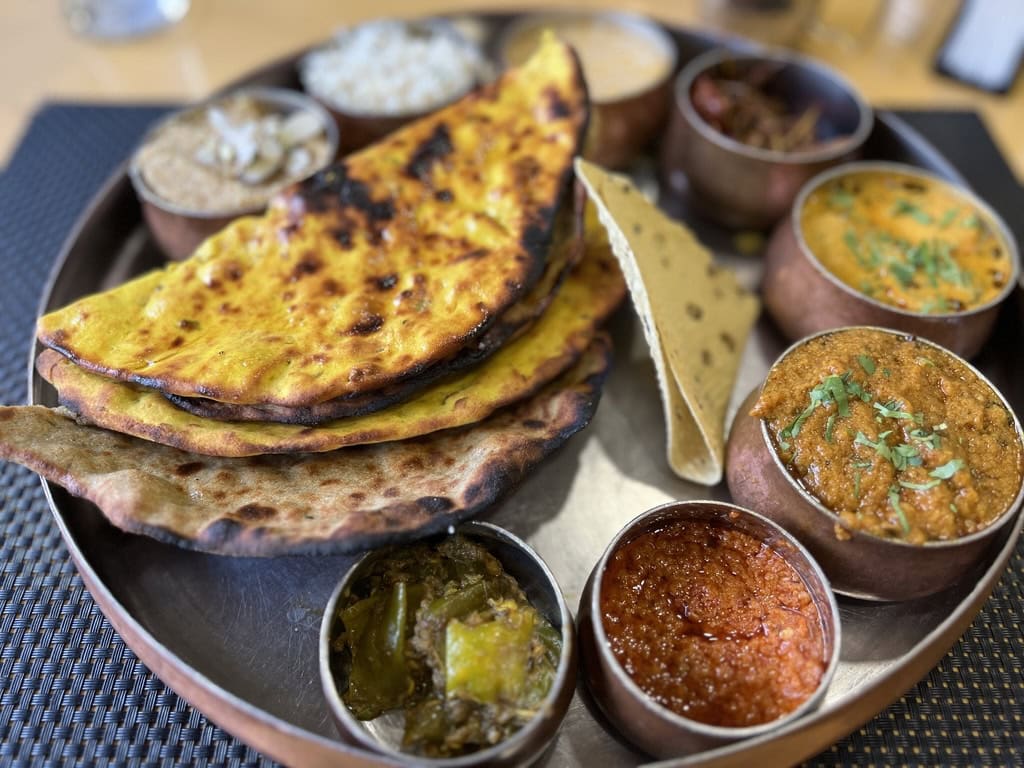
Fortunately, there’s plenty more to enjoy in a Rajasthani thali. In Jaipur, Google Maps led me to Thali and More, in a rather posh neighborhood. I was initially skeptical of the name, but the reviews were excellent, and the meal turned out to be wonderful.
The theater of thali service
One of the things I love most about thali restaurants is watching the service. Servers circulate with dal, vegetables, rice, breads, and sweets. In some places, each seems responsible for a particular dish. The initial serving is merely the beginning.
A server notices that your dal is running low and appears beside you. Another arrives with fresh roti. Someone else is offering more vegetables before you’ve finished the previous serving. It’s a performance.
I struggle to finish the initial portions, let alone accept refills. But those servers are sneaky. Look away for a moment, and another piece of bread has appeared. A little more dal. Perhaps another sweet.
Punjab and Delhi: wheat, dairy, and generous portions
Punjab is one of India’s major agricultural regions, and its cooking reflects the importance of wheat, dairy, pulses, and seasonal vegetables. A Punjabi-style thali may include roti, paratha, or naan, along with dal, chole, paneer preparations, seasonal vegetables, rice, yogurt, and pickles.
But don’t confuse a restaurant’s elaborate Punjabi thali with what every Punjabi family eats at home. Everyday meals are often considerably simpler, with a bread, a vegetable preparation, dal, and perhaps curd or another accompaniment.
Delhi adds another layer to the picture. Its food has been shaped by migration from Punjab and elsewhere, Mughal culinary influences, and the traditions of the many communities that call the capital home.
One of my regular Delhi favorites is Veg Gulati. I’d eaten there on an earlier trip and remembered that they offered thali. So when I returned to Delhi another year, I went straight back. It didn’t disappoint.
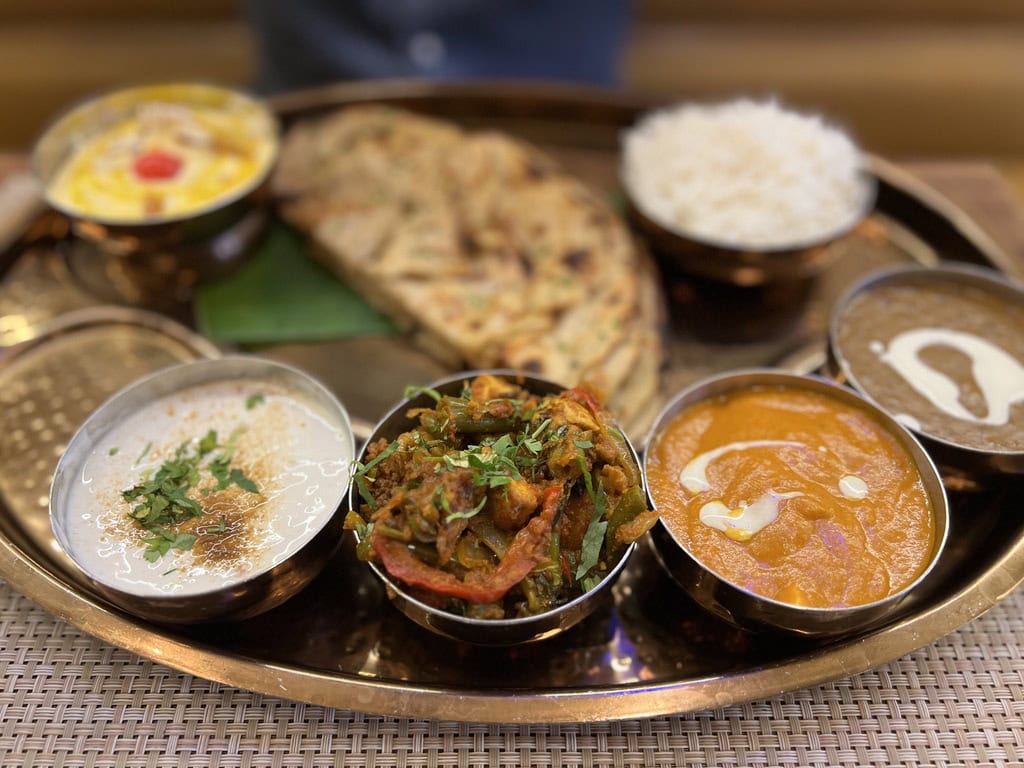
Give me a good vegetarian thali and I’m happy. I eat very little meat when I’m in India anyway. Eggs, yes. But with this much good dal, bread, rice, and vegetables on offer, I rarely miss it.
Himachal Pradesh: from thali to dham
In Himachal Pradesh, traditional food changes considerably as you move between valleys, districts, and communities. One particularly important tradition is dham, a ceremonial meal commonly associated with weddings, festivals, and religious occasions.
Dham varies by district. In parts of Kangra, for example, the meal may feature rice with preparations such as madra, made with legumes and yogurt, along with other regional dishes. Specialist cooks known as botis traditionally prepare dham for large gatherings.
It isn’t simply an everyday restaurant thali served under another name. The cooking, serving customs, and ceremonial setting are integral to the tradition.
The cooks who make dham happen
One detail I find especially interesting is the boti, the specialist cook traditionally entrusted with preparing Himachali dham. These aren’t simply people who know a good dal recipe. They’re responsible for a sequence of dishes, enormous quantities, and a meal that has to arrive properly for a whole gathering. The knowledge has often been passed from experienced cooks to the next generation by working alongside them.
Think about the logistics. Wedding guests don’t arrive one at a time, ordering off a menu. They sit in groups, and food is ladled out from large vessels. The timing matters as much as the seasoning. That’s a different sort of culinary skill from plating one restaurant entrée.
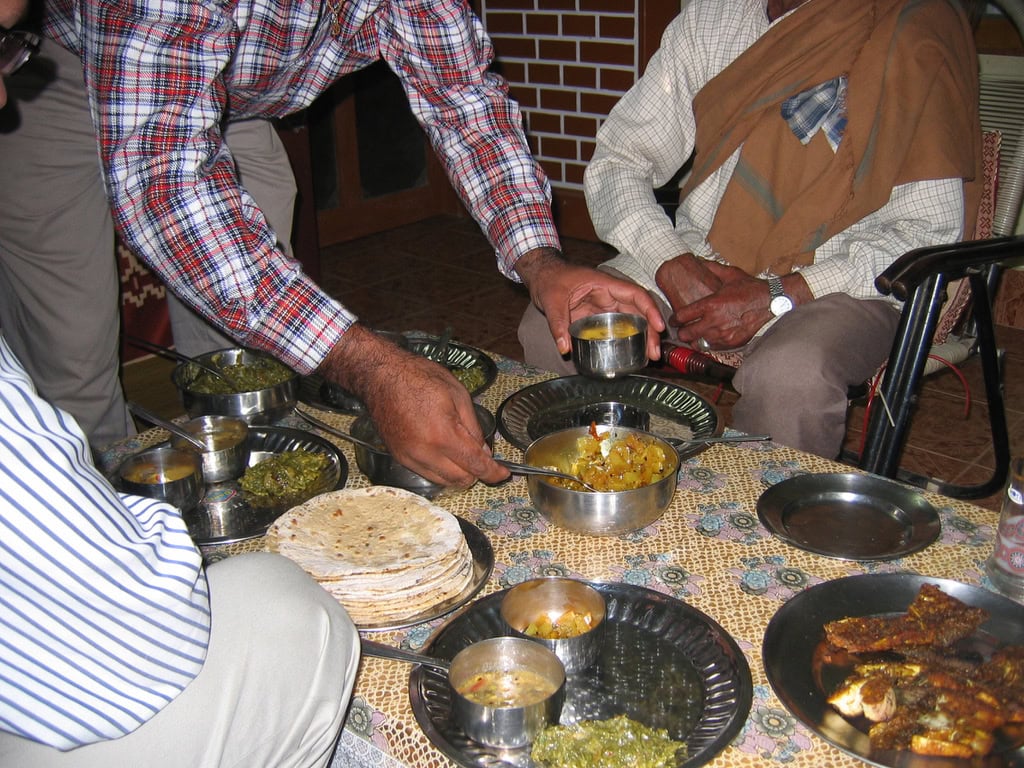
I’ve spent time in villages around Rangas in Himachal Pradesh, and some of my favorite food memories are of ordinary evening meals in people’s homes. In 2006, I ate at a friend’s friend’s mother’s home in a village. No occasion. No elaborate presentation. Just dinner.
That same year, I remember eating at a friend’s home in Delhi, sitting on his bed with newspapers spread across it to protect the sheets. It was a practical arrangement. We had food, we needed somewhere to sit, and nobody wanted dinner all over the bedding.
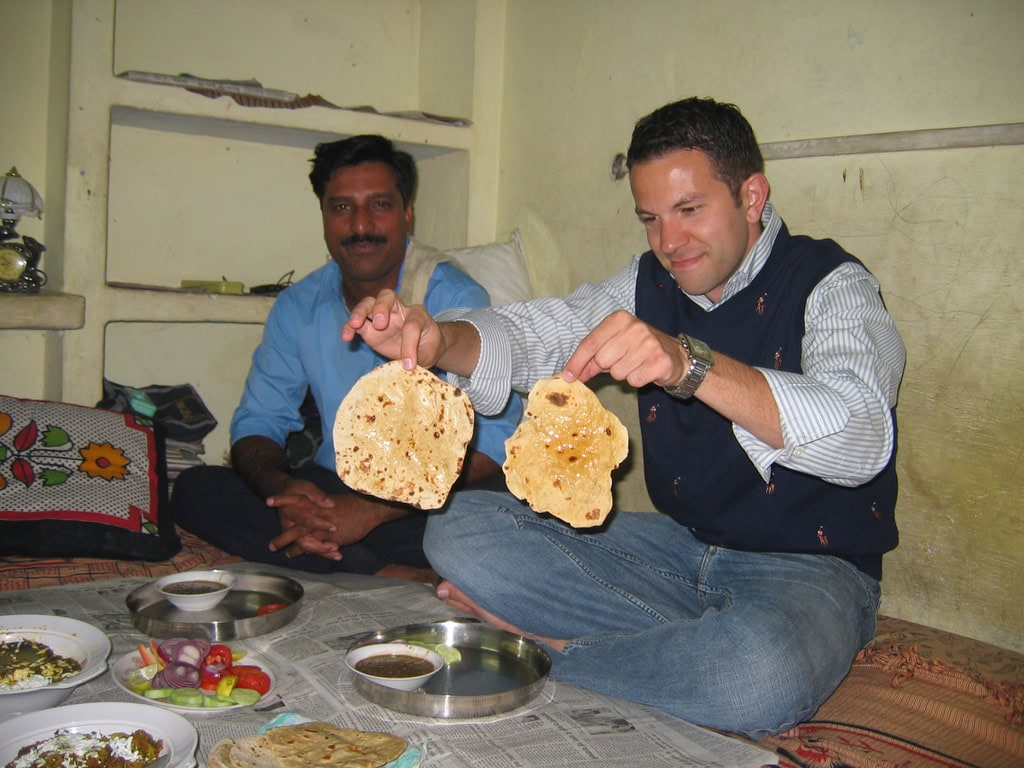
These meals weren’t necessarily formal thalis, and I wouldn’t describe them as such. But they illustrate something important about Indian dining: the familiar combination of breads, vegetables, dal, rice, and shared preparations isn’t confined to restaurants.
Maharashtra: and a restaurant I’d forgotten I’d visited
Maharashtra’s regional food traditions are remarkably diverse. In many Maharashtrian meals, you’ll find rice with varan, a relatively simple dal preparation, or amti, a more seasoned lentil dish. Vegetables, chutneys, pickles, and breads may accompany them.
Bhakri, a flatbread made from grains such as jowar or bajra, is particularly important in parts of the state. Coastal cooking incorporates rice, coconut, and seafood, while inland traditions make greater use of millets, legumes, and other crops.
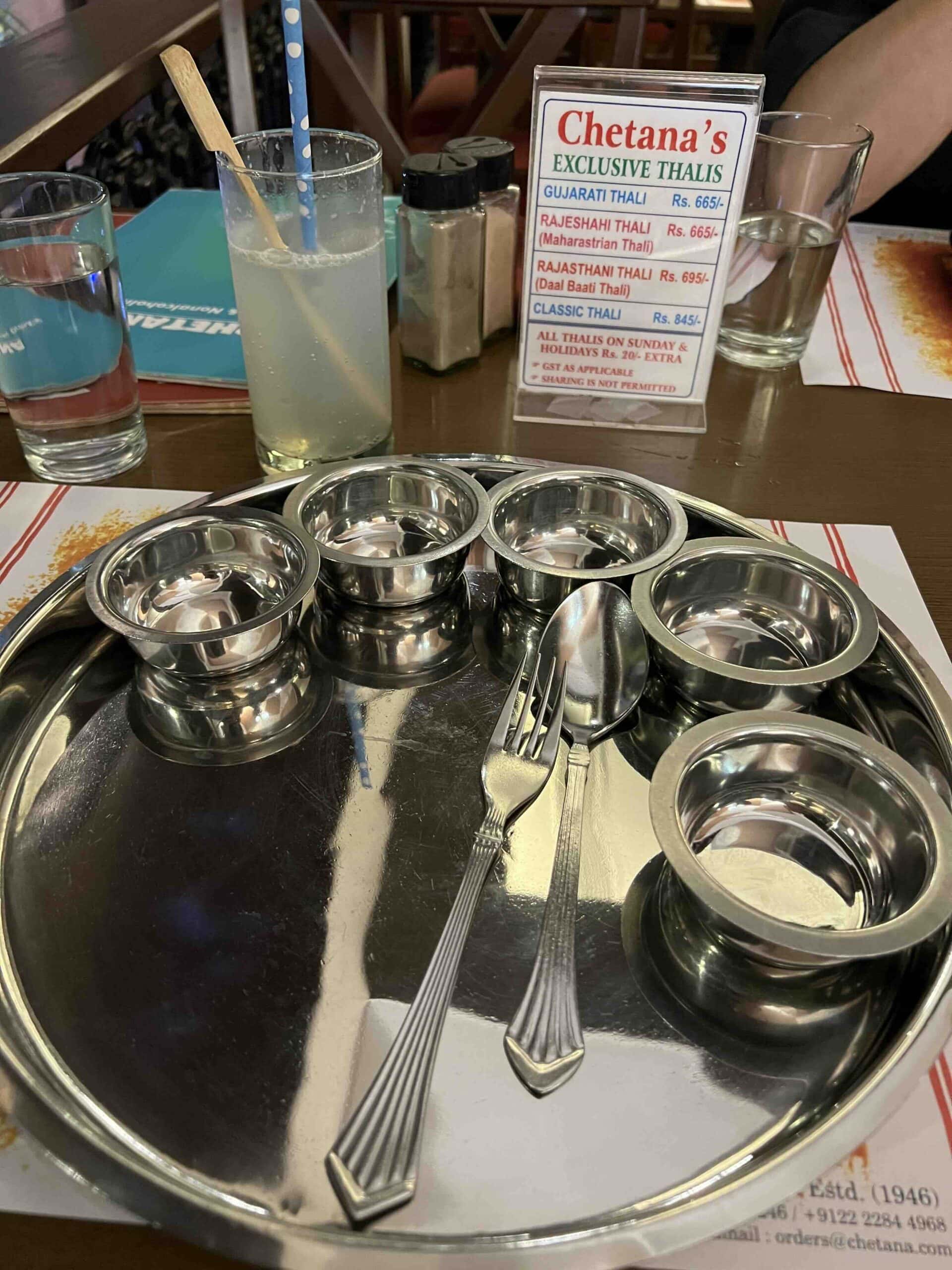
In Mumbai in 2025, I found Chetana on Google Maps. Good reviews, good photographs, exactly the sort of place I look for. So I went. Excellent thali.
Just a few days ago, while looking through photographs from my 2012 trip to Mumbai, I discovered something rather funny. I’d eaten at Chetana thirteen years earlier. I had absolutely no recollection of it when I returned in 2025.
Thirteen years apart, and I managed to discover the same restaurant twice. At least I have good taste.
Goa: more than fish curry and rice
Goan food is frequently reduced to a few familiar dishes, particularly fish curry, vindaloo, and xacuti. But the state’s food traditions are far broader, reflecting coastal agriculture, fishing, local Hindu traditions, and centuries of Portuguese influence.
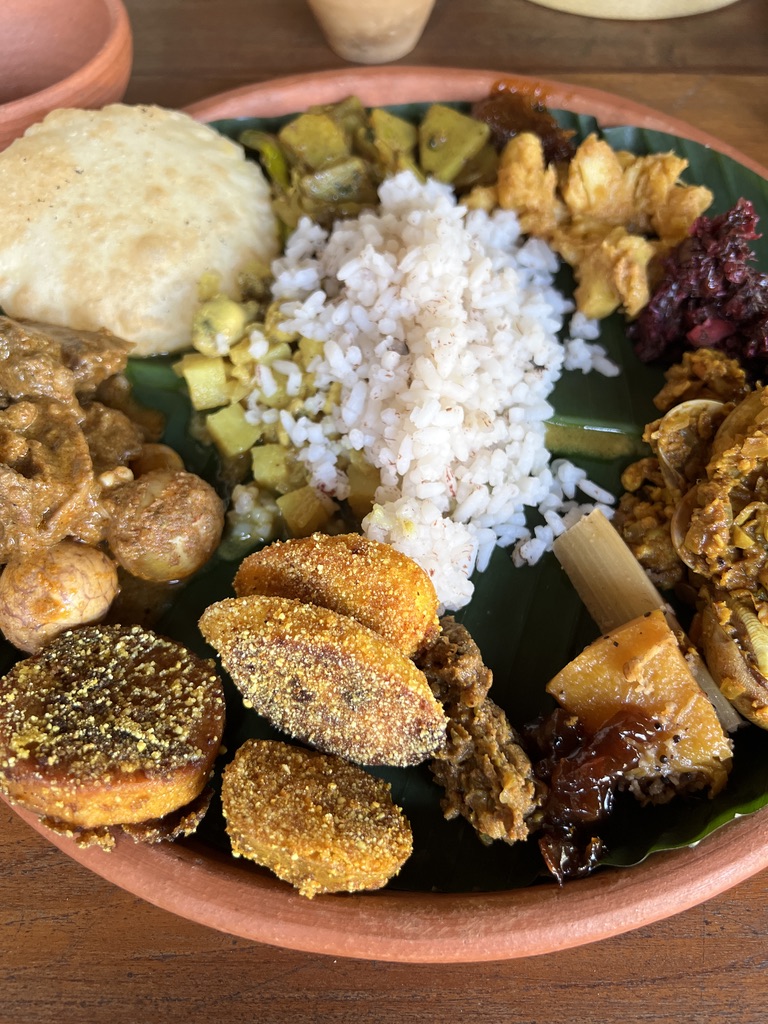
A Goan thali often centers on rice, accompanied by fish curry, vegetable preparations, pickles, and, in nonvegetarian versions, fried fish or other seafood. Coconut, kokum, chilies, and regional spice blends are important ingredients.
When the thali became the restaurant
A complete regional meal is one thing. Building a restaurant around it is another. Rajdhani began in Mumbai in 1985 and became a familiar name for Gujarati and Rajasthani vegetarian thalis. Maharaja Bhog, established in 2012, built its following around elaborate unlimited vegetarian service and changing menus.
The clever part isn’t simply promising thirty dishes. It’s getting them cooked, balanced, carried out, and replenished without the whole operation grinding to a halt. Watch the servers for five minutes. Someone knows which table needs bread, which bowl is empty, and who’s finally surrendered.
Chef Prakash Lobo, who worked as one of Rajdhani‘s founding chefs, is an interesting figure here. In a 2022 interview he described seeking out older home cooks and regional ingredients to recover recipes that rarely make it onto commercial menus. It’s easy for a thali to become a predictable rotation of restaurant favorites. It’s much more interesting when a cook brings a lesser-known regional preparation back to the table. Read the interview.
Karnataka: from Udupi to the millet-growing north
Karnataka is another state where geography makes an enormous difference to the food. In coastal Karnataka, rice, coconut, and locally grown vegetables are prominent. Udupi is especially associated with a vegetarian culinary tradition that has influenced restaurants throughout India.
An Udupi-style meal may include rice, sambar, rasam, vegetable preparations, curd, and sweets, although the selection varies. Travel north and the food changes. In North Karnataka, jolada rotti, made from jowar or sorghum, is a staple. It may be served with ennegayi, a spiced stuffed-brinjal preparation, along with pulses, chutneys, and other accompaniments.
Kerala: a banana leaf and a different way of eating
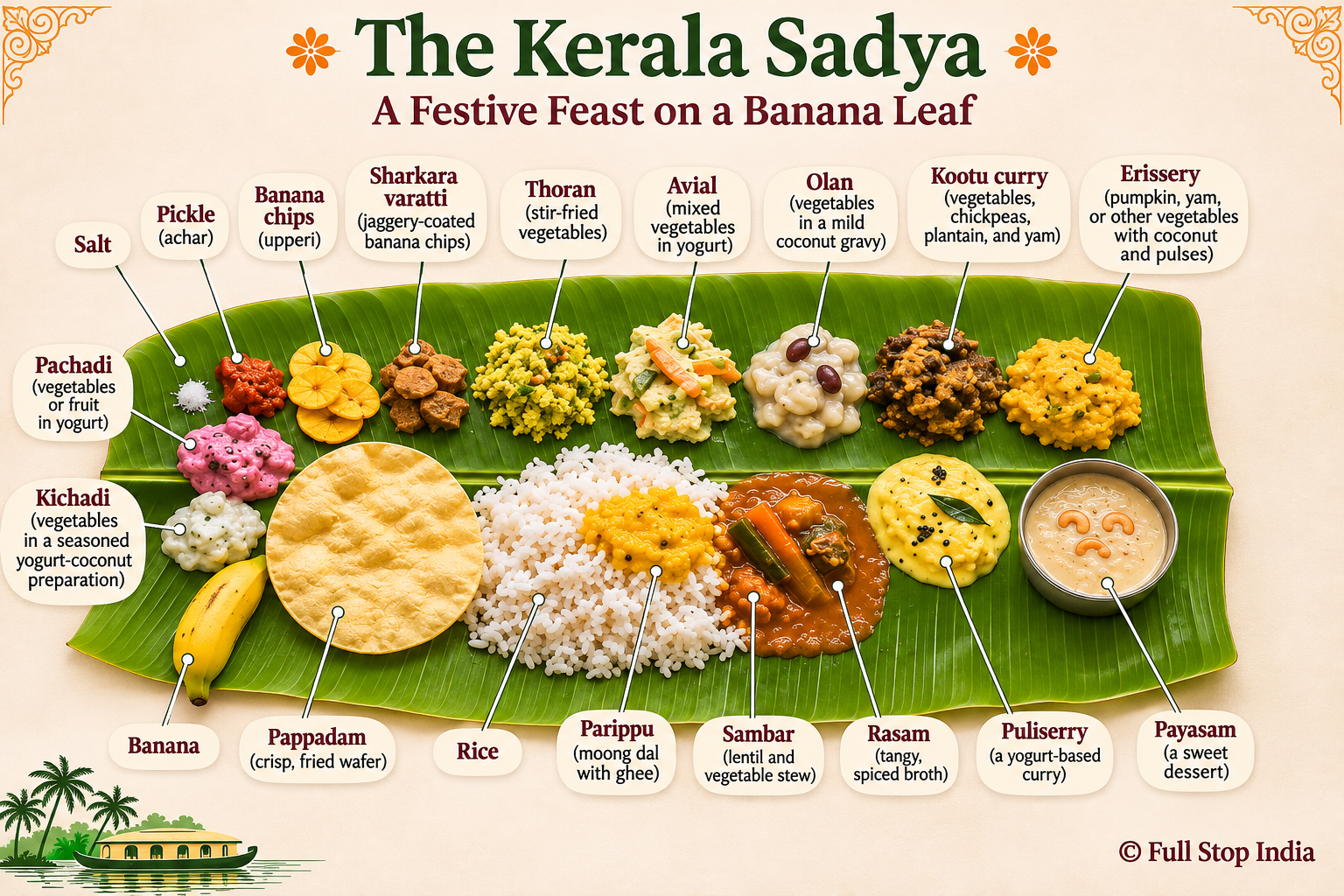
Kerala’s food traditions are among the most distinctive in India, and its elaborate vegetarian sadya deserves particular attention. Traditionally associated with celebrations such as Onam, weddings, and other occasions, sadya is served on a banana leaf. The number and selection of dishes vary according to the occasion and local customs.
You might encounter avial, a mixture of vegetables with coconut; thoran, a preparation of finely chopped vegetables; olan, often made with ash gourd or other vegetables and coconut milk; pachadi, a yogurt-based accompaniment; pickles; and different kinds of payasam, the sweet preparation served during the meal.
Rice occupies the central position, with accompaniments arranged around it. Different preparations may be served in sequence.
I’ve eaten banana-leaf meals in southern India, and I love them. There’s something about the simplicity of it. No collection of little metal bowls to manage, no enormous platter. Just the leaf, the food, and the meal in front of you. Somehow, it tastes better.
And here’s where I abandon my usual habit of eating one thing at a time. With a banana-leaf meal, I’m quite happy to mix flavors together. Perhaps it’s the way everything is presented, or the way the different preparations work with the rice. Whatever the reason, my usual rules go out the window.
Not every meal served on a banana leaf is a sadya, however. Everyday Kerala meals can be much simpler, and the state’s nonvegetarian cooking represents another substantial part of its food culture.
There is a method to the banana leaf
At a traditional sadya, the arrangement isn’t necessarily random. Small portions of pickles, vegetable dishes, and other accompaniments occupy customary areas of the leaf; rice arrives in the main eating space, and different curries follow. Placement and sequence vary by locality and household, so there isn’t one universal diagram for all of Kerala.
Tamil Nadu: saapadu and the progression of a meal
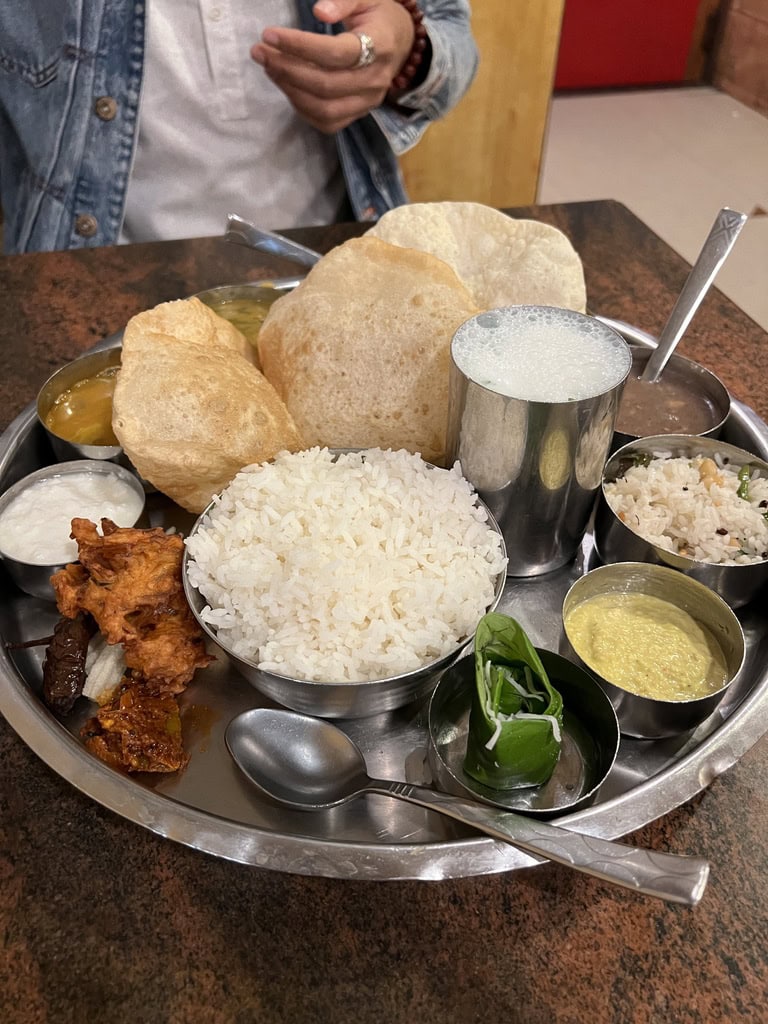
In Tamil Nadu, the word saapadu is commonly used for a meal, and the traditional full-meal format is closely related to what visitors might recognize as thali.
Rice is central, accompanied by preparations that may include sambar, rasam, kootu, poriyal, curd, pickles, and appalam. Kootu generally combines vegetables with lentils or other pulses, while poriyal is commonly a dry vegetable preparation, often finished with coconut.
What distinguishes many traditional Tamil meals is the progression of courses. Rice may first be eaten with sambar, followed by rasam, and later curd or buttermilk. Accompaniments are eaten throughout, with the sequence varying by household and occasion.
Andhra Pradesh and Telangana: rice, chilies, and pickles
The cuisines of Andhra Pradesh and Telangana share some ingredients and historical influences, but each has distinct regional traditions. Rice is central to many meals. Dal, or pappu, appears in numerous forms, sometimes incorporating leafy greens, tomatoes, or other vegetables.
Gongura, a tangy leafy green, is particularly associated with Andhra cooking and appears in chutneys, dal, and other preparations. Pickles can be intensely flavored, with chilies, tamarind, and other souring ingredients playing important roles.
Telangana has its own culinary traditions, including preparations made from jowar, millet, lentils, and regional greens. The reputation for heat is not entirely undeserved, but reducing the region’s cooking to chili levels misses its complexity.
Can you actually learn to cook a thali?
Yes. Cooking schools offer classes built around complete regional meals. Nirali Cookery in Nagpur advertises Gujarati, Maharashtrian, Marwari, Punjabi, Jain, and South Indian thali courses. Swad Institute has offered a Kathiyawadi thali workshop covering breads, vegetables, kadhi, khichdi, and accompaniments.
Learning one curry is manageable. Coordinating a dozen preparations so they’re all ready at once, taste different from one another, and still make sense together? That’s another level of cooking. I can barely coordinate my own twelve little bowls once they’re on the table.
West Bengal: where the order of the meal matters
Bengali meals have their own conventions, particularly in the sequence of dishes. Rice is central, and a traditional meal may begin with bitter preparations such as shukto, followed by vegetables, dal, fish or meat preparations where appropriate, chutney, and sweets.
Fish is important in much of Bengali food culture, reflecting the region’s rivers, wetlands, and long culinary traditions. But vegetarian cooking is equally significant, with a tremendous variety of vegetable preparations.
West Bengal’s reputation for sweets is well established, with preparations such as mishti doi, sandesh, and rosogolla forming part of its broader food culture.
Odisha: rice, dalma, and temple traditions
Odisha’s food deserves far more attention than it generally receives from international visitors. Rice is a staple, accompanied by preparations such as dalma, which combines lentils and vegetables, along with leafy greens, vegetable dishes, and regional chutneys.
Pakhala, rice soaked in water and often fermented, is particularly associated with Odisha and is commonly eaten with various accompaniments, especially during hot weather.
The food traditions associated with the Jagannath Temple in Puri are another important part of the state’s culinary identity. Temple preparations follow particular customs and should not be confused with ordinary restaurant thalis.
Assam and the Northeast: a different culinary landscape
Northeastern India is too diverse to be represented by a single regional thali. Assamese meals commonly feature rice with vegetables, greens, fish, and preparations such as khar, traditionally associated with an alkaline ingredient derived from plant ash, and tenga, a sour preparation often made with fish.
Mashed accompaniments known as pitika are another familiar part of Assamese cooking. Elsewhere in the Northeast, fermented ingredients, smoked meats, bamboo shoots, local greens, and different rice varieties play important roles.
The cuisines of Nagaland, Manipur, Meghalaya, Mizoram, Tripura, Arunachal Pradesh, and Sikkim are distinct from one another. Some have meal traditions that don’t fit neatly into the conventional restaurant-thali format.
Thali at the movies—or close to it
Think thali is just something put on for tourists? Oh no. It’s woven into everyday Indian life. In 2026, Bengaluru’s Historically Tempered Collective launched Thali by Thali, an educational video series examining what people ate at different points in Indian history.
Its early episodes look at the Harappans and the evidence archaeologists use to reconstruct ancient diets, from charred seeds to animal remains. It’s about the history of Indian food, not proof that modern thalis existed five thousand years ago. But that’s why I like it: it asks questions rather than making grand claims. Read about the series.
Thali beyond the restaurant
I’ve also eaten meals like these in homes, at weddings, and at community gatherings, far from any restaurant.
At weddings, I’ve experienced meals where guests sit together and food is brought around in large vessels, with people spooning portions onto plates or leaves. It’s a wonderfully practical way to feed large numbers of people.
You’ll see a similar tradition at the langar, the free community kitchen at Sikh gurdwaras, where volunteers prepare and serve meals to anyone who comes, regardless of religion or background. Depending on the region and occasion, guests may sit on the floor, at long tables, or in organized dining areas. The customs differ, but the underlying hospitality is familiar: guests are fed, and often encouraged to eat considerably more than they originally intended.
What does a thali cost?
Like everything in India, there are layers. Thali is no exception.
There are affordable thalis served piping hot at roadside dhabas or walk-up restaurants in busy city centers. Move a neighborhood over and the price might jump. Perhaps the service is more elaborate, the surroundings more comfortable, or there’s entertainment included with dinner.
And then there’s the posh side of thali. Beautifully presented food, almost art on a plate. Something to photograph, to savor rather than devour, and to enjoy over a long conversation with close friends.
On one hand, sustenance. On the other, an entire dining experience. Both get you fed. The difference is everything happening around the plate.
A few things to know before ordering
- Vegetarian or nonvegetarian: Check which version you’re ordering. Many traditional thali restaurants are entirely vegetarian, while others offer both.
- Limited or unlimited: Don’t assume refills are included. Ask whether the thali is fixed or unlimited.
- Lunch or dinner: Some restaurants serve their full thali only during particular meal periods, while others offer special pricing at lunch.
- Eating with your hands: Perfectly normal in many settings. Use your right hand for handling food in traditional communal settings, and wash your hands before and after eating.
- The unfamiliar dishes: Ask the server what something is, but remember that a thali is a set meal. Don’t expect substitutions.
- No sharing: Thinking you’ll order one unlimited thali for two, sneak a few bites here and there, and enjoy the refills? Nice try. No sharing. Get your own. We WILL be watching.

 Lime Soda Sweet: The Refreshing Drink of India
 The Masala Dabba: Inside India’s Traditional Spice Box
 Jalebi: Iconic Sweet Spirals of India