
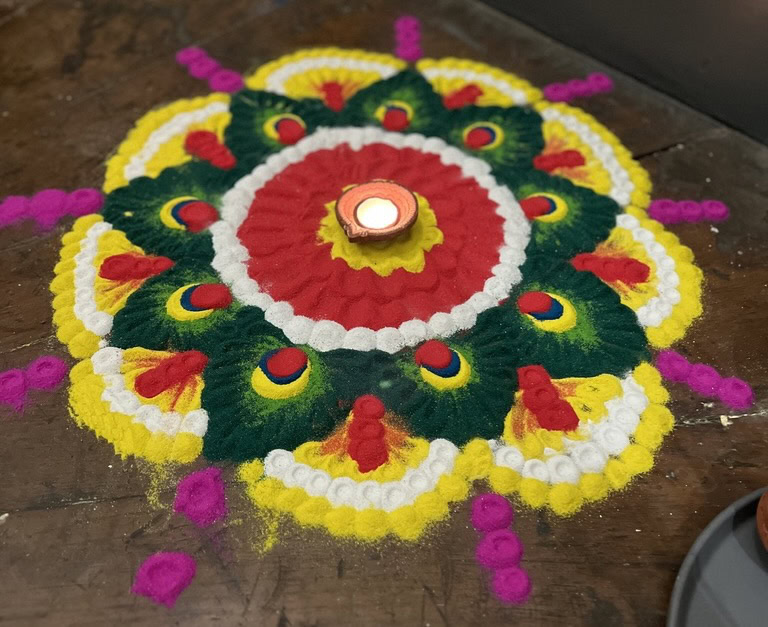
Commonly referred to as rangoli, the centuries-old practice of drawing colorful floor art at the entrances of homes, temples, and other buildings remains an important tradition throughout India.
Traditionally associated with Lakshmi, the Hindu goddess of wealth and prosperity, these designs can be both an offering and a welcome to visitors. Rice flour was commonly used, with the added benefit of providing food for insects and birds.
An Early-Morning Tradition
Early-morning walkabouts are a prime time to witness this simple yet rather impressive performance.
Women first sweep the entrance, sometimes washing the ground before starting. The damp surface helps the powder stay put. In some villages, a mixture containing cow dung is still used to prepare the ground, particularly where entrances haven’t been paved.
Loose flour is then released in a controlled stream between the thumb and forefinger. Watching someone create a perfectly symmetrical design this way, often without a stencil, is remarkable.
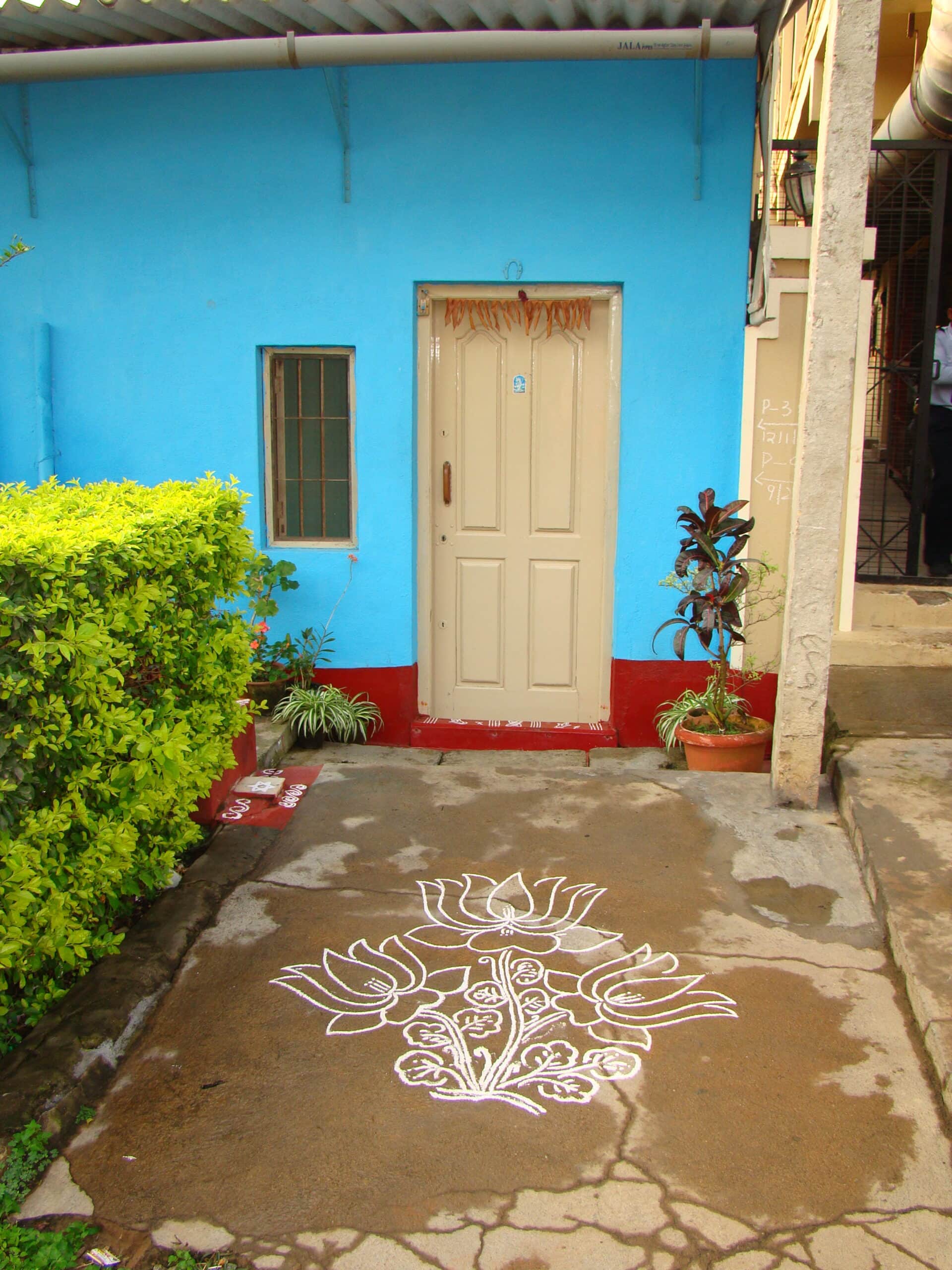
Imagine spending twenty minutes creating an elaborate design on your doorstep, knowing someone might walk straight through it an hour later. And then doing it all over again tomorrow.
For many households, it’s part of the morning routine, as ordinary as sweeping the floor or making chai. Some mornings call for a few simple dots and lines. Save the fancy stuff for festivals.
A Little Encouragement in Madurai
I’ve admired rangoli designs all over India, but one particular morning in Madurai stands out.
I was walking with a guide when I stopped to watch a young woman working rather timidly on a rangoli outside her home. An older woman stood just inside the doorway, watching her progress.
My guide noticed my interest and struck up a conversation. The younger woman, it turned out, was her daughter-in-law. The mother-in-law was mentoring her, offering quiet encouragement.
According to my guide, the mother-in-law said her daughter-in-law’s designs were “getting better.”
That gave me a chuckle. I took it to mean they weren’t quite up to the mother-in-law’s standards yet, but there was hope.
Apparently, even rangoli comes with a mother-in-law’s critique.
Rice Powder, Stone Powder, and a Little Imagination
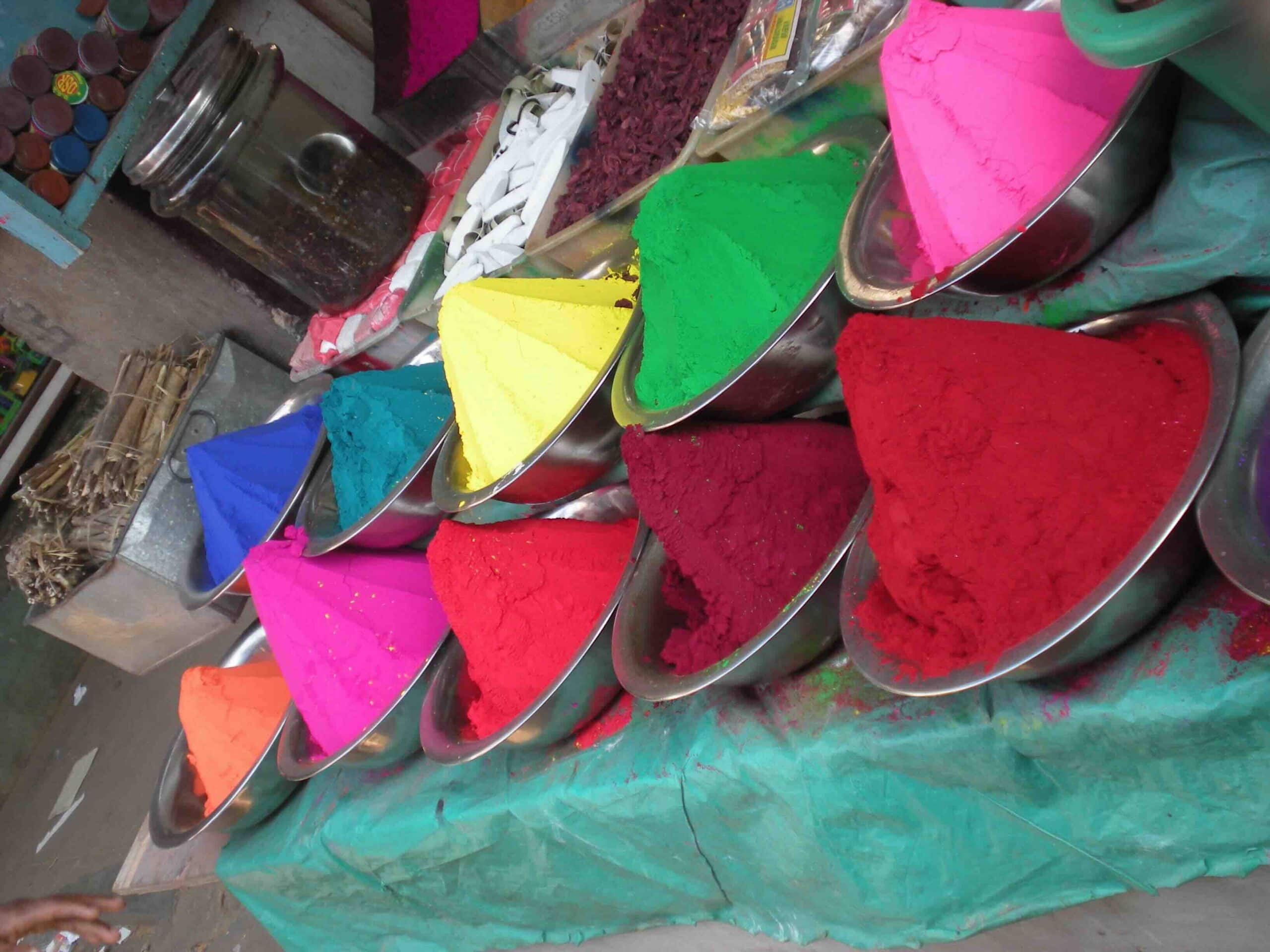
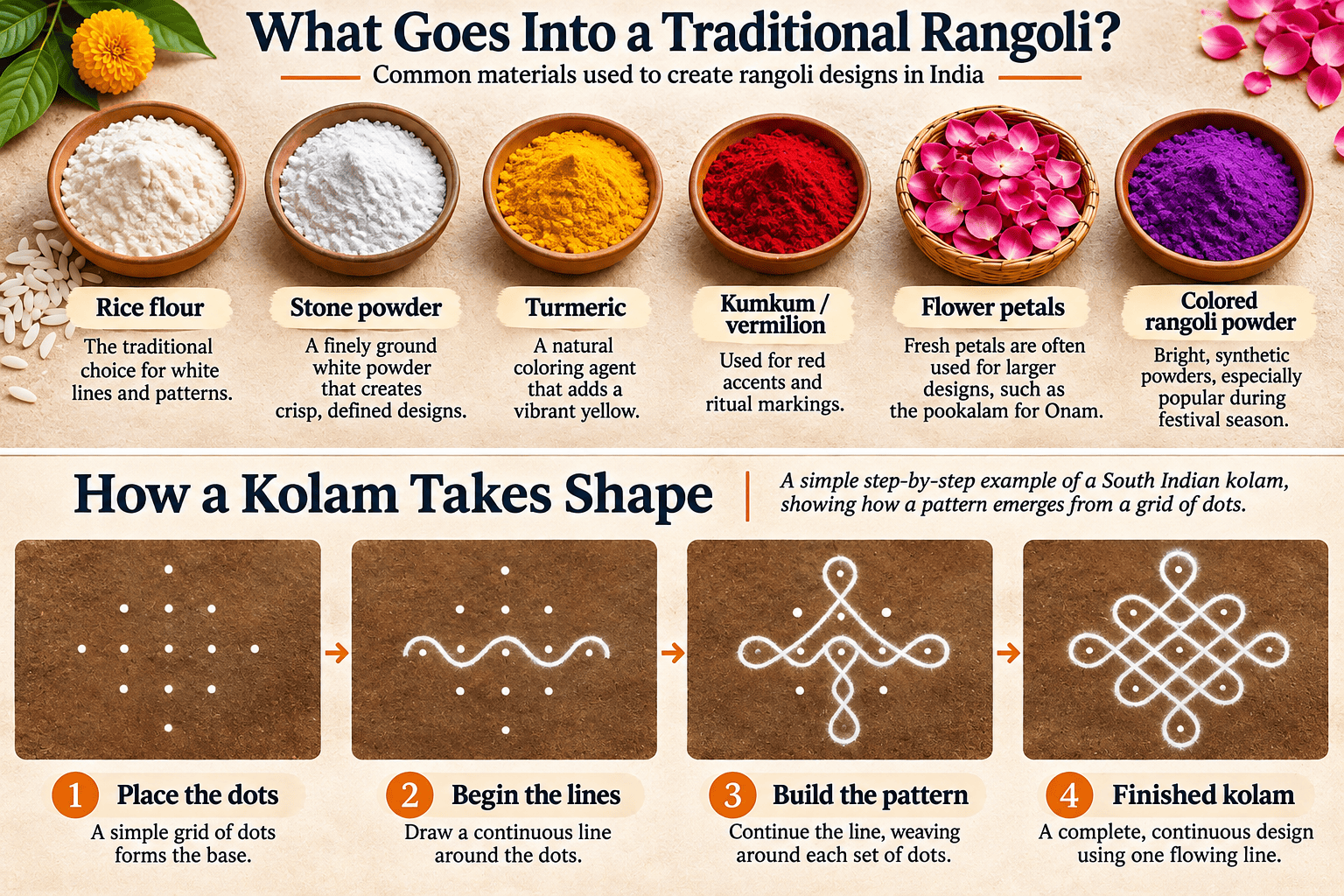
Rice flour is still used, although finely ground white stone powder is another option. For places with plenty of foot traffic, a paste can be made with water. Coffee grounds, turmeric, vermilion, flower petals, grains, and commercially colored powders provide more options.
Not much is needed to get started: a handful of rice flour and a reasonably steady hand. Come Diwali, however, market stalls are loaded with colored powders and stencils. In Kerala, elaborate flower-petal arrangements for Onam are another undertaking altogether.
Where You’ll Find Rangoli
Home entrances are the most familiar location, but designs also appear in courtyards, temples, and spaces used for weddings or religious gatherings. Some households draw an additional motif near their pooja room.
Rangoli competitions are held in schools, colleges, residential communities, and women’s clubs, especially during festival season. Some designs are enormous, with teams spending hours arranging colored powders or flower petals. The finished results can be extraordinary.
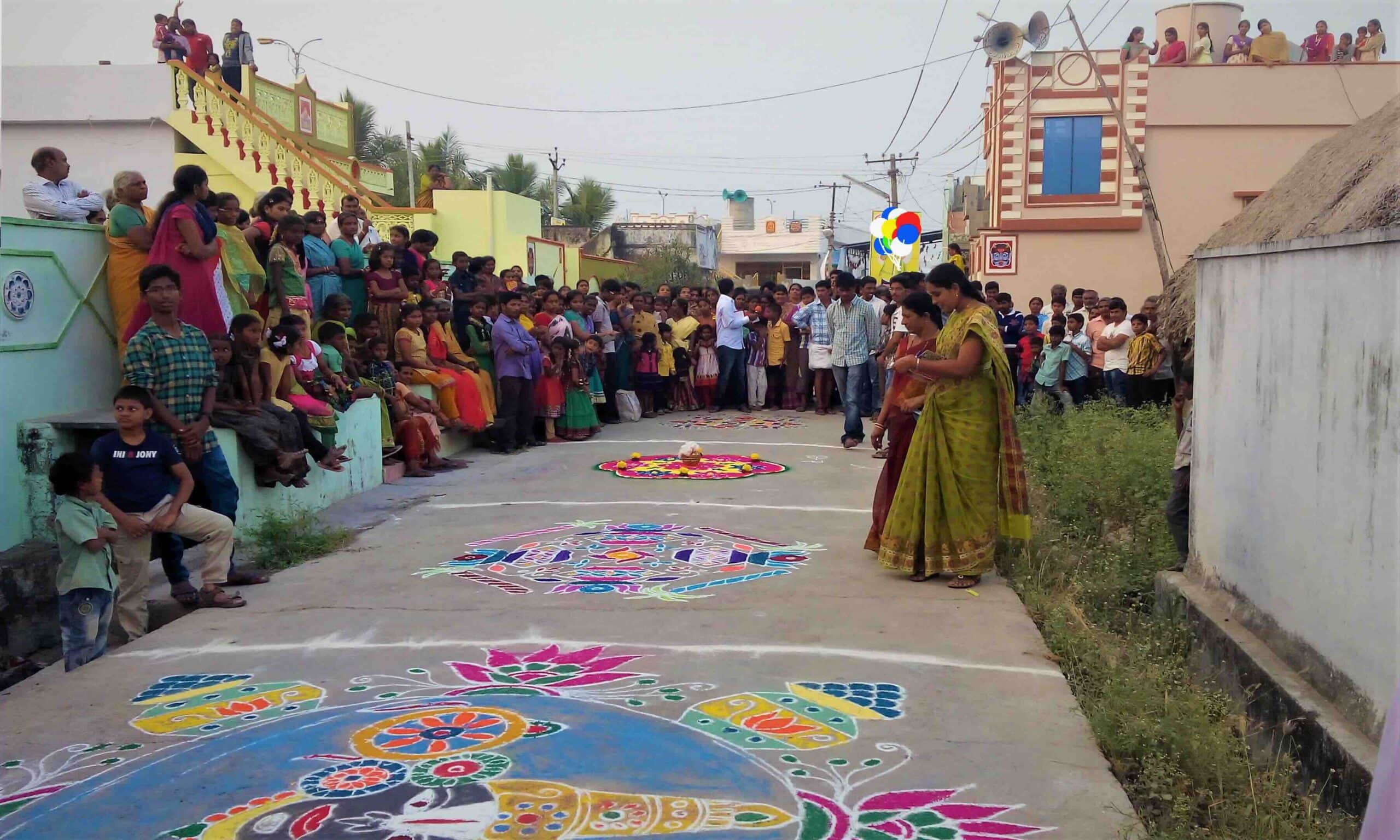
Apartment living may mean a smaller landing than the broad entrance of a village home, but the tradition hasn’t disappeared from India’s cities.
Rangoli Designs
Some patterns are drawn freehand. Others begin with evenly spaced dots that are joined by straight or curved lines, or encircled by a continuous looping line.
Don’t be fooled by the apparent simplicity of a few dots and lines. Some South Indian kolam patterns are remarkably complicated. Mathematicians have studied their symmetry and geometry, while the person drawing one outside her house may have learned the entire thing from her grandmother without a ruler or geometry lesson.
Regional Names for Rangoli
Rangoli isn’t the only name used for floor decoration in India, and the regional traditions aren’t all identical.
| State or region | Traditional name |
|---|---|
| Andhra Pradesh and Telangana | Muggu / Muggulu |
| Assam | Alpana / Alpona |
| Bihar | Aripan / Aripana |
| Gujarat | Sathiya / Rangoli |
| Haryana and Punjab | Chowkpurana |
| Himachal Pradesh | Likhnu / Likhna |
| Karnataka | Rangavalli / Rangoli |
| Kerala | Pookalam / Poovidal |
| Madhya Pradesh and Rajasthan | Mandana |
| Maharashtra | Rangoli |
| Odisha | Jhoti / Chita / Muruja |
| Tamil Nadu | Kolam |
| Uttar Pradesh | Chowkpurana / Chowk Pujan |
| Uttarakhand | Aipan |
| West Bengal | Alpana / Alpona |
A Tamil Nadu kolam drawn with rice flour, a Kerala pookalam assembled from flower petals, and a Kumaoni aipan painted on a red background have their own distinct traditions.
Keep an Eye on the Ground
After years of traveling around India, I still find myself stopping to admire a rangoli outside someone’s home. Sometimes it’s an elaborate festival display. Other times, it’s a few white lines on a doorstep, drawn before the day has even begun.
I suspect I’ll never stop looking for them on my morning walks.

 Districts of India: The Geography Between the State and the Village
 Ganesha: India’s Beloved Elephant-Headed God
 States vs. Union Territories: What’s the Difference?
