Shared linguistic roots, beautiful calligraphy and an extraordinary literary heritage.
I’ve spent considerable time learning Hindi, familiarizing myself with the Devanagari script and building a vocabulary that allows me to converse with friends in India. Curiously, Urdu has never come up in my Hindi lessons.
Words such as dost (friend), shukriya (thank you), khushi (happiness) and mohabbat (love) are familiar to me through Hindi. Yet all four have Persian or Arabic origins and are equally at home in Urdu.
I’ve wandered through the streets of Old Delhi, explored the extraordinary architecture of Lucknow and listened to Indian film music for years without giving much thought to the presence of Urdu in any of those experiences.
The written language, however, is entirely unfamiliar to me. Its elegant, flowing letters bear little resemblance to the Devanagari characters I’ve learned to read. Urdu’s traditional Nastaliq script is a form of calligraphy that seems as much an artistic expression as a means of communication.
How did two languages that share so much in conversation develop such different written identities? And how did Urdu become so closely associated with poetry, romance, music and the cultural heritage of the Indian subcontinent?
The story of Urdu takes us through royal courts, military camps, the cities of the Deccan, the literary circles of Delhi and Lucknow, and eventually into the recording studios of Bombay.
From the Deccan to Delhi
It would be easy to assume that the story of Urdu begins in Delhi. But travel south to the Deccan and another part of its history emerges. Long before Urdu became synonymous with the poetry of Delhi and Lucknow, poets in the courts of the Deccan were writing in a form of the language known as Dakhni.
What interests me about this history is how much of it is a story of people coming together. Local languages absorbed words from Persian and Arabic without losing their underlying Indian grammar. Persian was the language of royal courts and administration, but the language developing outside those courts had a life of its own.
Even the name Urdu, derived from a Turkic word for camp, has encouraged the popular story that it was born in military encampments. Its development was far more gradual than that. The bazaars, courts and literary circles of several cities all have a place in its history.
Before it was widely known as Urdu, the language appeared under several names, including Hindavi and Rekhta. The latter became particularly associated with poetry. In Hyderabad, Muhammad Quli Qutb Shah, the ruler who founded the city in 1591, composed poetry in Dakhni. Think about that the next time you see the Charminar: the ruler responsible for that landmark was also a poet.
Dakhni is still heard in southern India. In Hyderabad it belongs as much to everyday conversation as to literary history, with regional expressions and influences from neighboring languages. Learning standard Hindi or Urdu won’t necessarily prepare you for every local turn of phrase.
Where Urdu Is Spoken
When I think of Malayalam, I immediately think of Kerala. Tamil takes me to Tamil Nadu. Urdu is different. It belongs to the story of Hyderabad as much as it belongs to Delhi or Lucknow, and its speakers are spread across much of India.
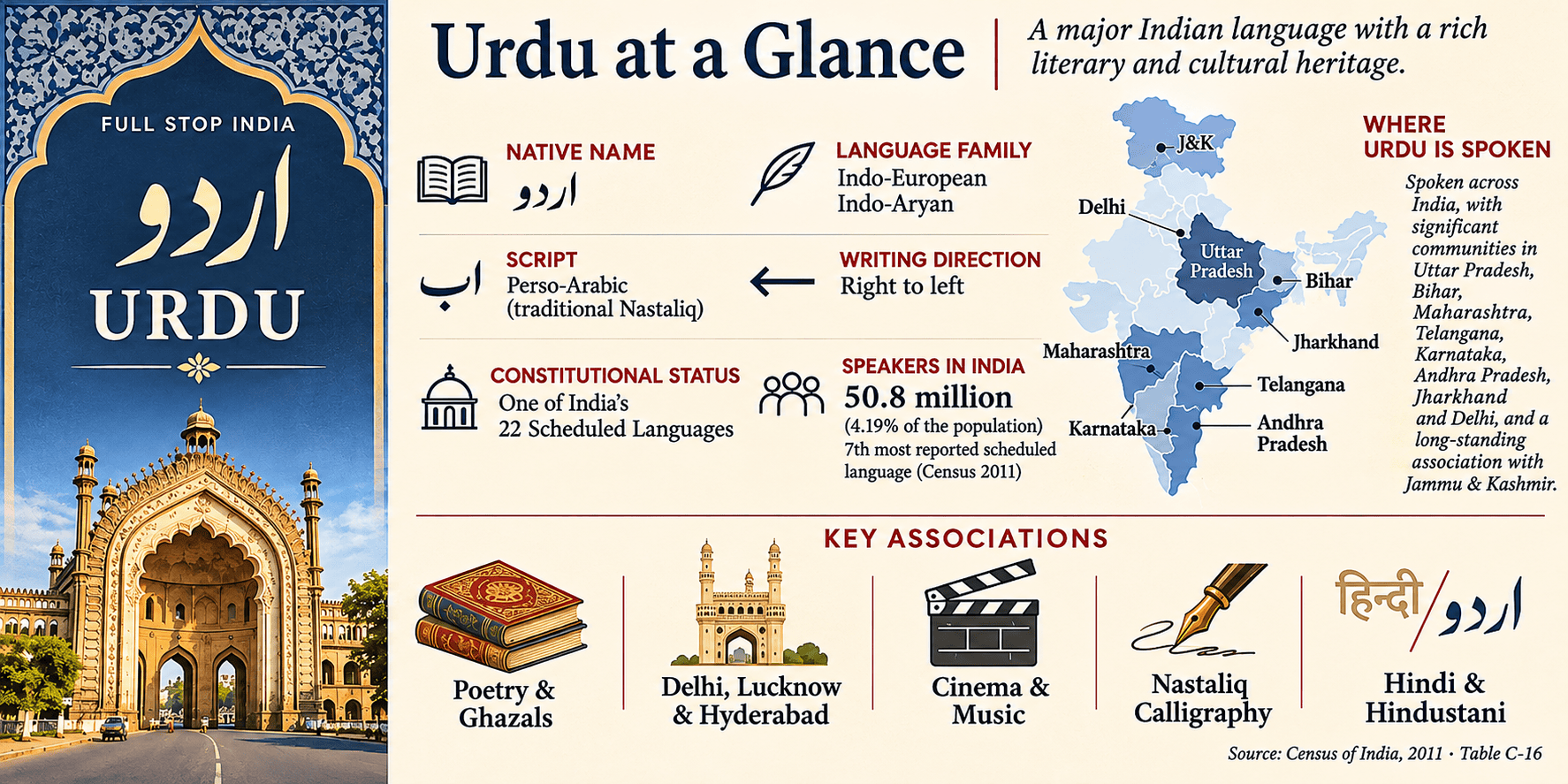
That makes it difficult to appreciate Urdu by looking at a map alone. There are substantial Urdu-speaking communities in Maharashtra, Bihar, Uttar Pradesh, Karnataka and Telangana, among other states. The language is also one of India’s 22 scheduled languages.
Urdu’s association with Pakistan is familiar to many people outside India. But Pakistan’s adoption of Urdu as its national language following Partition in 1947 is a relatively recent chapter in a much longer history. Delhi, Lucknow and Hyderabad were already home to flourishing Urdu literary traditions centuries earlier.
The 2011 Indian census recorded 50.8 million people reporting Urdu as their mother tongue. That figure does not include everyone who speaks it as a second language. Urdu also has official status in several Indian jurisdictions, including Telangana and Jammu and Kashmir.
Partition complicated the relationship between language and identity. Urdu became closely associated with Pakistan and Muslim identity, while Hindi increasingly served as a marker of Indian national identity for some. Neither description does justice to the history of either language. Indians continued to write, publish, teach and speak Urdu after 1947, just as they had before.
Two Languages, Shared Roots
Take away the written script for a moment and the distinction between Hindi and Urdu becomes much less obvious. The question I would use to greet a man in Hindi is precisely the same question I could ask in Urdu:
Hindi: आप कैसे हैं?
Urdu: آپ کیسے ہیں؟
Āp kaise hain? — How are you?
I can read the first line. I cannot read the second. Yet I can say both of them. That is what fascinates me about these two languages.
The shared conversational language is often referred to as Hindustani. The differences become more apparent as the vocabulary becomes more formal, with Hindi drawing more heavily on Sanskrit and Urdu on Persian and Arabic. Everyday conversation is considerably less neatly divided.
Consider the words for a book, kitāb, and a question, savāl. Both are familiar in everyday Hindi and Urdu. In a more formal Hindi setting you might encounter pustak and prashna instead. For a student of Hindi, the distinction is useful: the vocabulary in a lesson may not be quite the vocabulary heard in a film or on the street.
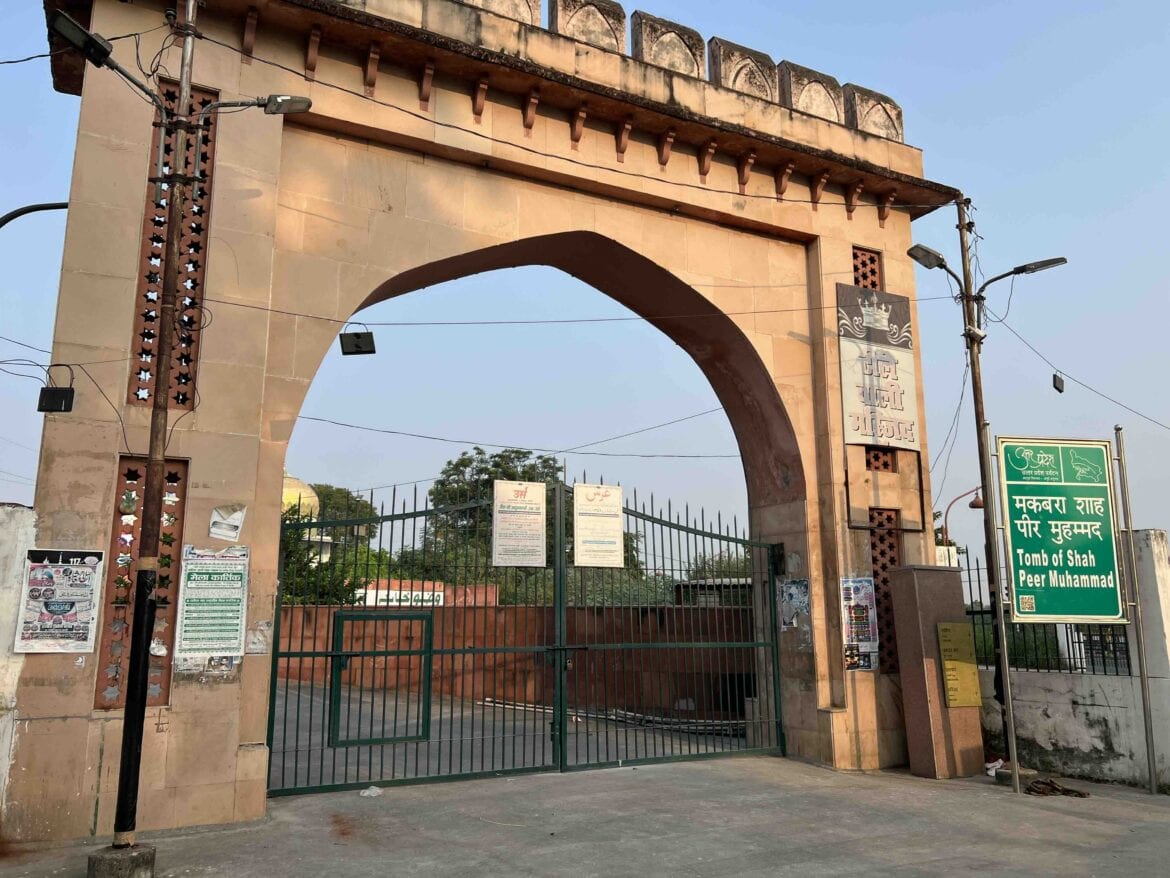
I went back through my photographs from Lucknow while working on this article. At the entrance to the Tomb of Shah Peer Muhammad, two notices hang side by side on the gate, one in Hindi and one in Urdu. A green tourism sign to the right identifies the tomb in Hindi and English. I hadn’t paid particular attention to the notices when I took the photograph, but they make a rather good illustration of the subject.

Lucknow also has a reputation for tehzeeb, a tradition of courtesy and refinement associated with the old Nawabi court of Awadh. The expression pehle āp (you first) is practically a shorthand for the city’s reputation for good manners. Janāb is a respectful form of address, while tashrīf rakhiye is a courteous invitation to sit. These expressions are not exclusive to Lucknow or Urdu, nor does everyone in the city speak in the manner of a nawab. But they offer a little insight into the value historically placed on gracious speech there.
The Beauty of Nastaliq
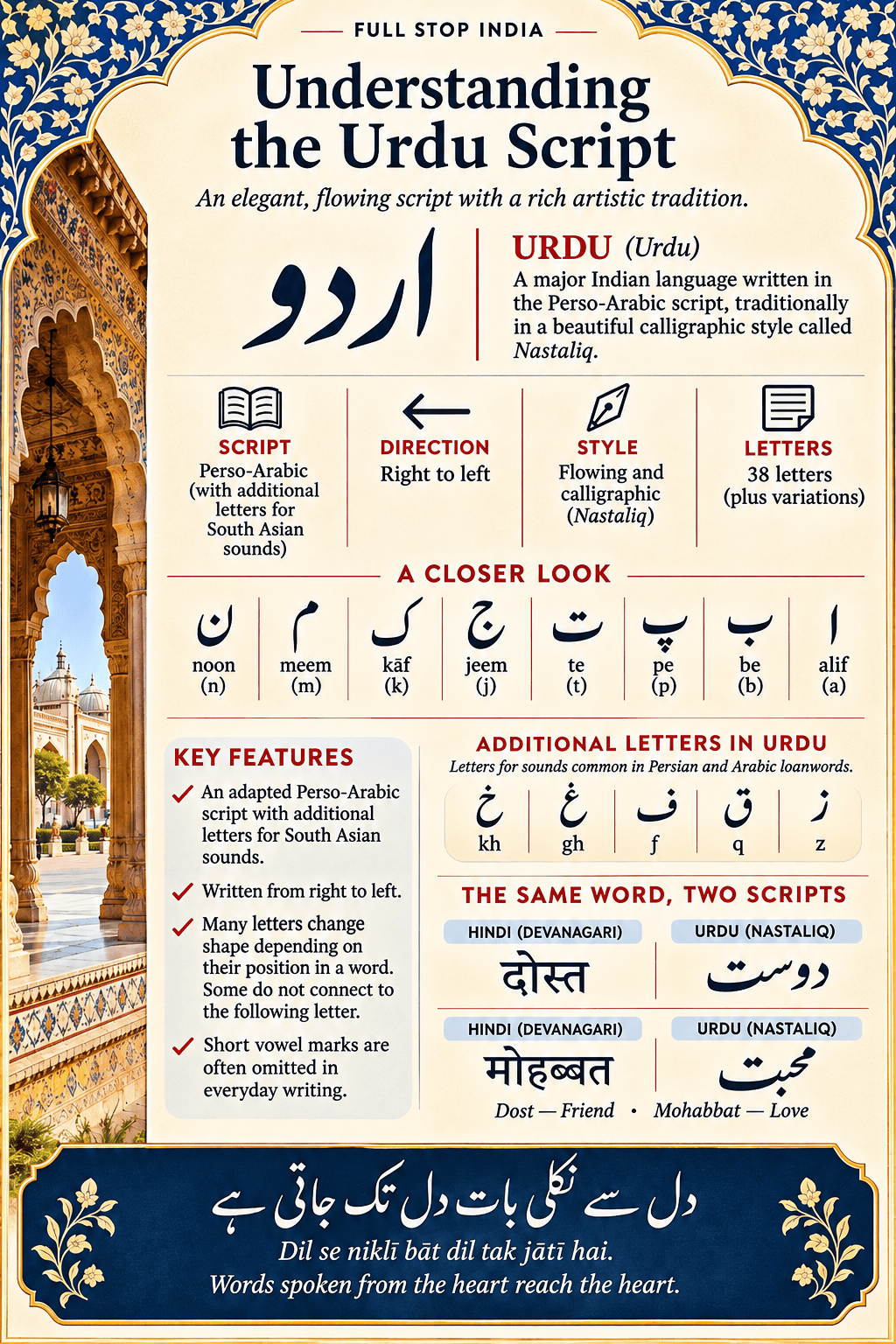
Learning to read Devanagari took time, particularly recognizing letters when they were joined together. Looking at Urdu, I would have an entirely new set of challenges. I’d be reading from right to left, recognizing letters that change shape within words and learning to supply short vowels that are often not written down.
There is also something particularly beautiful about Nastaliq, the style traditionally associated with written Urdu. Words appear to descend across the page rather than sit neatly on a horizontal line. It is easy to see why calligraphy has become such a celebrated part of the language’s artistic heritage.
From Poetry to the Cinema
In Old Delhi, tucked into the lanes of Ballimaran, is the former home of Mirza Ghalib. It is a reminder of a side of Delhi’s history that can easily escape visitors moving between its monumental forts, mosques and tombs. Ghalib and Mir Taqi Mir are among the great names associated with the Urdu ghazal, a poetic form that can explore longing, love and loss in remarkably few words.
There is a social side to this literature, too. At a mushaira, poets recite their work before an audience, making poetry something to be heard and shared rather than simply read. And Urdu’s literary world is not confined to one religion. Munshi Premchand, for instance, wrote in both Hindi and Urdu.
For me, the most familiar connection is Indian film music. I’ve listened to it for years without stopping to consider whether the lyrics were Hindi or Urdu. Lyricists such as Sahir Ludhianvi and Gulzar brought Urdu’s poetic vocabulary to the cinema, where it reached listeners far beyond the world of literary gatherings. It makes me wonder how many of the songs I’ve enjoyed over the years contain words I have yet to learn in my Hindi lessons.
There are places in Delhi where a traveler can pursue this literary history without knowing the Urdu alphabet. Ghalib Ki Haveli in Ballimaran is a small memorial to the poet, and the tomb of Ghalib stands in the Nizamuddin neighborhood. Anyone interested in his work can begin with English translations rather than attempt to decipher the original manuscripts.
In cinema, the contribution goes well beyond lyrics. The screenwriting partnership of Salim Khan and Javed Akhtar helped shape Hindi-language popular cinema in the 1970s, and Javed Akhtar went on to become a prominent poet and lyricist. The films and songs are a particularly accessible introduction to the overlap between the two languages, even if the credits describe the film simply as Hindi.
Urdu Beyond the History Books
For a language so often discussed in connection with the Mughal and Nawabi eras, Urdu has a remarkably active contemporary literary scene. Delhi’s Jashn-e-Rekhta festival brings together poetry readings, discussions, music and performances. The organization behind it, Rekhta, makes poetry available in Urdu, Devanagari and Roman script, with dictionaries and translations. For someone like me, who can read Hindi but not Urdu, that is a particularly useful resource.
Urdu is also the language of daily news. The Mumbai-founded Inquilab and Hyderabad’s Siasat are examples of a press tradition that continues today. Look for Urdu newspapers at newsstands in cities with large Urdu-speaking populations. Religious notices, shop signs and wedding invitations are other places where the script turns up outside museums and libraries.
There are challenges, particularly when children grow up speaking the language at home but receive their schooling in another script or language. Institutions such as the National Council for Promotion of Urdu Language support publishing and education. The distinction between speaking Urdu and being able to read it matters here, just as it does for an outsider learning the language.
Essential Urdu Phrases
If you already know a few Hindi phrases, look at the transliterations below. You may be surprised by how many you recognize. If you’re starting from scratch, try ādāb, a courteous greeting, or shukriyā to thank someone. You don’t need to be able to read Nastaliq to begin using either.
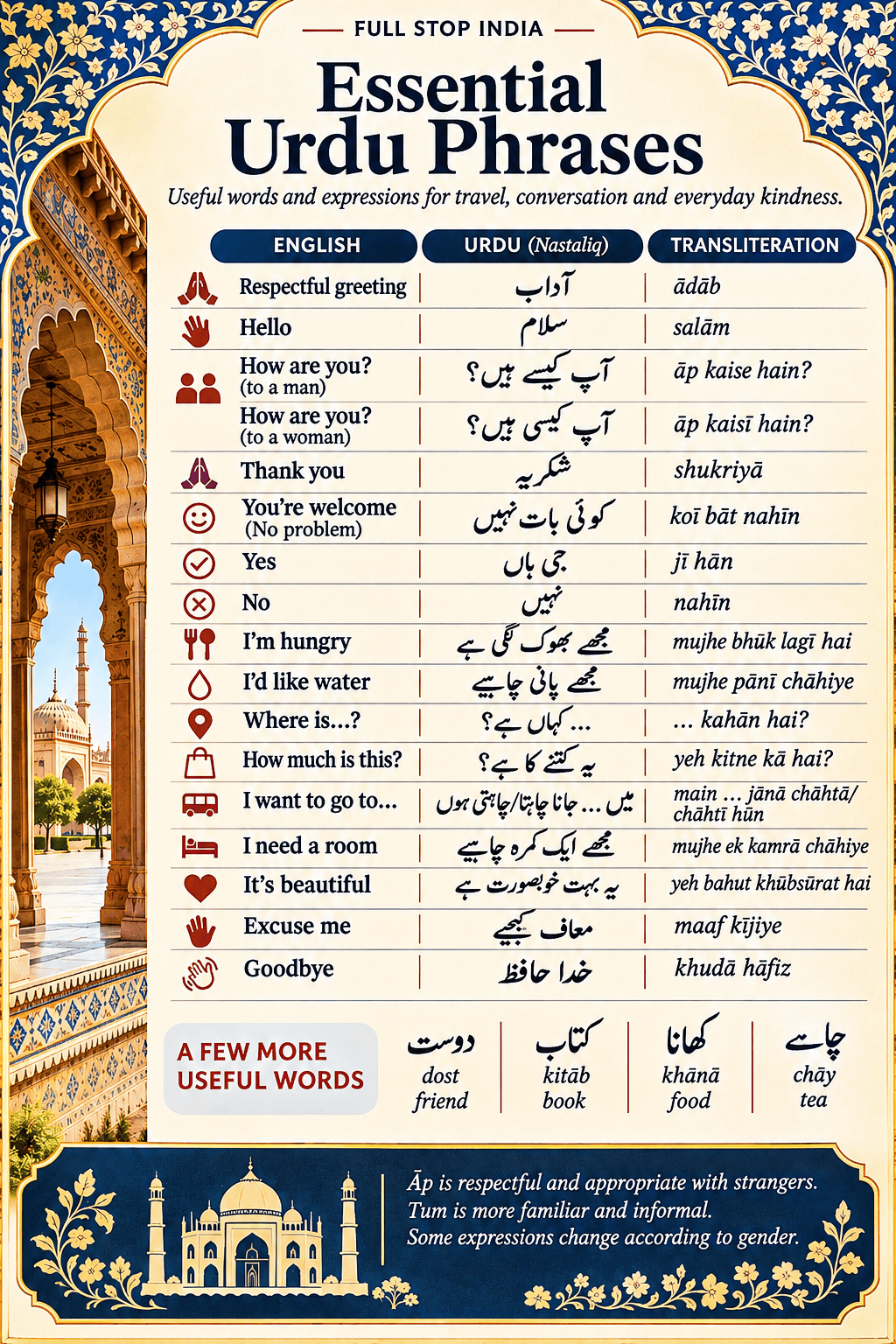
Read Urdu phrases as text
- Respectful greeting — آداب — ādāb
- Hello — سلام — salām
- How are you? (to a man) — آپ کیسے ہیں؟ — āp kaise hain?
- How are you? (to a woman) — آپ کیسی ہیں؟ — āp kaisī hain?
- Thank you — شکریہ — shukriyā
- No problem — کوئی بات نہیں — koī bāt nahīn
- Yes — جی ہاں — jī hān
- No — نہیں — nahīn
- I’m hungry — مجھے بھوک لگی ہے — mujhe bhūk lagī hai
- I’d like water — مجھے پانی چاہیے — mujhe pānī chāhiye
- Where is…? — … کہاں ہے؟ — … kahān hai?
- How much is this? — یہ کتنے کا ہے؟ — yeh kitne kā hai?
- I want to go to… — میں … جانا چاہتا/چاہتی ہوں — main … jānā chāhtā/chāhtī hūn
- I need a room — مجھے ایک کمرہ چاہیے — mujhe ek kamrā chāhiye
- It’s beautiful — یہ بہت خوبصورت ہے — yeh bahut khūbsūrat hai
- Excuse me — معاف کیجیے — maaf kījiye
- Goodbye — خدا حافظ — khudā hāfiz
- Friend — دوست — dost
- Book — کتاب — kitāb
- Food — کھانا — khānā
- Tea — چائے — chāy
Āp is respectful; tum is informal. Chāhtā is used by male speakers and chāhtī by female speakers.
My Hindi lessons have given me an unexpected starting point for appreciating Urdu. I may not be able to read its script, but many of its words are already familiar to me. The next time I listen to an Indian film song or find myself in Lucknow, I’ll be listening a little more closely.