

This article contains affiliate links. If you make a purchase through these links, Full Stop India may earn a small commission at no additional cost to you. As an Amazon Associate I earn from qualifying purchases.
There’s a particular moment at the end of a long international flight when everyone seems to have the same suitcase. You’re standing at the baggage carousel in Delhi or Mumbai, watching one black roller bag after another make its way around the belt. You’ve been traveling for the better part of a day, you’re tired, and all you want is to collect your luggage and get to your hotel.
Then you begin wondering whether the bag you’ve been staring at is actually yours.
Baggage identification isn’t the most exciting part of planning a trip to India. It’s also one of the easiest things to get right before leaving home. And in 2026, we have a few tools that weren’t available when I first started traveling to India in 2005.
Start with an Old-Fashioned Luggage Tag
Technology has changed, but a physical luggage tag remains useful. Every checked suitcase should have a durable identification tag containing your name, email address and a telephone number where you can be reached. I prefer a tag that conceals the contact information rather than displaying it openly to everyone walking past.
You don’t need to advertise your home address on the outside of your suitcase. An email address and reachable telephone number give airline staff a way to contact you without revealing unnecessary personal information.
And when I say durable, I mean it. I’ve learned that lesson the hard way.
The Short Life of My United Premier Luggage Tag
Every year, United Airlines offers me a personalized luggage tag recognizing my MileagePlus Premier status. It’s one of those little perks that comes with flying far too often on the same airline.
In theory, I’m supposed to proudly attach it to my suitcase and let the world know I’ve earned my place in the airline’s hierarchy. And I did. At least once.
A few years ago, when I reached Premier Silver, I attached my shiny new status tag to the handle of my checked suitcase. It was a proud moment. My luggage and I had officially arrived.
The tag survived approximately one and a half trips.
Somewhere between an airport baggage belt and the mysterious machinery that moves our suitcases around the world, my beloved Premier Silver tag was ripped from its rightful place. Gone into the abyss. Never to be seen again. I haven’t forgotten it to this day.
These days, my Premier tags hang from my carry-on backpack, where they stand a much better chance of surviving.
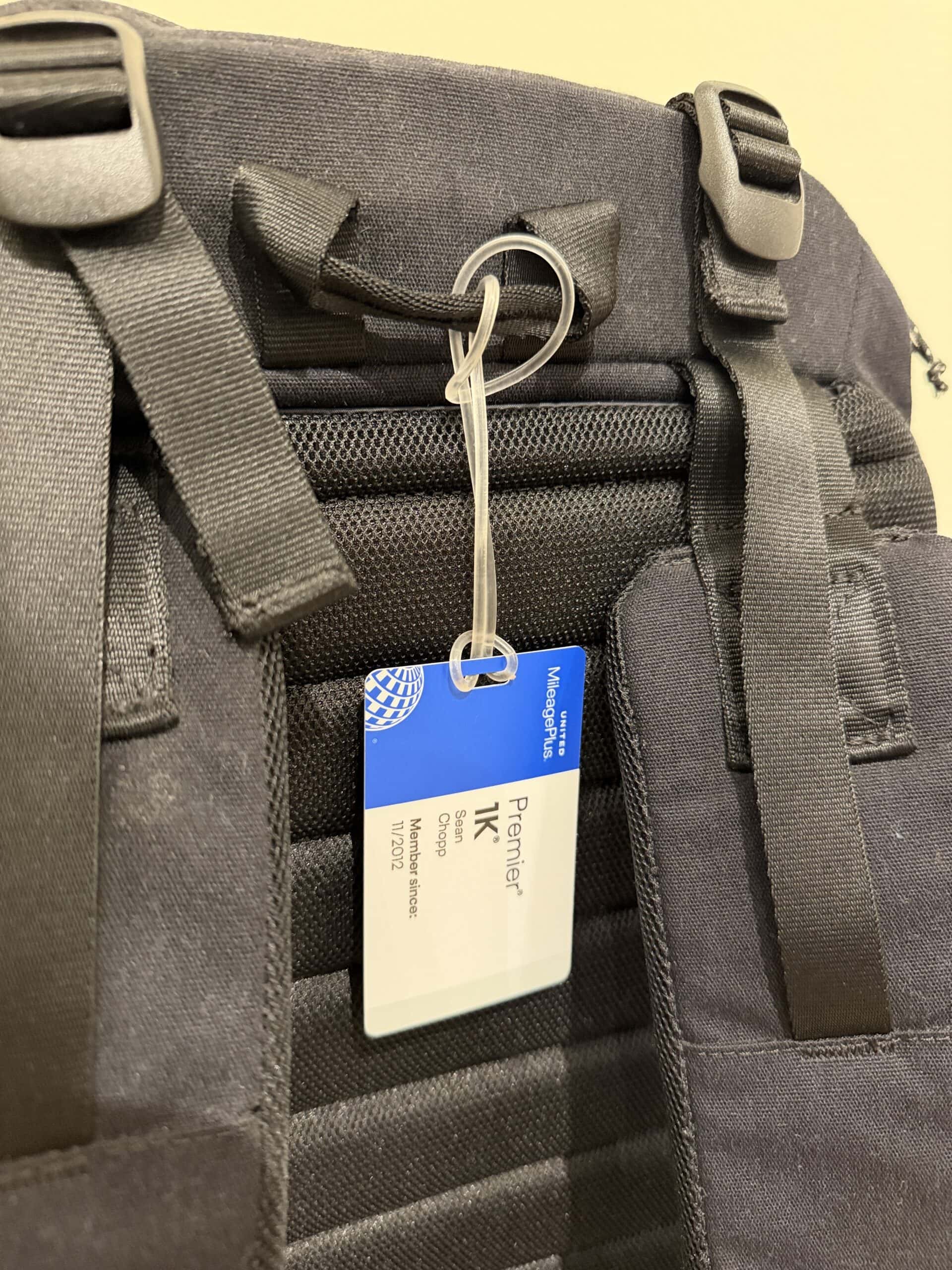
A little obnoxious? Certainly. A touch entitled? Probably. But I earned those tags.
And, ridiculous as it may sound, those little airline perks helped motivate me to keep working my way up the MileagePlus ladder, all the way to Premier 1K.
The experience also taught me something useful: anything dangling from a checked suitcase has to survive a baggage-handling system that isn’t particularly concerned about sentimental attachments. A sturdy, securely fastened identification tag is a better choice than something decorative.
Fortunately, we now have technology that can help locate our suitcases without attaching anything to the outside.
Track Your Luggage Through Your Airline’s App
One of the conveniences of modern air travel is the ability to follow your checked luggage through your airline’s mobile app. Since I fly United almost exclusively, its app is already part of my travel routine. Boarding passes, gate changes, flight updates and baggage information are all available in one place.
United offers baggage-tracking information through its app, and several other major airlines provide similar features. Air India, for example, allows passengers to follow checked luggage through its app and website, including available updates for transfers and connections. Qantas also offers baggage tracking on eligible journeys.
Depending on the airline and itinerary, you may be able to see when your suitcase was accepted at check-in, loaded onto an aircraft, transferred between flights or scanned upon arrival. This can be particularly reassuring when you’re connecting through a busy international airport.
There’s an important distinction, though. An airline’s baggage tracker tells you what its handling system last recorded. It doesn’t necessarily tell you where your suitcase physically is at that moment. If a bag misses a connection or ends up somewhere unexpected, the information may be delayed or incomplete.
Still, it’s one of the first places I’d look if my suitcase wasn’t where I expected it to be. And it’s already available to many travelers without purchasing another device.
Luggage Trackers: AirTags and Their Alternatives
Here’s where technology has made a considerable difference. A small tracking device inside your suitcase can help you determine where your luggage was last detected, even when the airline’s baggage-handling information isn’t particularly helpful.
I haven’t actually started using AirTags in my checked luggage yet, although the more I think about it, the more ridiculous that seems. Here’s a small device that can help locate a missing suitcase, and I’m still relying primarily on a luggage tag that may or may not survive the baggage-handling system. It’s probably time I changed that.
How Apple AirTags Work
An Apple AirTag doesn’t have its own cellular connection or provide continuous GPS tracking. Instead, it uses Apple’s Find My network, relying on nearby participating Apple devices to report its approximate location. That means the information isn’t always instantaneous. A suitcase sitting in an isolated baggage-handling area may not report a fresh location for some time.
Even so, imagine arriving in Delhi and discovering that your suitcase was last detected in Paris. That’s considerably more useful than standing at the baggage carousel wondering whether the airline has misplaced it.
I’d place the tracker inside an interior suitcase compartment rather than attach it to the outside. After my experience with that United Premier tag, I have little confidence in anything dangling from a luggage handle.
If you’re considering adding one to your checked luggage, Apple AirTags are available on Amazon.
Before traveling, make sure your tracker is paired with your phone, has a working battery and appears correctly in its location-finding app. Small Bluetooth luggage trackers that comply with applicable battery limits are generally permitted in checked baggage, although it’s worth confirming your airline’s requirements before departure.
What If You Don’t Use an iPhone?
Of course, not everyone lives in the Apple universe. Fortunately, AirTags aren’t the only option.
Samsung offers its Galaxy SmartTag series for compatible Galaxy phones. Android users can also consider trackers from Motorola, Chipolo and Pebblebee that work with Google’s Find Hub network. Tile offers trackers compatible with iOS and Android through its own app and finding network.
The important thing is to choose a tracker compatible with your phone. Not all devices use the same network, and the number of participating devices nearby can affect how quickly your suitcase’s location is updated.
For a useful comparison of different products, take a look at Travel + Leisure’s luggage tracker recommendations.
Regardless of which tracker you choose, I’d put it inside the suitcase. I’ve already lost one perfectly good United Premier luggage tag to the baggage-handling machinery. No need to offer it something more expensive.
Airlines Around the World Are Beginning to Work with Luggage Trackers
Here’s something that makes me think I really should start putting a tracker in my suitcase. In December 2024, United Airlines introduced a way for passengers to share the location of a missing suitcase directly with its baggage recovery team using Apple’s Find My technology. And United is far from alone.
Airlines around the world have adopted Apple’s Share Item Location feature, allowing passengers to provide a temporary location-sharing link when their checked luggage goes missing.
Participating airlines include United, American Airlines, Delta, Air Canada, British Airways, Virgin Atlantic, Aer Lingus, Air France, KLM, Lufthansa, SWISS, Austrian Airlines, Brussels Airlines, Eurowings, Iberia, Turkish Airlines, Singapore Airlines, Qantas, Air New Zealand and Air India, among others. This is particularly useful for international travelers who may be flying several different airlines on their way to India.
How Location Sharing Works
If your suitcase contains an AirTag and doesn’t arrive, you can open Apple’s Find My app, select the missing item and generate a temporary Share Item Location link. You then provide that link through your airline’s supported baggage-recovery process. Authorized airline personnel can use the reported location information to help locate your suitcase.
Sharing is temporary. You can stop it yourself, it ends when you’re reunited with your luggage, and Apple’s sharing links automatically expire after seven days.
The service isn’t the same as the regular baggage-tracking information available through an airline’s app. The airline’s tracking system generally relies on baggage-handling scans. A personal tracker provides a separate source of location information. And the airline must support receiving that information for it to become part of its recovery process.
Air India and Qantas: Two Useful Examples
Air India is particularly relevant to readers of Full Stop India. The airline introduced Apple AirTag location sharing in 2025 and has since expanded its baggage recovery guidance to include compatible Android tracking devices.
If your suitcase doesn’t arrive, you report the problem at Air India’s baggage counter and obtain a Property Irregularity Report, commonly called a PIR. You can then submit your tracker’s location-sharing link through Air India’s app or website, associating it with your baggage report. The airline’s recovery team can use the information to help locate the suitcase.
You can read more in Air India’s baggage recovery guide.
Qantas is another good example of how airlines are incorporating personal trackers into baggage recovery. In addition to offering baggage tracking through its app on eligible flights, Qantas allows passengers to share compatible tracker locations when reporting delayed baggage. Its official baggage-tracking guide explains the available options.
What about IndiGo, an airline I’ve flown frequently within India? You can still use a compatible personal tracker independently through its own location-finding app. However, I haven’t confirmed that IndiGo offers the same dedicated tracker-location-sharing process as Air India. It’s worth checking the airline’s current policy before your trip.
None of these technologies guarantees that your suitcase will arrive on time. Still, having two independent sources of information—and, where supported, the ability to share one of them with the airline—is a meaningful improvement over the days when all you could do was stand at the baggage carousel and hope.
What to Check When You Hand Over Your Suitcase
Before leaving the check-in counter, take a moment to look at the baggage label the airline has attached to your suitcase. Check that the destination airport code is correct.
If you’re flying from the United States, Europe, Australia or elsewhere to India with a connection, confirm where the airline has checked your bag and whether you’ll need to collect and recheck it along the way. Don’t assume every international connection works the same way.
Keep your baggage claim receipt until your suitcase is back in your possession. While you’re at it, take a photograph of the suitcase itself. If the bag goes missing, a picture showing its color, shape, brand and distinguishing features is considerably more useful than describing it as a medium-sized black suitcase.
And remove any old airline barcode labels or destination stickers before your next trip. There’s no reason to give the baggage-handling system conflicting information.
Your Bag Isn’t on the Carousel. Now What?
If you’ve flown enough, you’ve probably seen those colorful PRIORITY tags attached to checked luggage. Airlines offer them to premium-cabin passengers and certain frequent flyers, theoretically giving their suitcases preferential treatment when it’s time to unload the aircraft.
As a United Premier 1K member, I’ve had my share of priority-tagged luggage. And in my experience, about eight times out of ten, that tag makes absolutely no difference in how quickly my suitcase appears on the baggage carousel. And that’s fine. I can wait.
The important thing to remember when you arrive in India is that just because your suitcase isn’t among the first bags coming off the belt doesn’t mean it’s lost. In fact, don’t panic at all. At least wait until all the luggage has been unloaded before assuming your suitcase isn’t coming.
While you’re waiting, open your airline’s app. Check the available baggage-tracking information to see whether your suitcase was loaded onto your flight or has been scanned at your destination. If you’re traveling with an AirTag or another compatible tracker, check its last reported location as well. There may be a perfectly reasonable explanation for why your suitcase hasn’t appeared.
Your Suitcase May Have Arrived Before You
Here’s something that has happened to me several times when arriving in India: my luggage was already there. Depending on your itinerary, particularly when you have a long international connection, your checked suitcase may occasionally travel ahead of you.
Rather than waiting at the connecting airport for your scheduled flight, the bag may be placed on an earlier departure to your final destination. Imagine arriving in Delhi, watching the carousel for twenty minutes, and wondering where your suitcase has gone, only to discover that it’s been waiting at the airport longer than you have.
Before filing a missing-baggage report, ask the airline’s baggage staff whether your suitcase might have arrived on an earlier flight and been placed in a separate holding area. This isn’t something you should expect routinely. Airline baggage-handling policies vary, and bags aren’t always permitted to travel separately from their passengers. Still, I’ve experienced it often enough that it’s one of the possibilities I consider.
Don’t Forget the Oversized Baggage Area
There’s one more place worth checking before deciding your luggage has disappeared. Most international airports have a separate area for oversized or unusually shaped baggage, often adjacent to the regular carousels.
Did you bring golf clubs? A large piece of sporting equipment? Or perhaps a ridiculously oversized trunk that seemed like a good idea when you packed it? Your luggage may be sitting just a short distance away, waiting patiently for you to collect it.
Occasionally, even an ordinary suitcase may be directed somewhere other than the expected carousel. It’s worth looking around before assuming the worst.
When It’s Actually Time to Ask for Help
Once the carousel has stopped, the bags have been unloaded, and you’ve checked the airline’s tracking information and nearby baggage areas, it’s time to speak with baggage services. Have your baggage claim receipt and flight details ready.
If your suitcase truly hasn’t arrived, make sure the airline records a missing-baggage report before you leave the airport.
I learned that lesson about eighteen years ago when Air France managed to deliver me to Delhi, via Paris, while my suitcase apparently had other plans. I filed a report at Delhi airport and was handed a rather uninspiring toiletry kit containing a miserable toothbrush, a miniature tube of toothpaste and a few other forgettable necessities.
Fortunately, my luggage arrived the following day and was delivered directly to my hotel in Delhi. That experience changed how I pack.
To this day, my carry-on backpack contains deodorant, a toothbrush, toothpaste, dental floss and my hair goop. Enough to survive a day, or perhaps even a week, without my main Dopp kit.
The entire experience deserves its own article, particularly what to do when an airline loses your luggage and what you may be entitled to while waiting for its return. For now, remember that a slow suitcase isn’t necessarily a lost suitcase.

Will I Finally Become a Carry-On-Only Traveler?
Despite all this talk about luggage tracking, there’s one rather obvious way to avoid waiting at the baggage carousel. Don’t check a bag.
I’ve never been particularly good at following that advice. I check my suitcase. Every time.
Although after a recent domestic flight into Minneapolis–Saint Paul, when I waited nearly thirty minutes for my bag to appear, I’m beginning to question that commitment. Thirty minutes. For a simple domestic flight. Perhaps there’s a carry-on-only traveler hiding somewhere inside me after all.
For the rest of your travel preparations, see my essential predeparture checklist for India.
Before You Leave Home
For more practical planning, see my essential predeparture checklist for India.
A few simple steps can make baggage identification and tracking much easier:
- Attach a durable exterior luggage tag with your current contact information.
- Photograph your suitcase so you have a clear record of what it looks like.
- Consider placing an AirTag or another compatible tracker inside your checked luggage.
- Download your airline’s app and familiarize yourself with its baggage-tracking features.
- Check the destination printed on your baggage label when you check in.
- Keep your baggage claim receipt until you’ve collected your luggage.
- Pack essential toiletries, medications and other necessities in your carry-on bag.
None of this takes much time.
One Less Thing to Worry About
Traveling through India involves enough moving parts without adding a missing suitcase to the experience. A physical luggage tag helps identify your bag. Your airline’s app can provide information about how it’s moving through the baggage system. A personal tracker offers another way to help locate it when things don’t go according to plan.
None of these tools guarantees that your suitcase will arrive with you. And even with a priority tag, you may still find yourself standing at the carousel long after everyone else has collected their belongings.
That’s travel. Give the bags time to arrive. Check the information available to you. Look around before assuming your suitcase is missing.
And remember that a PRIORITY tag is apparently more of a suggestion than a guarantee.

 Bindi: What the Dot on the Forehead Means in India
 What Is a Geyser in India? How to Get Hot Water
 How Much Should You Tip in India? A Practical Guide