

Twenty-one years of shopping in India, from a $400 wooden elephant to a clay camel that still sits beside my desk.
On my first trip to India in 2005, I found myself standing in a shop in Udaipur, admiring a rather large, brightly painted wooden elephant.
I thought it was just about the greatest thing I’d ever seen.
There was one problem. How was I going to get it home?
I mentioned to my travel partner that there was simply no way I could take something that large on the plane.
The shopkeeper overheard me and immediately dismissed my concerns.
“You will take the elephant on the plane,” he insisted.
I explained that I didn’t have a bag large enough.
No problem. He would make me a carrying bag, wrap the elephant in bubble wrap, and deliver everything to my hotel that evening.
I explained that I was leaving for another destination the following morning. I really didn’t think I should buy it.
“Trust me,” he said.
So I did.
I also paid far too much for the elephant. If memory serves, it was around $400. In 2005.
Silly me.
But that evening, just as promised, the elephant arrived at my hotel, wrapped and tucked into a carrying bag the shopkeeper had made specifically for it.
The bag worked beautifully. The elephant made it home without a problem.
And twenty-one years later, I still have it.
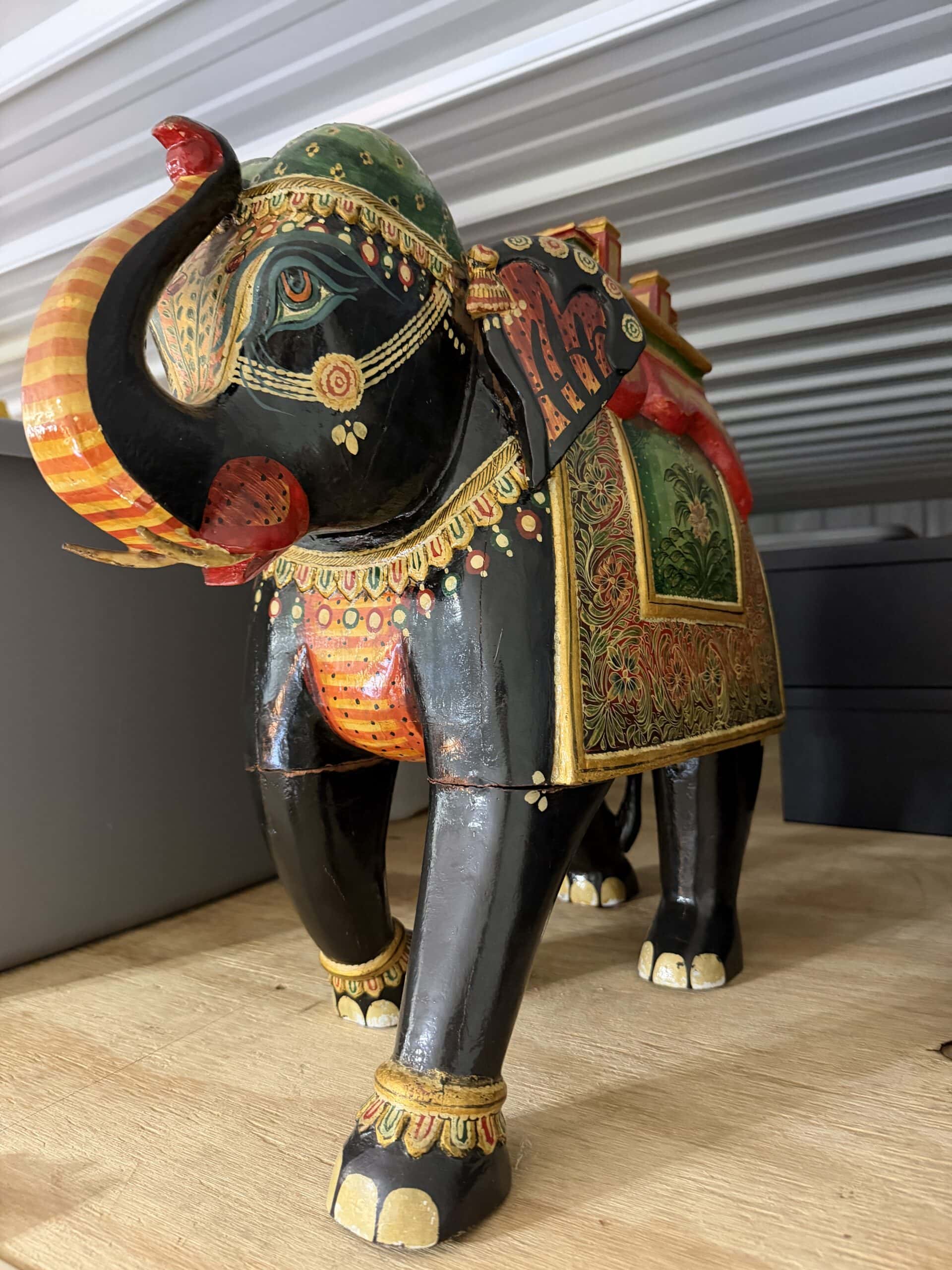
Would I pay $400 for it again? Probably not.
Am I glad I bought it? Absolutely.
That elephant was one of my earliest lessons in shopping in India. Over the years, I’ve bought everything from inexpensive trinkets to handmade rugs and original artwork. I’ve had clothing made, shipped large purchases internationally, negotiated prices, overpaid, and occasionally walked away from something I really wanted.
I’ve also bought plenty of things I probably shouldn’t have.
Here’s what I’ve learned.
Where I Actually Shop in Delhi
If you ask about shopping in Delhi, one of the places you’re likely to hear about is Dilli Haat.
It’s a popular open-air market where visitors can shop for traditional Indian clothing, handicrafts, jewelry, and other products from around the country. In India, shops that don’t negotiate often display a sign reading FIXED PRICE. If you don’t see one, it’s generally worth asking whether the price is negotiable—but don’t assume every seller will bargain. There’s also MRP, or Maximum Retail Price, printed on many packaged products. That’s the maximum price a retailer can charge for those products, and it’s a subject worth exploring in a separate post.
It’s a well-known tourist destination, but personally, I prefer the cottage emporiums around Janpath, near Connaught Place.
What Is a Cottage Emporium?
In India, a cottage emporium is a shop specializing in products associated with the country’s traditional cottage industries. Think textiles, clothing, handicrafts, artwork, decorative objects, and other goods connected to regional craftsmanship.
Some emporiums are operated or supported by individual Indian state governments. Their merchandise reflects the traditional crafts and products of those states. Others are independently operated and carry a broader assortment of goods.
The word cottage refers to small-scale industries and traditional methods of production, not the size of the shop.
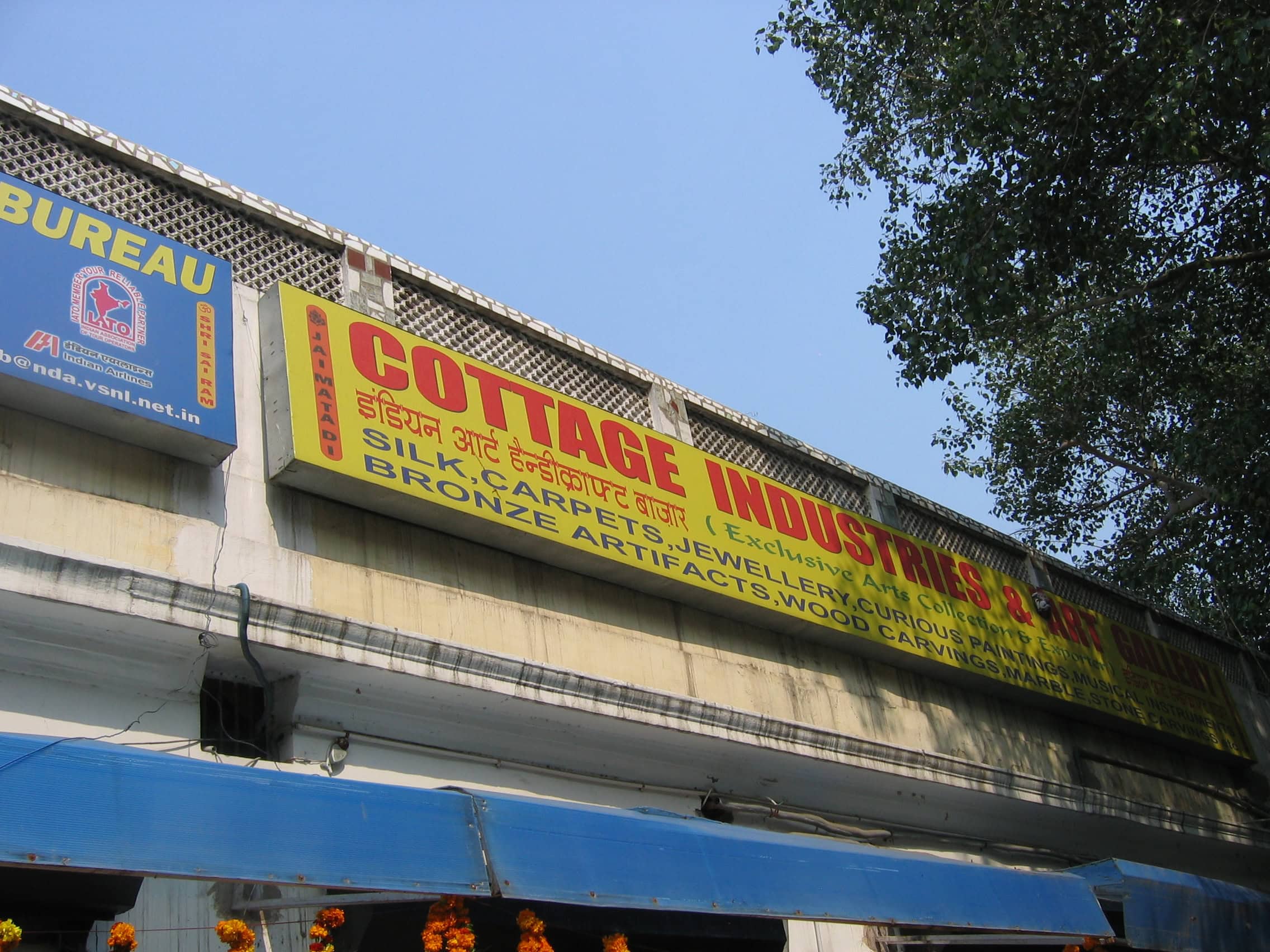
What I particularly enjoy about the state emporiums near Janpath is moving from one to another and seeing how the merchandise changes. You might find textiles associated with one state, decorative objects from another, and an entirely different selection of clothing and handicrafts next door.
Other cottage shops offer a mixture of artwork, health and beauty products, household items, and gifts.
For me, it’s a more interesting shopping experience than simply wandering through a market aimed primarily at tourists.
Connaught Place and Khan Market
Nearby is Connaught Place, usually called CP.
CP is a large, multi-ringed commercial district filled with shops, restaurants, cafés, and offices. You’ll find familiar international clothing brands alongside Indian retailers.
One Indian store I particularly recommend is Fabindia.
It’s a terrific place to browse clothing, textiles, and household items. Even if you don’t need anything, it’s worth popping in.
Another shopping destination is Khan Market, an upscale, open-air shopping district with a dense collection of bookstores, clothing shops, stationery stores, cafés, and specialty retailers.
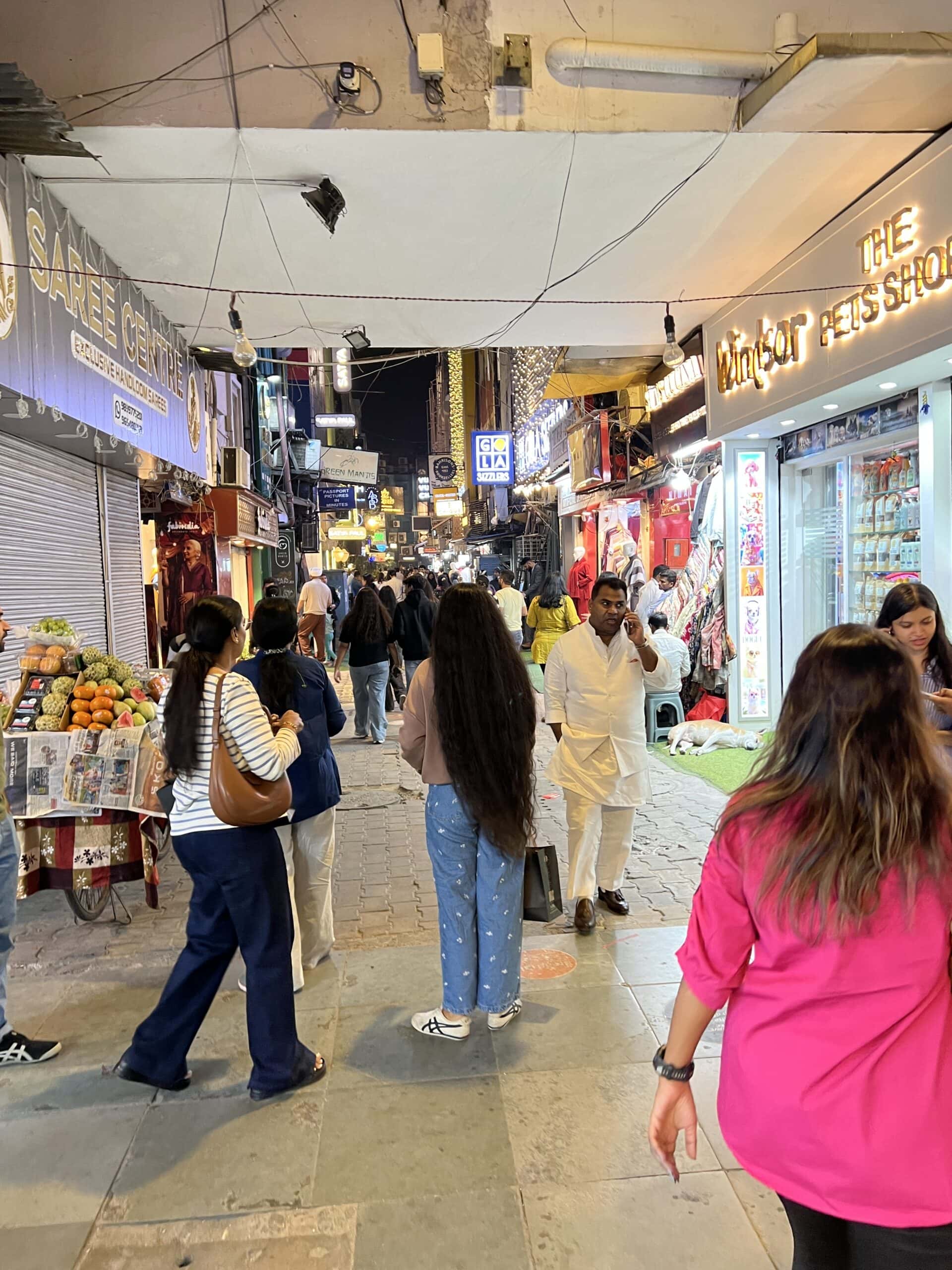
These places offer quite different experiences. And that’s part of my point: there’s no reason to limit yourself to one famous tourist market.
Every city in India has shopping opportunities worth exploring.
Ask your hotel staff, Airbnb host, local driver, or guide for recommendations. Consult guidebooks and independent travel blogs. Better yet, tell people what you’re interested in buying.
If you’re looking for textiles, books, ceramics, clothing, or artwork, you’ll probably get more useful suggestions than if you simply ask where to go shopping.
Sometimes the Shopping Finds You
Some of my favorite shopping experiences in India weren’t planned.
In Madurai, I’ve twice stopped at a local tailor across from the Sri Meenakshi Temple to have kurtas made.
Both times, I sorted through piles of fabric, eventually selecting what I wanted. The tailor took my measurements, and that was that.
Later that same evening, the finished kurtas were delivered directly to my hotel.
Not once, but on two separate visits.
Only in India.
In Rishikesh, I’ve shopped for amulets. In Mumbai, I’ve purchased silver coins at Crawford Market.
Three cities, three very different shopping experiences.
That’s one of the things I enjoy about India. You can be walking through a neighborhood, visiting a temple, or exploring a market and suddenly come across something interesting.
And depending on where you are, there may be a particular craft or product worth seeking out.
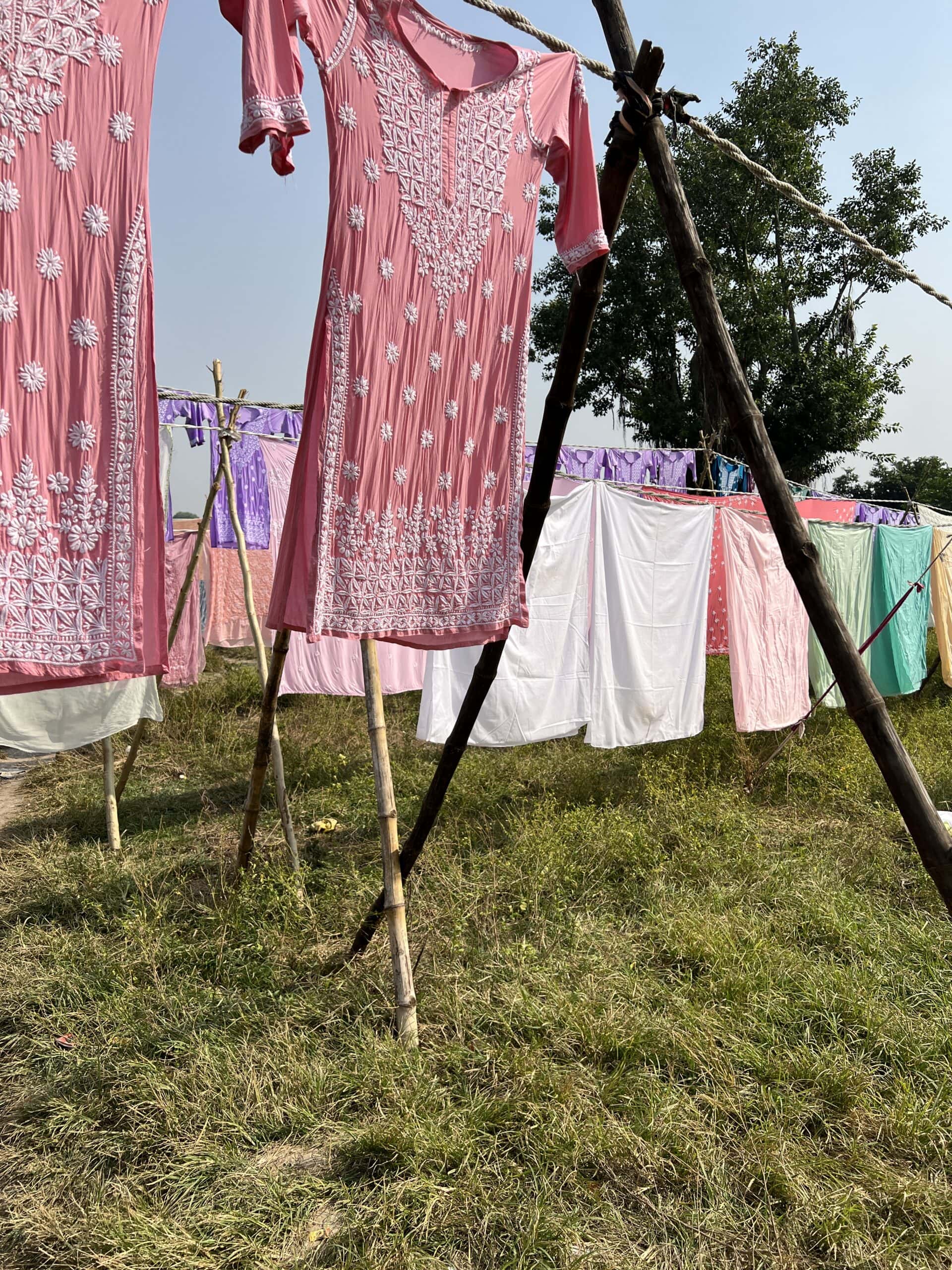
In Jaipur, look for block-printed fabrics and blue pottery. In Himachal Pradesh, there’s the pottery tradition of Andretta. Lucknow is known for chikankari, its intricate embroidery. In Lucknow, I took a tour specifically focused on the traditional craft of chikankari embroidery. Part of the experience included seeing rows of beautifully embroidered garments hanging outdoors to dry after washing. It was fascinating to see this stage of the process rather than just the finished clothing displayed in shops. Varanasi, also called Benares, is famous for silk saris. In Kerala, look for spices such as pepper and cinnamon. Around Agra, you’ll find marble inlay work, decorative dishes, and carved stone objects.
The list goes on.
You don’t necessarily need to dedicate an entire day to shopping, but I’d encourage you to leave a little room for the unexpected.
Sometimes the most interesting purchases are the ones you hadn’t planned to make.
Buying Something Because You Love It
There’s a difference between purchasing something because you genuinely want it and buying something because someone is determined to sell it to you.
I’ve experienced both.
If you’ve spent time around India’s tourist attractions, you’ve probably encountered persistent hawkers selling inexpensive trinkets.
Sometimes they can be remarkably determined.
You might think buying one small item will satisfy them and they’ll finally leave you alone.
Think again.
Purchasing something simply to end an uncomfortable interaction doesn’t necessarily work. You may only encourage the seller to continue or attract the attention of others.
My advice is to politely decline and keep moving.
Don’t waste your money on something you don’t want. And don’t spend your time negotiating over something you never intended to buy.
On the other hand, if you find something that genuinely appeals to you, why not consider buying it?
Maybe it’s an object you can picture displaying in your home. Perhaps it’s something you’ll actually use. Or maybe you simply enjoy looking at it.
Not everything needs to be practical.
But it helps to know the difference between something you love and something that just seems appealing because you’re on vacation.
I’ve learned that distinction the hard way.
Not Everything I Bought Was a Winner
Somewhere in storage, I have a tablecloth and matching napkins that I thought were wonderful when I purchased them.
I’ve never used them.
Not once.
I’ve also purchased several scarves over the years. They hang in my closet, unworn.
And then there are the trinkets.
Small decorative objects that seemed like a good idea at the time. I may have displayed some of them briefly, but honestly, I can’t remember.
Today, they’re sitting on a shelf in my storage room, collecting dust.
It’s easy to get carried away when you’re traveling.
You’re somewhere interesting, surrounded by merchandise you don’t ordinarily encounter, and you begin imagining how wonderful everything will look once you get home.
Then you get home.
The tablecloth goes into a box. The scarves go into the closet. The trinkets end up in storage.
I don’t think the lesson is to stop buying things when you travel.
But I do think it’s worth asking yourself whether you actually want to live with something, or whether you simply enjoy looking at it in the shop.
Those are two different things.
To Bargain or Not to Bargain?
Bargaining is something you’ll encounter while shopping in India.
But should you negotiate every purchase?
I don’t think so.
Personally, I’ll negotiate a little, depending on the circumstances.
Are you shopping at a fixed-price cottage emporium? Buying vegetables from a street vendor? Looking at jewelry? Considering a handmade rug?
These are very different transactions.
If I’m in a store purchasing a rug, I’m probably going to negotiate. If I’m shopping somewhere with fixed prices, I’m not going to waste anyone’s time trying to get a discount.
I’m certainly no expert at bargaining, and I don’t pretend to be.
There are plenty of other resources that explain what to do and what not to do when negotiating prices in Indian markets.
My advice is simply to use some common sense, understand the type of shop you’re visiting, and approach the interaction respectfully.
And remember, the goal isn’t necessarily to get the lowest possible price. It’s to purchase something you genuinely want at a price you’re comfortable paying.
Getting Your Purchases Home
One of the more interesting challenges of shopping in India is figuring out how to get everything home.
Over the years, I’ve approached this in just about every way imaginable.
An Oil Painting from Mumbai
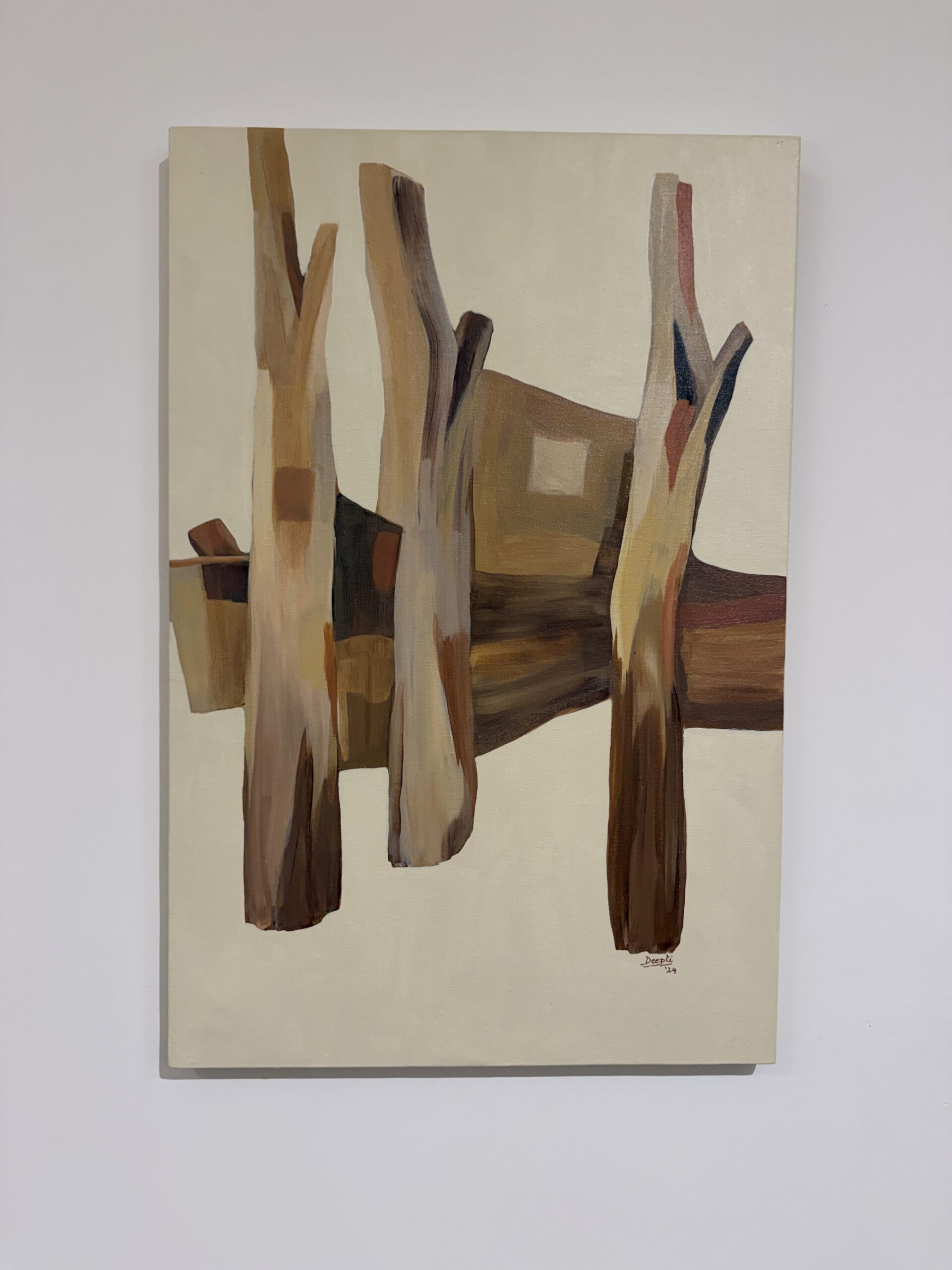
On a recent trip to Mumbai, I purchased an original oil painting by Deepti directly from the artist at a gallery.
It was too large to bring home in my luggage, so I asked whether she could ship it to the United States.
She happily obliged.
The painting arrived a few days after I returned home, in excellent condition.
It now hangs on my office wall, where I enjoy looking at it every day.
Twenty Rugs from Rajasthan
Years ago, I was on a buying spree for my company, collecting rugs throughout Rajasthan.
By the end of the trip, we’d purchased around twenty rugs.
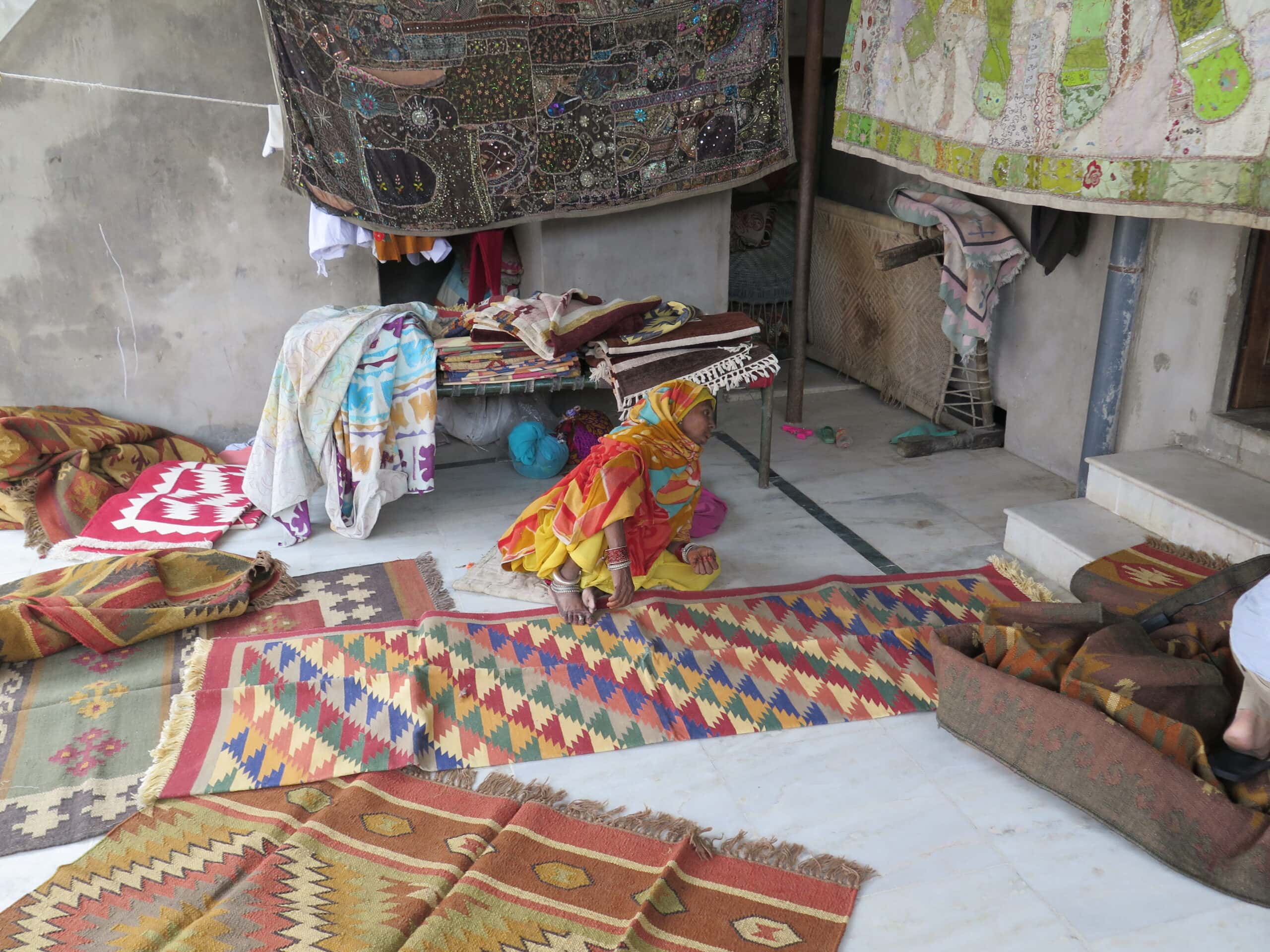
Clearly, those weren’t going to fit into our suitcases.
We still had to get them back to Wisconsin, and that meant arranging shipping rather than trying to squeeze another purchase into our luggage.
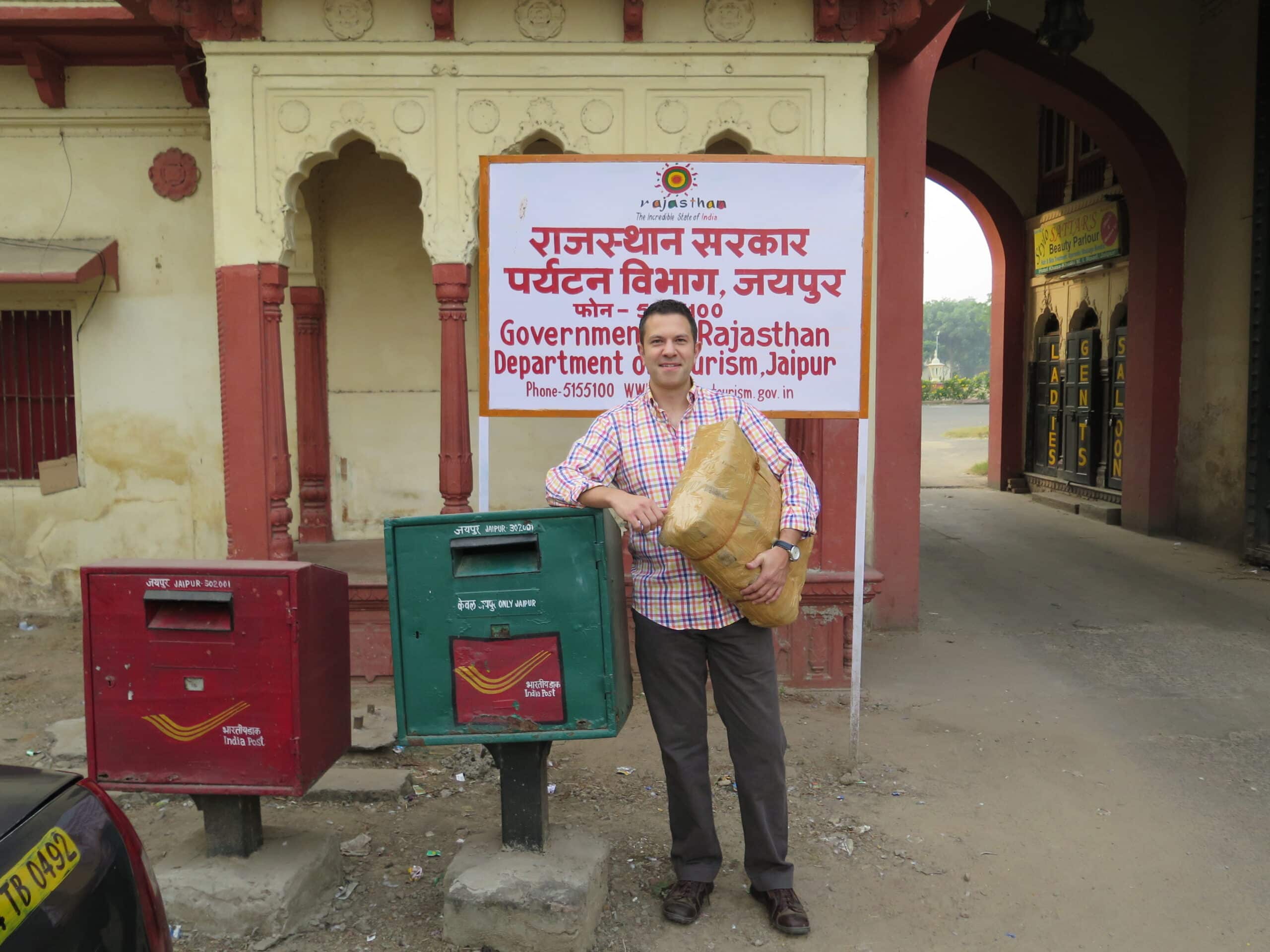
We took everything to a courier service in Delhi, where the rugs were prepared for shipping and sent through DHL.
I was leaving India later that day.
Somehow, the rugs beat me home.
When I arrived at my office two days later, the shipment had already been delivered.
The Bronze Shiva That Stayed Behind
Of course, not every purchase works out.
On another trip, my brother became enamored with a bronze dancing Shiva statue.
We’d already left the shop and were traveling toward our next destination when our driver overheard us discussing it.
Before long, he was texting back and forth with the shopkeeper, negotiating the price and working out how the statue could be delivered to our next stop.
Several rounds of messages followed, discussing pricing and logistics.
Ultimately, my brother decided against buying it.
It was an expensive piece, and he simply couldn’t justify the cost.
Sometimes walking away is the right decision, even when someone has figured out exactly how to get the item to you.
A Few Things to Consider Before Shipping
I’ve heard more than a few stories from travelers who purchased something in India, arranged to have it shipped home, and never saw it again. Those stories may well be true. But I also think where you shop, and who you trust with your purchase, makes a difference. A reputable gallery or established business is a better bet than your driver’s cousin’s uncle’s shop.
When we bought those twenty rugs in Rajasthan, we didn’t leave the shipping to the individual sellers. We collected the rugs over several weeks, carrying them in the back of our privately hired car as we traveled. At the end of the trip, we took the entire collection to an established courier service in Delhi. Before I left India, I had a receipt, photographs, insurance, and a tracking number.
With the painting, I had several ways to reach the artist, Deepti, and we stayed in touch on WhatsApp from the moment I left her gallery until it arrived. It’s another reason I recommend using WhatsApp in India, as I explain in Keeping in Touch with People You Meet in India.
Of course, shipping costs matter. So do proper packing, insurance, customs restrictions, and any taxes or import duties that might be added to the price. Ask questions, get the details in writing, and don’t assume that a promise to ship something is the same as a reliable shipping arrangement.
I’ve had very good luck shipping purchases from India. I don’t assume everyone has. Choose wisely.
For smaller items, I’ve often simply found room in my luggage, wrapping things in clothing and hoping for the best.
Which brings me to one final purchase.
The Camel That Stayed
On my first trip to India, the same trip when I purchased that outrageously expensive wooden elephant, I visited a Bishnoi village in Rajasthan.
There, I came across a clay camel statue.
It was roughly 18 inches long, 8 inches wide, and 12 inches high.
Something about it spoke to me.
So I bought it.
I managed to wrap it in clothing and squeeze it into my luggage. Admittedly, I traveled with much larger suitcases back then. I’ve since learned to pack considerably lighter, as I explain in What to Pack for India — and What to Leave Behind.
The camel arrived home with a chipped ear, which I glued back on.
That was twenty-one years ago.
Today, the camel sits near my desk in my office.
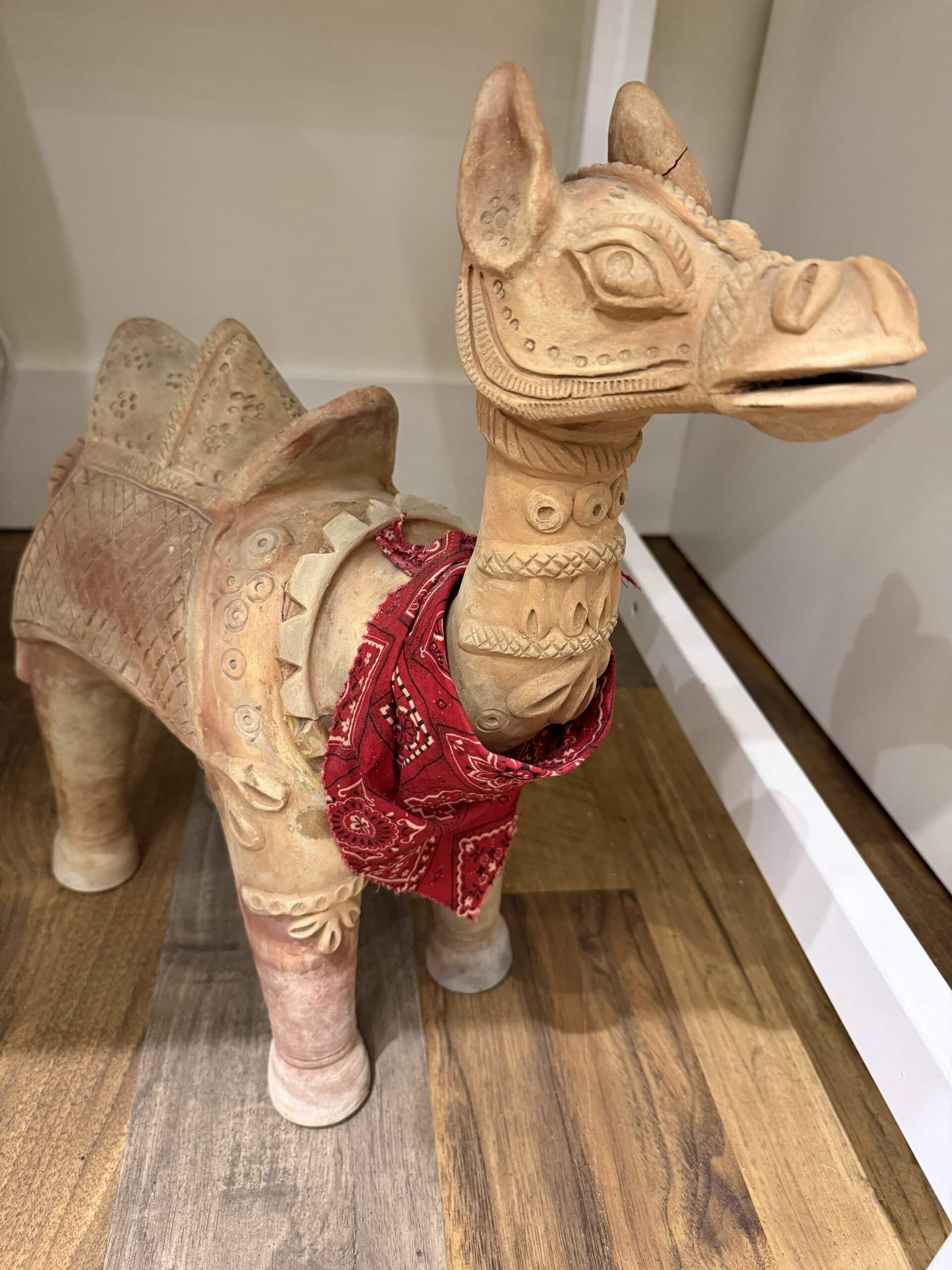
Around its neck hangs a kerchief that belonged to my dog, who has since passed away.
I look at that camel regularly.
When I bought it, I had no idea where it would eventually end up or what it would come to mean to me.
It was simply something I liked, discovered during a visit to a village in Rajasthan.
Meanwhile, somewhere in my storage room are those unused napkins, unworn scarves, and forgotten trinkets.
I suppose that’s the difference between shopping for the sake of buying something and finding something you genuinely want to bring into your life.
After twenty-one years of traveling to India, I can’t tell you exactly what you should buy, what you should pay, or where you’ll find your favorite purchase.
But I can offer one suggestion.
If something speaks to you, and you can imagine enjoying it long after you’ve returned home, consider buying it.
You never know.
Twenty-one years later, it might still be sitting beside your desk.

 Planning Your Return: India Is Never Quite the Same Twice
 Bringing India Home: The Things We Carry Back
 10 Annoying Things About India and Indians